Pages

12.14.2006

All's Fair: Scope

The pedicabs were doing a brisk business shuttling visitors from Pulse to Scope and vice versa, but with the weather so nice and the distance between the two venues just blocks away, I decided to walk. There was no need for directions. I just followed the arrow: a big red balloon arrow marked Scope hovering over the tent.

(c) Joanne Mattera www.joannemattera.com

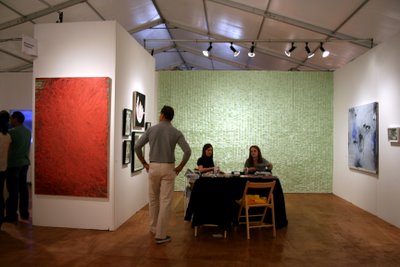
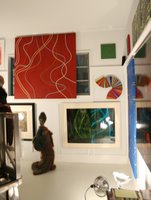
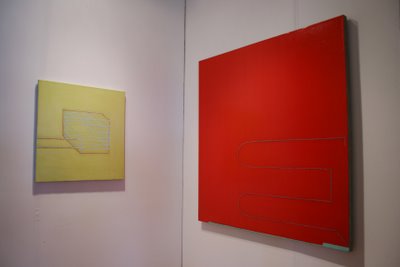
My favorite piece at the Scope fair was about Nothing. Not a Seinfeldian nothing but an elegant installation by Joseph Havel at Dallas's Dunn and Brown
booth composed of hundreds (thousands?) of custom-embroidered shirt labels pinned to the wall.


About Nothing: The installation (detail above) by Joseph Havel at Dunn and Brown Gallery, Dallas; Sam Reveles painting at left

The red Sam Reveles painting on the wall to the left was the perfect complement, not only chromatically but conceptually, as energetically sensuous as "Nothing" was formally cool.
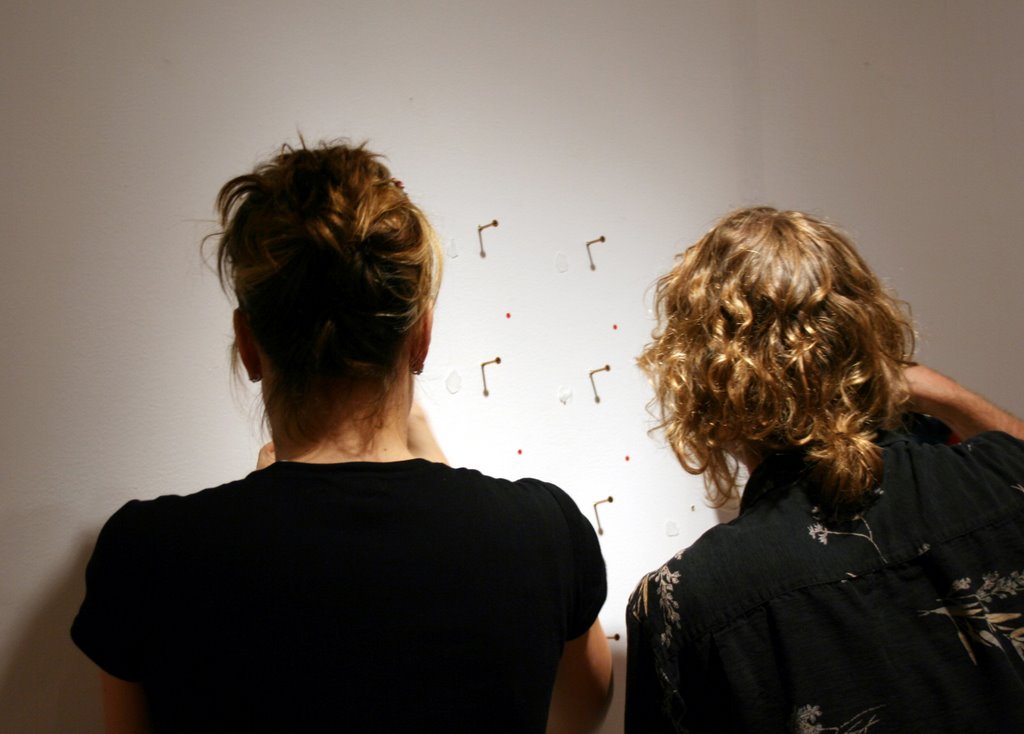
Then there was the grid installation, about three feet square, composed of black sheetrock screws and red dots. Oops. This one really IS about nothing. Whatever was there had been taken off the wall (sold, presumably). I shot the grid moments before the gallery personnel moved in to remove the screws.

Really about nothing: What's left after the work comes off the wall

At Las Vegas's Dust Gallery, I saw the pristinely reductive work of Marietta Hoferer. You can’t see this work too well in the installation shot below, so I’ve pulled an image from the artist's website. What you’re looking at is a work on paper composed of meticulously cut and placed strapping tape on paper. Such elegance from workaday material.

At Dust Gallery: An installation of six reductive works by Marietta Hoferer, all strapping tape on paper, with a related work below

Continuing with the elegantly minimal, I loved the work of Frank Gerritz at Pablo’s Birthday. Gerritz paints bands of dark color on thick sheets of steel. The brushstrokes are visible, a sensuous texture against the cool, milled metal. Gerritz just might be the lovechild of Richard Serra and Agnes Martin. Clicking this New York gallery’s link on the Scope website just kept looping back to Scope, so if you wish to see more, Google Frank Gerritz.

Frank Gerritz: Oil on metal, the painting/sculpture at Pablo's Birthday Gallery, New York


Add a shock of color to your reductive abstraction and you have the work of Paul Pagk at Moti Hasson Gallery. I get the sense that this is a painter who works slowly and purposefully. Each painting is dense with paint, but there's not one extraneous brushstroke, line or gesture.

Paul Pagk: Reductive imagery with a chromatically dense surface at Moti Hasson, New York

The geometric constructions of Lisa Sigal at Frederieka Taylor
are neither painting nor sculpture but flat assemblages composed of layers of paper and tissue and other materials—freeform geometries that are ephemeral but muscular.
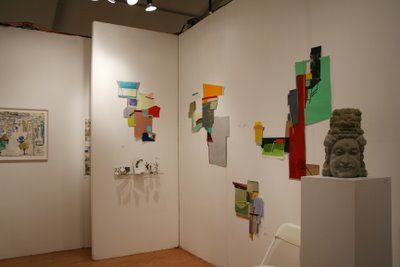
Lisa Sigal at Frederieke Taylor Gallery, New York
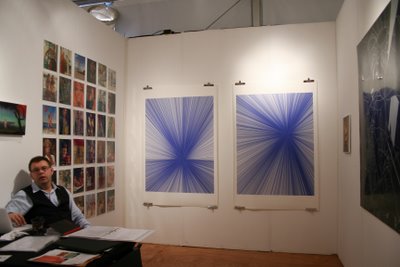
Other works I liked were 10,000 Lines to a Point at London's Carter Presents. Two works from a series of large-scale inkjet prints by Daniel Jackson were uniquely written to code—computer to printer--so that while all were related, none were alike. At Daneyal Mahmood, blue ink (via much handwork and many ballpoint pens) went in a different direction with Andrei Molodkin’s two soldiers embraced in a kiss in God is Great. Art Info reports that the Brooklyn Museum decided not to buy it for fear of offending its visitors but that the museum director, Arnold Lehman, purchased it for his own collection.

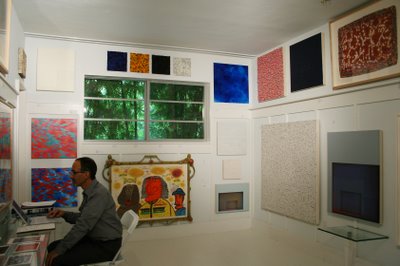
Working blue: Daniel Jackson's 10,000 Lines to a Point at London's Carter Presents, above (that's the dealer, seated); Andrei Molodkin's God is Great at Daneyal Mahmood Gallery, New York


At Patricia Sweetow’s booth, a collaged head by Jonathan Burstein was startling—equal parts delightful and freakish. I’m guessing this is the work of a recently minted MFAer. In any case, his collages are made from images taken from art magazines, a visual variant on you-are-what-you-eat.On the outside wall of the booth, below, you can see the sensuous geometry of Jane Harris. Harris’s show was in the San Francisco gallery when I was there last month. I’ve pulled an image from the gallery’s website so that you can see some of what I saw. Cindy Rucker was working the booth along with Sweetow—that’s Cindy seated. She’s about to open her own gallery on the Lower East Side: Numberthirtyfive (www.numberthirtyfive.com, when the website launches, which should be soon). Good luck, Cindy. Put me on your mailing list!

Outside the Patricia Sweetow Gallery booth: Jane Harris's twinned geometries, with Cindy Rucker, seated, above; an installation view from Jane Harris's recent show at Patricia Sweetow Gallery, San Francisco
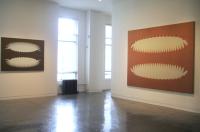

And since I'm on the subject of gallerists, I’m going to close this post with The Proposition’s Ellen Donahue and Ronald Sosinski. Their booth had a large work by the hot young painter Mickalene Thomas, but for me it was the dealers themselves who stole the show with their his-and-hers patterned suits. "We’ve been in business together over 20 years, and this always happens," said Donahue. And no, she says, "We don’t plan it."

The pattern at The Proposition: Sartorially resplendent gallery partners Ronald Sosinski and Ellen Donahue, with their assistant

Next up: All's Fair: NADA

All's Fair: NADA
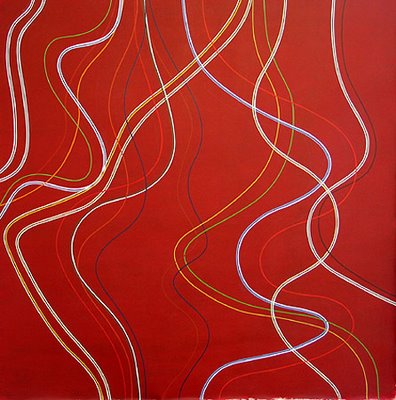
I wouldn’t want to belong to a group whose acronym is the Spanish word for nothing. (Especially because the buzz for this show was less than kind.) But I’m not a member of the New Art Dealers Association, so what do they care about my opinion. And I certainly wasn’t going to let a little nattering negativity keep me from going. Though it would be the last of three big shows I saw on Saturday, I soldiered on. And I’m glad I did. There was a lot I liked.

© Joanne Mattera www.joannemattera.com
If only I could read my notes to tell you about it. In the fog of art overload I omitted artists’ names, wrote illegibly, and shot bad digital images. In fairness to my photographic skills, the Ice Palace is a venue with uneven lighting. What’s worse, whole sections of booths are blurred in my memory. (I’ll do better with Bridge, coming up.) But I did do some after-the-fact gallery surfing on the web and found material to help fill out this post.

The path into the Ice Palace, a big barn of a building where NADA is held, is lined with hammocks. Thirty minutes in one of those slings would have gone a long way to clearing up my cranial fuzz. Photo is by the emerging photographer David Schoerner
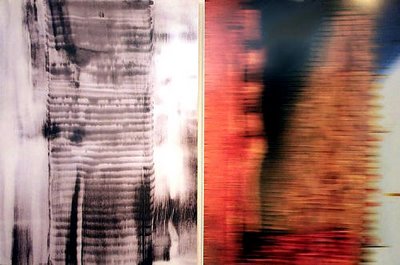
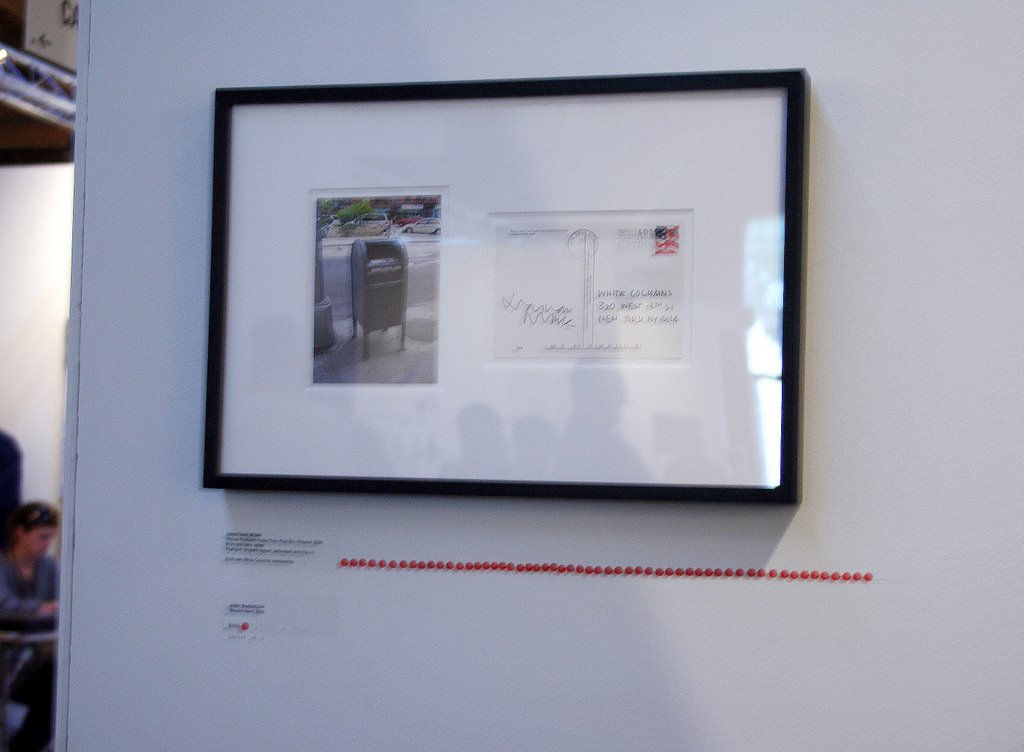
First stop was at the White Columns booth, where the prints always sell well. See what I mean: .

I liked the luminous "bone" curtain in cast resin at Elizabeth Dee Gallery, New York. Looking now at the gallery’s website, I think it’s by Virgil Marti.

The bone scrim in cast resin (by Virgil Marti?) at Elizabeth Dee Gallery, New York

And I liked the quilt-like abstractions by Mette Winckelman at Copenhagen’s Galleri Christina Wilson—some paintings, others paper-and-cloth collages under glass.

Mette Winckelman: geometric abstractions at Gallerie Christina Wilson, Copenhagen

On a Scandinavian roll, I liked three small framed paintings by Haavard Homsvedt at Brooklyn’s Southfirst Gallery. These paintings were built up from the swipes and wipes of the artist’s brush, a la Scott Richter. But these are as quiet as Richter's are brash. (Heidi Cho Gallery has two wonderful Richter paintings at Scope.)

Havaard Homsvedt at Southfirst Gallery, Brooklyn

..

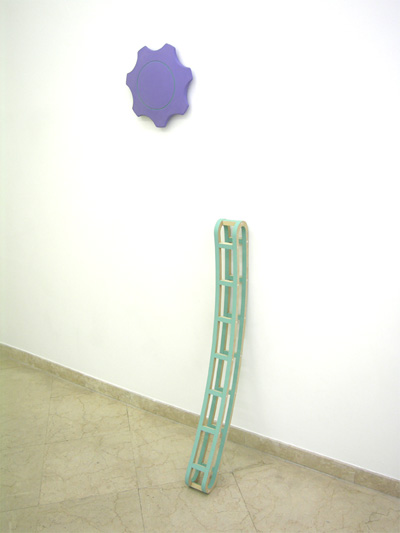
Following the thread of material sensibility, I really liked the work of Olivier Soulerin at Atelier Cardenas Bellanger, Paris. A corner of the booth contained wrapped armatures, painted sponges, and household fabrics used as the canvas for the artist’s unstretched paintings. The lovechild of Mario Merz and Martha Stewart, maybe? Though my pictures were not good, the gallery has some good images, two of which I reproduced left and right.

Olivier Soulerin: Untitled wall piece, resin and acrylic on mixed media, 12 x 12 x 2", and sculpture against wall, Echelle, 42 x 4 x 5", left; Eponge, synthetic sponge and acrylic paint, 5 x 6.5 x 2.5"; all 2005, at Atelier Cardenas Bellanger. Below, a corner of the gallery's booth at NADA
At the booth for Los Angeles’s Mary Goldman Gallery, Rob Fischer deconstructs not only the materials of his sculpture but the space it occupies. The piece here suggests a spatially reconfigured hallway that holds the wall and floor.

Rob Fischer sculpture at Mary Goldman Gallery, Los Angeles

At Boston’s Samson Projects, I watched a transaction taking place. Frame one: Young man in shorts and t-shirt studies the small figurative paintings at left and asks if he can take the work with him. Frame two: Gallery owner Camilo Alvarez comes over and chats with the potential collector. Yes, the work can be taken. Sold.

Looking and buying at Samson Projects, Boston

Artists who labor under the studio responsibilities of making the art, promoting it, and handling administrative, janitorial and delivery duties will appreciate the Samson Gallery staff as described in the NADA catalog: "Camilo Alvarez: Owner/Director/Preparator/Curator."
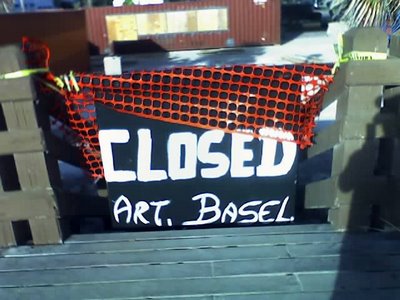
Last up: All’s Fair: Bridge

All's Fair: Bridge

For this last installment of "All’s Fair," we go back across the causeway to Miami Beach and the Bridge Fair. With its 65 galleries, Bridge took place in the Catalina Hotel, occupying the larger of the hotel’s two buildings (Flow resided in the smaller one). I didn’t hear much buzz either way about this new event, but running in the middle of the pack is not a bad position for a fair’s first year.

© Joanne Mattera www.joannemattera.com


Of course the top spot in the Miami hierarchy goes to Art Basel Miami Beach. The number-two position seemed to be split between newcomer Flow and second-year Aqua. Surely it’s not coincidental that the two smallest fairs got some of the biggest attention. After the mega-dose of art at the Convention Center, there was a visual and visceral need to scale down and experience art on a smaller scale.

Bridge boasted excellent galleries from around the country: Andrea Schwartz, Brian Gross and Elins Eagles-Smith from San Francisco; Pentimenti from Philadelphia; Kidder Smith and Howard Yezerski from Boston, and Rice/Polack from Provincetown, a tiny lick of land (with several very good galleries) at the end of the long curling arm of Massachusetts. The New York galleries included Chelsea’s Sundaram Tagore, which occupied the lobby, as well as SoHo’s Nancy Hoffman and Brooklyn’s Metaphor Contemporary.

If you're going to show art in small hotel rooms, the white walls and floors here were perfect. But the lighting was not well thought out (some dealers brought their own illumination, but others scrambled to install aluminum bowl reflectors, and still others used, with unsatisfactory results, the pole lamps that came with the room). Between the lighting and the small spaces, I found it difficult to photograph in the little rooms. In a few instances I went to a gallery’s website for images.
.
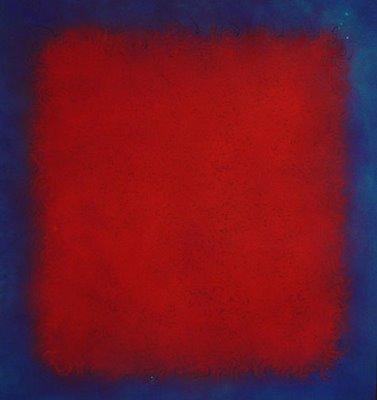
Following the map on the venue's two floors, these were the highlights for me: In the lobby, color dominated. This was the exhibition space of Sundaram Tagore, New York, which showed Natvar Bhavsar’s saturated color fields and Judith Murray’s large-scale, brushstroke-y abstractions.

Natvar Bhavsar: Bhandraa, pure pigment on canvas, 67 x 68", 2005 (above); Judith Murray: Fusion, oil on linen, 41 x 45", 2004; images from the Sundaram Tagore website


At Metaphor Contemporary Art, Brooklyn, I liked Mary Judge’s monochromatic monoprint mandalas, Manfred Mayerle’s tiny gouache grids, and gallery partner Julian Jackson’s light-infused abstractions.

Mary Judge: monoprint from the Rose Window Series, 48 x 48" (above); Julian Jackson: After Vermeer, oil on canvas, 76 x 63", 2006, both from the Metaphor website

Manfred Mayerle: from the series For All We Know, ink, watercolor, and gouache on paper mounted on aluminum, 6.75 x 6.75", from the Metaphor website

Looking at work in the Metaphor Contemporary room

At Kidder Smith, Boston, I liked Cheryl Goldsleger’s smallish black and white geometric paintings in encaustic with elements of relief sculpture, David Moore’s linear color fields and Jimi Gleason's atmospheric light-refractive paintings.

A view of the room for Kidder Smith Gallery, Boston


At Hogar Collection, Brooklyn, the fluid geometries of gallery partner Cecilia Biagini dominated.

Installation view of the Hogar Collection room, above; and gallery website image of Meandering, by Cecilia Biagini


Upstairs, working my way in the same counterclockwise direction, I stopped in at the room of Brian Gross Fine Art, San Francisco. Its organized installation and formal work--paintings by Teo Gonzalez and Marco Casentini; works on paper by Jill Baroff, Stephen Sollins and Andrea Way--resonated on my frequency.

Andrea Way: detail of For Renee, ink on paper, 30 x 22", 2005

Two views of the installation of Brian Gross Fine Art, San Francisco; that's Brian Gross seated at the desk, above

Pentimenti Gallery, Philadelphia, has a strong program with restrained pattern and geometry in equal measure. At the fair I liked, among other work, Kevin Finklea’s reductive geometry, shown below.

Christine Pfister, Pentimenti's owner and director, in her room at Bridge


At Howard Yezerski Gallery, Boston, I particularly liked Malham’s Cove, a small deeply spatial and atmospheric diptych, by the reductive abstractionist Paul Shakespear

Paul Shakespear: Malham Cove, 2006, acrylic on wood, 20.75 x 16.75 at Howard Yezerski Gallery, Boston


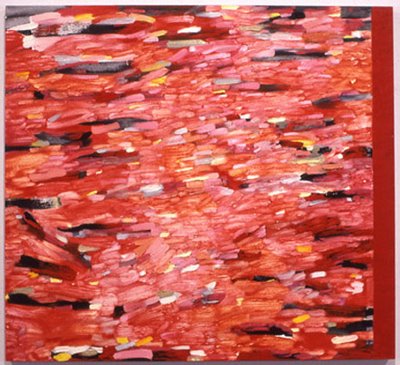
At Melanee Cooper Gallery, Chicago, there were paintings in encaustic by two artists whose work I like, Tremain Smith and Kathleen Waterloo, and sensuous circles in oil and gouache by Julie Gross.

Two views at the Melanee Cooper Gallery: circles in oil (top) and gouache (framed) by Julie Gross, above; a painting being packed for delivery

Tremain Smith's work was installed in the hallway outside the Melanee Cooper room, impossible to shoot, so I pulled this painting from the artist’s own website: My Great Prakriti, encaustic on panel, about 48 x 60

My shots of Andrea Schwartz’s room were too blurry to publish, so I pulled this image of John Berlingheri’s coolly ebullient painting, Diphthong Cobalt, to show you. Do you remember it? It was the far left wall, as you walked in.

John Berlingheri, Diphthong Cobalt, oil on canvas, 60x36, at Andrea Schwartz Gallery, San Francisco


At Provincetown’s Rice/Polak Gallery I liked the black and white paintings of Berndt Haussmann. Suggestive of chalkboards, his surfaces are in fact a thin layer of rubber mounted to panel on which he has worked his signature lyrical gestures in a retstrained palette.

Berndt Haussmann: from The Blackboard Series, 21 x 21", oil on rubber-mounted panel, from the Rice/Polak Gallery website


Here's Marla Rice, director of the Rice/Polak Gallery, in her exhibition room


I have no pictures of the Elins Eagles-Smith Gallery exhibition room. It was a corner space, with big paintings (by Johnnie Winona Ross and Ricardo Mazal) always full of people. So I just pulled an image of a work by Mazal from the gallery's website to show you.


Ricardo Mazal: Untitled Diptych, mixed digital process, 41 x 61.5 inches, collaboration with photographer Gary Mankus, from the Elins Eagles-Smith website

By Saturday evening the exodus began. I stuck around until Sunday, visiting The Big Fair one more time with my friends Gloria De Sole and Meredith Butler. We made time for lunch at the Botanic Gardens across from the Convention Center, and I departed for the airport in late afternoon. I’ll leave you with one final image from Miami, shot by Joseph Poras on Tuesday, December 12, in Collins Park, with the Containers barely visible in the background:

December 12, 2006: The party's over. Photograph courtesy of Joseph Poras

See you next year.

www.joannemattera.com
www.joannemattera.blogspot.com
www.jmschedule.blogspot.com

12.05.2006

Six Hours in Philadelphia on Sunday

After the dozenth, "Sorry we have no rooms," and an uncomfortable number of, "Sorry we have no rooms in your price range," I decided to fly to Philadelphia for the day instead of driving down and staying over. The Winged Goddess must have been a kind mood because I found a round trip on US Air for $124—cheaper than the cost of gas.

My impetus for making the trip was the Sunday, December 3, opening of the "Gigantic Small Works Show" at t
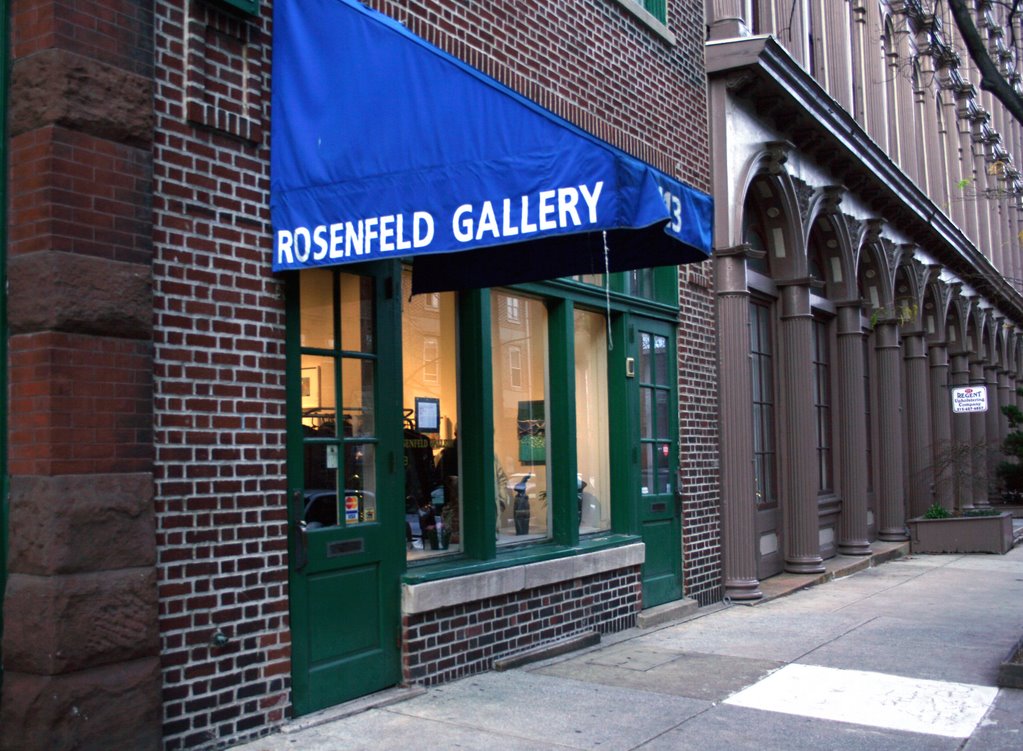
he. . . . . . .. . Rosenfeld Gallery, where I’m participating. The Rosenfeld Gallery is on Arch Street, a few doors down from the Betsey Ross House. It’s as large and rambling as the Ross house is teeny tiny. There’s about 2000 square feet of narrow-but-deep exhibition space in the ground-floor venue. It reminds me (in the best way) of SoHo in the early days: dark wood floors, white display panels over brick walls, and an emphasis of art over architecture. For this exhibition—an annual event at the gallery—about 30 artists showed over 120. .
. .
That's my painting, Uttar 247, in the center of the picture above
works in various media. The opening was from noon to 5:00 p.m. The space comfortably accomodated art, artists and the guests who kept arriving all afternoon.

Two views from the opening at Rosenfeld Gallery on December 3


One of the things I like about Philadelphia is the collegiality among artists and dealers. Last May, when I was in town for the "Order(ed)" show at Gallery Siano, I’d visited the Rosenfeld Gallery to see Tremain Smith’s work. Unbeknownst to me, Tremain had mentioned me to Richard Rosenfeld, the owner, so when I introduced myself to the softspoken bearded man behind the desk, it was Richard, and he was familiar with my work. Long story short, he invited me to participate in this show. I love when that happens.

I stayed at the opening until 5:00 pm and then took a taxi back to the airport and flew home. But I’ve got to backtrack to my arrival because I’m leaving out a chunk of the story.

When I landed at 11:00 am, I took a taxi to Minimal Works on Chestnut Street in Center City. There I met the gallery’s owner, Dennis Towers, a man with a passion for reductive work, and he opened the space for me to take a look (it’s normally closed on Sunday). I have five paintings and some


Above, Sharon Brant: Untitled, 24 x 24", acrylic on panel, 2002. Below, Siri Berg: Small Bars One, 12 x 12", oil on linen, 2006

work on paper in the gallery. Moreover, I have Richard Rosenfeld’s good wishes about participating in the project, just as I have Dennis’s good wishes about my involvement with the Rosenfeld Gallery. This is what I mean about collegiality.

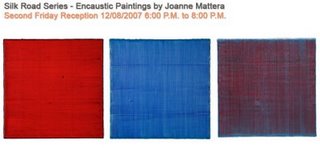
Minimal Works is unique as a gallery in that rather than mounting shows of an individual artist each month, it focuses on a curated group exhibition that evolves as work sells—kind of like what happens at an art fair. Dennis recently started spotlighting the work of his artists for the "Second Friday" openings that take place in Center City. ("First Friday" openings take place in Old City, where Rosenfeld Gallery, Pentimenti, Larry Becker, Wexler and other galleries are located.) My work is spotlighted for December. Here's the announcement:


Dennis has promised to send a few shots of the gallery, and I'll post them as soon as they arrive. In the meantime, I've pulled a few images from the gallery's website, some just above and some below:

Above, Douglas Witmer: Bungalow, 20 x 16", acrylic on canvas. Below, Edward Shalala: E.S. Six, 12 x 16", painted canvas and handmade paper made from the painting.

If you’re in Philadelphia this month, please check out both Galleries: Rosenfeld Gallery, 113 Arch Street and Minimal Works, 2007 Chestnut Street.