Pages

Showing posts with label Geoform. Show all posts

6.21.2008

Awash in Color: More Friends of Mr. Biv


Click here for "No Chromophobia."

So a friend e-mailed me the other day to ask, "Who is this Mr. Biv?" If anyone is similarly confounded, think back to third grade. It's the mnemonic used to help you remember the spectrum. Remember?

Red Orange Yellow Green Blue Indigo Violet

Since we're discussing Roy (and in the interest of equal representaton, it could just as easily have been Rona, you know), I'd like to show the work of a few more of his friends. Most of these folks I know, a few others I don't. I'm motivated strictly by the chromatic intelligence of their work. For some of these artists, color is not necessarily the dominant element, it's the geometry. But we don't have to take sides, as color and composition are perfect complements.


.

Julie Karabenick, Composition 71, 2007, acrylic on canvas, 30 x 30 inches

I curated Julie's work into Luxe, Calme et Volupte last year at the Marcia Wood Gallery in Atlanta. I'm impressed with the intellectual rigor and physical demands of her work. On such a pristine surface, there's no going back and painting over. Decisions made are decisions maintained. This is a breakthrough painting, because there's now a figure-ground relationship in the work, and the color has a chance to interact with the viewer's eye from various points in a visually dimensional space. Julie is the editor of Geoform. You can see her work there, or on her own website, Karabenick-Art.


.

Marcia Hafif,TGGT 12: (Red-Gold, Violet), 22 x 22", oil on Canvas, 2006. Image from the Marcia Hafif website
.

I've seen her work in person here and there over the years--Larry Becker in Philadelphia, the now-closed Baumgartner Gallery in Chelsea, and a few months ago at a gallery showing at Pulse in New York. Though relatively small--modestly proportioned easel size work--each painting has a huge presence. Her newer work is divided vertically, each section containing a different hue. Considering what she said about painting in 1990, her more current work is positively image laden:

"Having taken into consideration years ago the consensus decision of the art world that painting was no longer acceptable as an art form, it seemed necessary to move my awareness to a second level. Accepting the idea that one could no longer paint in good faith, I thought it would be possible to paint on another level, one providing a certain distance, in order to look at the paint rather than at its subject. It would be possible to paint "as if" one were painting, using the materials and techniques of painting, but without referring to a separate subject. This thinking led me to monochrome. Thus I do not paint with the intention of making a painting as such, but I work from the outside of painting using traditional methods and materials to discover a new image. " (Why Paint: Marcia Hafif from the catalog Marcia Hafif: Red Paintings, Verlag der Galerie Conrads, Neuss 1990 ).

In this relatively newer work, the vertical created by the abutting of two colors creates an image--a "painting as such"--but it does so on Hafif's terms.


.


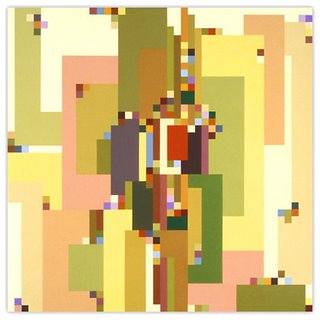
Chris Ashley, Cluny, 2008, HTML image

Chris works in a unique way, creating "drawings" directly on his computer screen using HTML code. They could easily be called "paintings," but I'm using his preferred word. The work is created using, I think, numbers that translate into blocks of color, so it's keystrokes rather than brush strokes that make the work. Lately, the work has made the leap off the screen and into a printed image, which makes me call them "paintings," but I suppose technically that would make them prints. In this new incarnation the saturated color on creamy paper has the look and visual feel of super-saturated gouache on watercolor paper. Visit his website, Look See, to see much more.

BTW, Chris wrote about my work in his blog a couple of years ago. Then I curated him into my Luxe, Calme et Volupte show. (You see how my blog world has very few degrees of separation; but then, that's true for the entire art world, where three degrees will probably take you back to the Cave Painters). In the fall we're going to be in a show called "Calculated Color," curated by the painter Jane Lincoln, at the Higgins Gallery on Cape Cod. Oh, and we're both part of the Geoform.project, along with Lyda Ray, below. Full disclaimer, yo.

.


John Tallman, Color Stack, 2007, polyurethane resin, 1o x 10 inch diameter

Tallman is a painter and sculptor for whom materiality is essential. Indeed, you can't disentangle the painter from the sculptor any more than you can disentangle the color from the form. Visit his website and his Color Chunks blog to see what I mean. I don't know him, but when I found his blog I felt an instant affinity for what he's doing.

.

Bill Gusky, Crush, 2007, enamel on urethane, 21 x 19 inches

I didn't know Bill until we we showed together in the Blogger Show, organized by John Morris, in the East Village last fall. That's when I saw this painting and purchased it for my collection. (More no degrees.) I've still not actually met him, so I don't actually know him, but I feel as if I do, partly because I wake up to his painting every morning and partly because I read his blog, Artblog Comments, regularly. Anyway, I like the way Bill combines color and form and material. See more at Bill Gusky.com

.


Lynda Ray, Float Copper, encaustic on panel, 14 x 18 inches


I was introduced to Lynda's work when I was looking at images for my book, the The Art of Encaustic Painting. Her slides vibrated right out of the envelope. Like John Tallman and Bill Gusky, above, Lynda mixes color, form (via sensuously slathered paint) and materiality--and she maintains a geometric sensibility as well. See more on Lynda Ray Art.com

I suppose "Friends of Mr. Biv" will become a recurring feature on this blog. Stay tuned.

6.01.2008

Awash in Color: Karl Benjamin on Geoform


Karl Benjamin, #6, 1990, oil on canvas, 48 x 60 inches. These images courtesy of the artist and Louis Stern Fine Arts, via Geoform

..

Karl Benjamin, a founding father of geometric abstraction, is the subject of a newly posted, long and in-depth interview with Geoform editor Julie Karabenick.

"Quite early on, I began to develop a strong sense of shapes and the areas in between them," says Benjamin early in the interview. A lively discussion ensues, along with five decades' worth of images--including one of his studio as seen from his home. Look for it. ("I've alway been able to see my paintings through windows in my house, says the artist. "I'd keep a light on in the studio so I could see the paintings any time I needed to settle down.")

"He is simply the most wonderful, generous man, " writes Karabenick in the course of an e-mail correspondence with me. "He has helped so many younger artists, as well as having an amazing art career. I have a very deep respect for him and am glad to see he's starting to get more recognition on the East Coast--of course, he's an icon on the West. "

.


A recent portrait of the artist in front of I.F. Big Magenta with Green, 1959, oil on canvas, 40 x 50 inches.

.

7.31.2006

Talking About Geoform

Today I’m finally talking about Geoform, an online curatorial project coedited by Julie Karabenick, of Ann Arbor, Michigan, and Rick Barnhart, of Tenants Harbor, Maine—geometric abstractionists both—that shows the variety of geometric expression in contemporary abstract art. In my previous post, I talked about the ways several artists are connected, and I gave you links to Julie’s and Rick’s individual sites—as I’m doing here—so perhaps their work will already be familiar to you. (I am unable to download images of Rick's work from his website, so I urge you to visit the site directly: www.barnhartart.com )


Julie Karabenick: Composition 59, acrylic on canvas, 30" x 30", 2005

Geoform was launched in the spring of 2005, about 15 months ago, with a beautifully designed site and a handful of participating artists. Today 76 artists from 15 countries are on the site. The work is satisfyingly diverse in size, format, medium, approach and expression, and the site appears to grow weekly. "Rick and I spent months and months reviewing and discussing artists in order to develop our criteria for inclusion—which is to say, sufficiently abstract and sufficiently geometric," says Julie. "The boundaries are subject to some redefinition and refinement as we continue on."

I was one of the first artists on the Geoform site and the subject of an early interview with Julie, so I’ve had a chance to see Geoform grow and flourish. Given that Julie also paints and curates (scroll halfway down the page of this link to see her curatorial efforts), Geoform, with its roster of artists and a growing number of artists interviews, is impressively robust. Julie and I correspond regularly by e-mail and have become good friends, so I’m sharing some of the conversation we had recently.

"From ‘geometric’ marks made on rock faces and cave walls and on human faces and bodies, extending far back into prehistory, to geometric patterns found in textiles and adorning pottery and masks and other objects in world cultures, this type of form has attracted me," says Julie. "During the early 90s, geometric shapes began appearing in my prints amongst the more representational elements." The figurative elements began to fall away, she says, and soon she found herself working abstractly. "I’m not sure I could have given a very good account of why this was happening, but I certainly was intrigued."


Julie Karabenick: Composition 64, acrylic on canvas, 30" x 30", 2006

Julie began looking more seriously at geometric form and structure in fine art. She acknowledges the Internet as a deep well of images. "On-line wandering and searching has become my primary means of discovering artists working in geometric abstraction," she says. (That’s how she found me. She called in late winter 2005 and we talked for an hour, growing the roots of a friendship that would grow surprisingly deep given the physical distance between us.) A developmental psychologist--PhD, University of Michigan, 1981--as well as a painter, Julie approached this change in her own painting with a readings in philosophy, anthropology, psychology, linguistics, neurophysiology, and various approaches to spirituality.

"As my files of research began to fill drawers, I decided I wanted to find some way of sharing this admittedly unsystematic and idiosyncratic ‘research,’" says Julie. Finding a creative partner in Rick Barnhart was the impetus she needed, and together they launched the Geoform site.

Julie Gross, an artist on Geoform, is the subject of a recent interview. This is one of her paintings: Blue Inversion, oil on linen, 32" x 32", 2004

Gail Gregg, another artist on the site, is also the subject of an interview. Here, Kincaid, encaustic on panel, 36" x 36", 2003

Geometric abstraction is no longer an art world flavor of the month. From Op Art and Hard-edge Abstraction in the Sixties, to a resurgence of Neo Geo in the Eighties, geometric abstraction in all its variations has evolved into a menu staple. Since art now is so much about the constantly new and titillating, a site like Geoform keeps geometric abstraction visibly fresh and tasty. "We hope the project helps raise the visibility of this type of art, perhaps encouraging curators to develop exhibitions to showcase it regionally or thematically," says Julie. Continuing with the food metaphor, she adds, "I say ‘thematically’ because there are many ‘flavors’ to sample—many motivations, sources of inspiration, artistic temperaments, stylistic outcomes involved. We are also happy if Geoform contributes to networking, communication, and/or collaboration among artistic kindred spirits."

Burton Kramer: Resonant 2, acrylic on canvas, 30" x 60", 2001