"Allora. Un biglietto, per favore." Well, then, one ticket, please," I said, my heart pounding.

Tiziano, Flora, 1516-18, oil on canvas
Still Titian, Tintoretto and Veronese: Rivals in Renaissance Venice, the current exhibition in Boston, is quite fine and you get two more Venetian painters in the mix.
The premise of this exhibition is that the three powerhouses of Venetian painting, whose lives overlapped for four decades during the 16th Century, were spurred by rivalry to do their best work, often taking on the same sacred and secular subjects in the pursuit of acclaim in Venice, throughout Italy, and in the courts of Europe. Their rich palette and sensuous paint handling defined a Venetian sensibility. All three artists adopted the then-new technique of painting with oil on canvas, which resulted in brilliant color on larger paintings than panel allowed.
Portraits range from popes to the painters themselves, from Last Suppers to martial themes, and from sumptuously dressed figures to nudes. Of course it is the women—Danae and the Venuses—who are naked. (Yeah, they're mythological figures; I get it.) I find the red room where these nudes are installed a bit too "bordello" for my taste. But if I can put my politics aside for a moment, these are pictures about flesh and sex, and the hue suggests fertility and engorgement. Why beat around the bush?
Whatever your feeling about these zaftig objects of the male gaze, we're reminded how standards of beauty have changed.
 .
.
.
.
.
.
The naked and the dressed
Tiziano: Portrait of a Man (Tommaso Mosti?), about 1520, oil on canvas; Venus with a Mirror, 1555, oil on canvas (dimensions not available online)


 .
.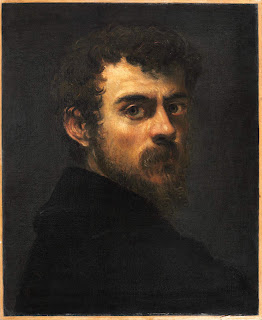
Tintoretto (Jacopo Robusti, 1518-94), son of a tintore, a fabric dyer: Self Portrait, about 1546, above, and Self Portrait, 1588, below; both oil on canvas

The Museum of Fine Arts website provides plenty of information. The exhibition is up through August 16. At $25 for adult entry, it's a pricy ticket—but not as pricy as getting to the next venue on the schedule: It will be at the Louvre in the fall.
By the way, you notice now all the portraits (as opposed to the narrative paintings) have one eye centered along the vertical axis of the canvas? Read more about it here in The Centered Eye, a post I wrote when this blog was in its infancy.
. .


