.

Buren to McLaughlin: view from Gallery 3 to Gallery 4
.
We are in Gallery 4, where the walls have again become gray. The glimpse of Daniel Buren’s work in the previous gallery should orient you somewhat. As I noted earlier, this space is the mirror image to Gallery 2; so where the dividing wall held Mary Heilmann’s work in Gallery 2, here it holds four prints by Blinky Palermo, which you will see shortly.
Above, and below, with our back to the Palermos, we’re looking at two lithographs by John McLaughlin. Being a lifelong East Coaster, Northeaster specifically, and New Yorker most specifically, I am not familiar with the oeuvre of this California-based painter. Minimalism is certainly his focus, though color does not seem to be a strong point.
John McLaughin, two untitled lithographs, 1963; at left, 18 x 21 7/16 inches; at right, 18 x 21 1/2 inches
.
.
Now we turn around to face the Palermos, which face Gallery 3. My own camera didn’t get the vertical shot I wanted, so I have pulled the four images from MoMA’s website and arranged them as they were installed. These four, oriented vertically, are not so much narrative as declarative The shapes are what they are. I don’t know the artist’s intent, but I find these works almost playful and related to the Ellsworth Kellys in Gallery 1.
.

Installation view of Blinky Palermo screenprints in foreground; Josef Albers screenprints on the far wall
..


Four prints by Blinky Palermo, 4 Prototypen, 1970, each 23 5/8 x 23 5/8 inches. Images from the MoMA exhibition website
.
.
With the Palermos still in our view, we look to the left to see 10 Josef Albers screenprints. These works are in a mirror-image installation to the Kelly drawings and collages on the mirror-image wall in Gallery 2. The symmetry of the spaces and of the Albers and Kelly installations underscore the geometry of the exhibition in a fundamental and deeply satisfying way.

Josef Albers, Homage to the Square: Ten Works by Josef Albers, 1962, a portfolio of 10 screenprints, 16 1/2 x 16 1/2 inches
..
.
This series, Homage to the Square, is classic Albers. How do I love it? Let me count the ways: the color, the order, the variation, the simplicity, their systematic and intellectual study of something as sensuous and subjective as color. Whether or not you’re interested in the physics and relativity of color—and if you’re a painter, how can you not be?—or in the empirical studies that resulted, you can simply bask in the refulgence of the hues, or thrill to the formality of the installation: a grid of square-framed work of squares within squares.

Squares to more squares: Albers to Stella
.
To maintain that thrill a little longer, we move around to the Frank Stella screenprint, Double Gray Scramble, which alternates and and opposes tonalities of color and gray. The maze-like, but in fact concentric, progression pulls you deeply into its depths. This work, to me, is the abstract version of those Russian nesting dolls set into a hall of mirrors. Call me old fashioned, but I prefer this early work of Stella’s, before it exploded into dimensional frenzy. (I don’t dislike the new work, which I wrote about last year, I just like these flat geometries better.)
.

Frank Stella, Double Gray Scramble, 1973, screenprint, 29 x 50 3/4 inches
.
.The Stella print is to the left of the doorway that takes you back into Gallery 1. To the right of the doorway is this celestial Sol Lewitt, below. The artist’s title is the dry
Lines from Corners, Sides & The Center, To Points on a Grid, but it suggests to me nothing so much as a star map for a cubic universe. (I know, bad minimalist, reading poetry into the work.)
 Sol Lewitt, Lines from Corners, Sides and the Center, to Points on a Grid, 1977, etching and aquatint, 34 5/8 x 34 13/16 inches
.

Sol Lewitt at left. Francois Morrellet, 8 Wefts 0 Degrees 90 Degrees, 1974, eight screenprints, each 23 5/8 x 23 5/8 inches
.
To the right of the Lewitt is a series of eight screenprints by Francois Morellett. The proportional order of the works seems a minimalist cliche to my eyes in 2008; still, there’s no denying the graphic power of these eight works as they move from white to black, maintaining the simplest geometric expression into a compressed infinity of blackness. Its placement after the Lewitt is graphically brilliant.
An enormous Richard Serra punctuates the dividing wall, and the gallery, with a muscular sweep of black oil stick and graphite. This work predates by about three decades the mighty steel sculptures shown at MoMA last year, but in this work you can certainly see where he was headed. And let me express awe for the framing job as well. How many of us have either the financial werewithall or the museum support to get a frame like this?

Richard Serra, Heir, 1973, paint stick and graphite on paper, 114 5/8 x 42 1/4 inches
These last three images are meant to give you an overview of the exhibition:
 Here we're standing with our backs to the Stella print so that we see Gallery 4 as it flows from Gallery 3
.

Here we're in Gallery 1 by the vitrine looking into Gallery 4, with a view of Serra and the Morrellets
.
Below, we're back at the entrance, peeking at the Albers in Gallery 4

.
It has taken us four posts, but we have traveled a circle within a square, so our geometric journey has in fact been geometric itself.
.


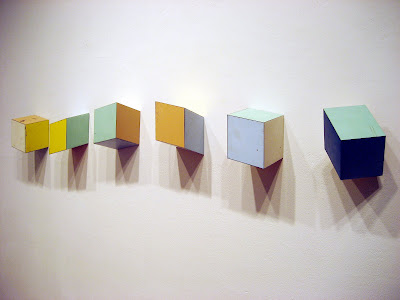
 Far wall, from left: Richard Smith, image and info below; Dorothea Rockburne, Locus, 1972, series of six relief etching and aquatints on folded paper, each app. 40 x 30 inches.

 . . . and details of each


.jpg)
.jpg)
.jpg)
.jpg)
.jpg)




.jpg)