Pages

1.30.2012

Marketing Mondays: What Would You Tell This Young Man?

.

Here's a snippet of conversation that Loren Munk, the artist, had with his wife, Kate, which he posted on Facebook recently and which I repost with his permission.
 .
 "A young family friend, estranged from his  mom, talked with me for hours. I told Kate, "I think his problem is, he wants to come  out..."

Kate says, " That's great. I'm so glad."

I finish, "... as an artist".

She says, "Oh dear God, not that."

Joking (I think) Munk adds, "An intervention might be the only way to save this youngster from a life of tragic desperation."

It's like one of those New Yorker jokes that cuts to the bone. Funny. And then you realize you're bleeding.
.


When I was lecturing in the early aughts, mostly to senior-year B.F.A. candidates or grad students, I used to say, "You're going to start out at the bottom of the pile, but this is a robust economy and you have nowhere to go but up." Indeed, the art fairs were going great guns, galleries were selling well, and even artists selling out of Open Studios were pulling more than enough to pay the rent. 
.
Of course all that changed in October 2008 when the economy came crashing down. Art sales disappeared overnight. So did many galleries. While blue-chip artists and galleries are back to doing OK, they are the one percent. Most of us--artists and dealers--have our shoulder to the wheel. "Breaking even" is the new "profit" these days.

(The image that opens the post is from, surprisingly, a campaign for the College of Creative Studies in Detroit. There's more of the campaign here.)

So here's my question to you:
Knowing what you know about rejection, about the difficulty of earning a living, about working endless hours for small wages. And knowing what you know about the economy now, what would you tell this young man? Go for it? Find another line of work? Do it but have "something to fall back on"? Marry rich? Make your peace with poverty?

If you have found this or other Marketing Mondays posts useful, please consider supporting this blog with a donation. A PayPal Donate button is located on the Sidebar at right. Thank you. (Or click here and scroll down the sidebar.)

1.28.2012

Paperpalooza

.

A collaged panorama of Paperazzi, viewed from the entrance 


There are two big salon-style shows up in Brooklyn right now. One is at Sideshow Gallery. The other is Paperazzi at Janet Kurnatowski. Paperazzi, which shows the work on paper of nearly 200 artists, is up through February 12. It's a big tossed salad of a show, and I mean that in the best possible sense.
.
Exhibitions like this are generous on the part of dealers, as it's a lot of work to organize and install so much art. They're equally generous on the part of artists, as it's easy for one's individual work to get lost in a sea of so much to look at. But exhibitions like Paperazzi are important because they strengthen the art community, providing a democratic opportunity for the well-known and the not-so-well-known to hang out, literally. Equally important, they provide a visual barometer of what's going on, right now. With much work at reasonable prices, shows like Paperazzi should bring emerging collectors into the community, too. And the whole thing is a great deal of fun.
.
Though I picked out work by my art buddies David Ambrose, Steven Alexander, Julie Gross, Brent Hallard, Kylie Heidenheimer, Suejin Jo, Scott Malbaurn, Loren Munk, Gary Petersen, Karen Schifano and Kim Uchiyama, there's no way I can identify all of these works without a map. So instead I've posted high-res images; click on each to see whose work you can pick out. Here's the list of artists, which starts with Peter Acheson and ends with Alice Zinnes. Go see it if you can.

View at the back of the gallery, which leads into the viewing room

Below: a peek into the viewing room

With our back to the viewing room, we can look down the wall on our right, above, and on our left, below

1.25.2012

Visiting "Textility" (Part Two)

.
.
. . . continuing the tour from Part One

We’re starting here where we left off in Part One: at the stairs heading up to Studio X, the third gallery in the Textility exhibition at the Visual Art Center of New Jersey in Summit. On the way up we’ll take a look at Debra Ramsay’s installation. And when we come back down, we’ll pass through a hallway that shows additional work by two of the Studio X artists, Grace DeGennaro and Stephen Maine, as well as that of Elana Herzog. (I'm mixing up the internal architecture of the institution a bit to be able to give you a flowing narrative.) 

In the stairwell, looking up from the ground floor: Debra Ramsay's site-specific installation, Two, Twice With Green and Yellow, 2011, thread, fabric, paint and pins
...
Above: View from the second floor
Below: left corner detail
.

On the wall outside Studio X: Ramsay's Squarely Divided, Times Two, 2001; thread, Tyvek, glassine, bubble wrap, acrylic paint, pins, dimensions variable; image from the VACNJ Facebook page


Peeking into Studio X: Stephen Maine on far wall

Touring the gallery clockwise: Maine, Elisa D'Arrigo; foreground, Joell Baxter

D'Arrigo, Pip Culbert, Baxter

Culbert, Grace DeGennaro, Baxter


Panoramic view as we circle past the entrance and continue around the gallery: DeGennaro, Ken Weathersby

Weathersby, Baxter

Joell Baxter, Endless Day (For G.M.B), 2011, screenprinted paper and glue; 46 x 46 x 5 inches
Detail below


Stephen Maine, Mesh painting #11-011, 2011; acrylic, paper, plastic mesh, thermal installation, T-pins, 36 x 36 x 6 inches
.
Above: shadow detail
Below: closeup

Elisa D'Arrigo, Byzantine Homage 1, 2005, cloth, acrylic paint, thread; 35 x 35 x 3 inches
Detail below

Pip Culbert, Patchwork, Blue and Pale Blue, 2011, cotton and pins, 41 x 27 inches
Detail below


Grace DeGennaro, Weaving, 2007, oil on linen, 26 x 16 inches

.
Ken Weathersby, 179 (twn), 2010; acrylic paint film with removed areas over wood scaffold over linen; two panels, each 24 x 19 inches
.
Details above and below


From Studio X we go back downstairs, passing through the art-hung hallway on our way out. The decision to install work here came late in the process, but I'm glad it came about as it gave us an opportunity to show work on paper by three exhibiting artists.

Looking down the hallway, work by Grace DeGennaro, right, Stephen Maine, left, and Elana Herzog in distance on right

Above and below: Grace DeGennaro, two watercolor on paper paintings from the Trinity series, each 30 x 22 inches
.

Elana Herzog. four from the Untitled series of work iin handmade cotton paper and textile
Closer view below
.

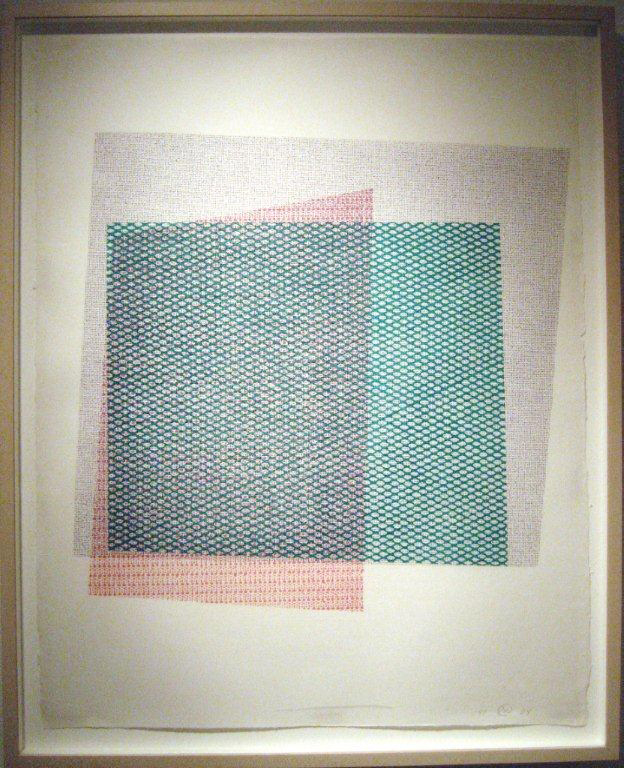
Stephen Maine, monoprints from the Pitched Planes series
Closer view below
.


Textility is up through April 1, with a Walk-and-Talk conversation with the curators and artists on Sunday, March 25, 4:00-6:00 p.m. I plan to post sporadically about the exhibition between now and then.

Also visit
.  The Textility blog of the Visual Art Center of New Jersey, which has posted installation images as well as pics from the reception
. Sharon Butler's Facebook album from the opening
. My blog post with screen grabs from New Jersey transit showing directions from Penn Station
. HomeTowne TV, a regional arts program, which features several artists and myself talking about the exhibition


1.23.2012

Marketing Mondays: Do It yourself

.
Laura Moriarty in her Hudson Valley studio.
..
"I'm giving myself a two-week residency in my own studio beginning today.”

That was the sculptor Laura Moriarty announcing her intention via Facebook several weeks ago. Moriarty’s residency is now over, but I love the idea that in her busy life as an artist, gallery director and teacher, she decided to carve out a block of time with no other distractions. It helps that Moriarty has been the recipient of many residencies, so she knows how they work—and thus how to take advantage of the intense focus. I love the idea that she defined her studio time as a residency.

Reading about Moriarty’s self-gifted residency brought to the fore—yet again—the idea that one of the great things about being an artist right now is that we are able to direct our careers  ourselves, rather than waiting for the big break, the big grant or the unlikely miracle. There are many ways to take the DIY approach.  

Want a solo show but there’s no gallery offering you one?
Do it yourself. Gwyneth Leech had a great idea for a show, secured a display window in the Garment District, and installed it. I wrote about it here. For some artists an exhibition such a Leech's would be, in and of itself, a great DIY project but that’s not the end of this story. She invited the Cheryl McGinnis Gallery in Chelsea to co-sponsor the project.  It was so successful that she’s

now represented by the gallery, and together McGinnis and Leech secured yet another space for Leech’s particularly fabulous brand of exhibition with the artist in attendance for some part of just about every day.

Above: Leech's Hypergraphia in the Garment District in  2011.
Right: Hypergraphia in the prow of the iconic Flatiron Building. Read more in Leech's blog,
Gwyneth's Full Brew
.
.
Want to curate a show?
There are art centers that would love to have you present a proposal. A busy curator who’s smart enough to respond to a well-thought-out proposal will buy herself some time for the rest of the year’s programming because you have already done a good deal of the work. That’s what Gregory Wright did with his exhibition, Pollination, at the Brush Gallery in Lowell, Mass., recently. He got funding from the Massachusetts Cultural Council, too, which allowed him to do a catalog of the show. And the show is about to travel, in slightly altered form, to Provincetown, Massachusetts in June. If you can build some perks for yourself, such as  curatorial or travel fees, or if the gallery can do that for you, so much the better.

Above: Installation view of Pollination at the Brush Gallery, Lowell, Mass., with  work by Toby Sisson, foreground; below: the grant-funded catalog
Both photos: Nancy Natale


.
Don’t have a bricks-and-mortar venue? Curate online
I'm surprised more artists haven't done this. Structural Madness, a “New York virtual gallery” founded and run by Gloria Klein—who has curated many physical exhibitions for Gallery 128 on the Lower East Side—is one such venue (and guess whose work is featured this month?)
. 
I’ve also curated “exhibitions” here on my own blog. To be honest, I don’t see them as exhibitions so much as curated blog posts, but the point is that they’re an opportunity to bring together work by various artists in a way that creates a visual narrative.  See Spring Greens and Rhomboid Rumba. I loved doing those! The World Wide Web, which I pulled together from what I saw at the recent Miami art fairs, is another such curated post, along with Black is the New Black. Again. The bonus here: While I get to exercise my curatorial muscles, I’m spared the administrative and physical process of planning and installing the show. 
.
Julie Karabenick has a splendid curatorial project on line, Geoform, which takes an international look at abstract geometric art. I’ve mentioned it before but it’s worth mentioning again, as Karabenick is adding new artists and interviews regularly.


Or curate in print
That's what Sharon Butler did. The painter and editor of the blog Two Coats of Paint has been publishing limited-edition books on various topics. A recent one, Against the Tide, looks at the work of artists who have reference water in their work (disclaimer: I'm one of them). It's a catalog of a show that exists only in the catalog. In our media-sophisticated existence, an exhibition in print makes perfect sense.
.

.Start a Gallery
Zach Feuer started with an apartment in Boston while still an art student at the Museum School and now has a serious gallery in Chelsea.  Minus Space, started by artists Matthew Deleget and Rossana Martinez, began as a curated website and now has a physical gallery in Brooklyn. Chris Ashley has an appointment-only gallery, Some Walls, in his Oakland home. (I have previously written about Ashley's project here.) Ashley’s essays about artists on his blog, Look See, seem to have been the germinating point for the gallery shows, which are always accompanied by an Ashley essay.
.
.
Wish someone would write a monograph on your work?
Until Rizzoli comes calling, you have the power to create your own monograph using one of the various online publishers, such as Blurb or Lulu. 

Sharon Butler did just this with her Tower Paintings: Keeping Our Distance, left. Online publishing means that you create the book or catalog and then print only as many copies as needed. Yes, the per-copy cost may be higher than conventional book publishing, but considering that you don’t need to pay a designer (you can use one of many available templates), or a printer (it’s print on demand), and you don’t have to pay for a big print run, for shipping the copies to you, or for storing them, it turns out to be not such a bad deal. For most artists the point is not to go into business selling books, but to create a limited-edition monograph of your work. (You’d be wise to commission an essay. And if you can involve an institution or gallery where you’ll have an exhibition, or do so in conjunction with an exhibition, the project should be treated with the same respect as a conventional catalog.)
.
.
Give yourself an art fair
Long before the Armory Fair reincarned in 1994 on several floors of the Gramercy Hotel in New York City, likely igniting the current art fair

Binnie Birstein works on paper at the in-house Hotel Fair at the International Encaustic Conference, June 2011. Unframed works are easy to travel and set up
.
frenzy, small fashion businesses were renting hotel rooms to show their collections twice yearly to the fashion press. The flexibility of this format became clear to me when Debra Ramsay and Cora Jane Glasser, two artists participating in the encaustic painting conference I run, rented a suite and turned the living room into an after-hours art fair. It was a big hit, providing not only an opportunity to see their work but a place to hang out and talk about art. Sales were made, and Ramsay and Glasser’s salon became the model for the in-house Hotel Fair that takes place each year now.  It seems to me that any kind of conference could provide you with the opportunity to create a “hotel fair” to show your work. Show small work, or unframed work on paper, and you can take the show in your suitcase. (I'd love to see what artists at the CAA Conference do with this idea.)

.
Give yourself a residency
We end this post where we started: with the idea of a self-gifted residency. How did Moriarty's residency go? "It went great!" she says. "I experienced a breakthrough and completed a new 30 piece collection, worked out some new panoramic shelf pieces, and my work has taken a slight new turn during this period, which has energized my curiosity."

One result of Moriarty's residency: Flattop, 2012, encaustic (app 12 inches high)
.
Moriarty offers this advice for anyone considering a DIY residency: "Act as if you are going to be leaving town; get all of your appointments out of the way, pay the bills, clear your calendar, and pre-clean your studio." Two weeks, she adds, "worked perfectly for me."

Over to you: What have you done for yourself lately?
.
If you have found this or other Marketing Mondays posts useful, please consider supporting this blog with a donation. A PayPal Donate button is located on the Sidebar at right. Thank you. (Or click here and scroll down the sidebar.)

1.19.2012

Visiting "Textility" (Part One)

.


Panoramic view from the entrance

Several hundred people turned out for the opening of Textility at the Visual Art Center of New Jersey in Summit last Friday night. This is the exhibition I co-curated with Mary Birmingham, who is the curator at the institution. Sharing an interest in the ways contemporary artists are referencing textiles, we put together a survey that approaches the topic from two directions: artists who use conventional artmaking materials to create the image or suggestion of textiles, and those who use thread and cloth to create painting, sculpture and work on paper. We installed 40 works by 28 artists in three galleries and various other spaces throughout the institution.

You can read the particulars about the work in my catalog essay, posted last week on this blog: Diverse Practices, Common Threads. (And you can see some behind-the-scenes views here.) In this post I simply want to show you what the exhibition looks like. There's so much to show you, in fact, that I'm splitting the installation into two posts. In this post you see work in the large ground-floor gallery and the smaller Eisenberg Gallery next to it. Next Wednesday we'll go upstairs to Studio X, and travel elsewhere in the building.

We're going to work our way clockwise around the gallery:
.

From foreground: Lael Marshall, Elana Herzog, Susanna Starr, Leslie Wayne, Nava Lubelski, Mary Carlson, Peter Weber
.
..
Elana Herzog, Untitled,  2011; wood, metal staples, textile, 33 x 34 x 3 inches
.
Detail below

Susanna Starr, Dresser Doily, 2005, hand-cut mahogany wood veneer, 70 x 47 inches
.
.
Leslie Wayne, One Big love #46, 2010, oil on wood, 14 x 11 inches
.
Detail showing gathered layers of paint film


Nava Lubelski, Chance of Flurries, 2011, thread on stained canvas, 46 x 36 inches
.
Mary Carlson, Ghost Flag, 2007, sewn sheer fabric, 123 x 70 inches
.
.
Peter Weber, Arlene Shechet on plinth on floor
Barbara Ellmann, Wherewithall, 2011, encaustic on panel; 12 panels, each 24 x 24 inches, 102 x 76 inches overall
.
Ellmann detail below


Continuing around the gallery from left: Weber, Shechet, Ellmann, Sharon Butler; foreground: Susan Still Scott
(When we move to the Eisenberg Gallery it will be through the door you see here)
.

Peter Weber, Vernetzung BL6 (9), 2009, folded felt, 20.5 x 20.5 inches


Arlene Shechet, Coil, 2004-07, cast and pigmented crystal, 25 x 8.5 x 7 inches

Sharon Butler, UniQlo, 2011; spray paint, urethane, pencil and sewing on unstretched gessoed canvas and unprimed linen, 65 x 50 inches
.
.
Butler; detail of Derick Melander sculpture, The Painful Spectacle of Finding Oneself, 2010; second-hand clothing, wood, steel, 12 x 12 x 72 inches

.
Butler; full view of Melander sculpture; foreground: Susan Still Scott, Slider, 2010; acrylic, flashe and enamel on canvas, cotton duck, wood with staples, wire, polyfill fiber, 57 x 16 x 31 inches
.
.
Butler, Melander, Lalani Nan (in distance), Scott
.
.
Lalani Nan, Gray, 2006, oil on linen, 52 x 46 inches
.

Lalani Nan
(Wall text is just to the left of the entrance)
.
.
View from the opposite end of the gallery: Melander, Jennifer Cecere, Marshall, Herzog, Starr, Scott
.
.
Jennifer Cecere, Mother, 2011, ripstop nylon, 96 inches diameter

.
Now we move to the Eisenberg Gallery next door. The room is not quite octagonal, but it has a number of walls that are not at 90-degree angles. The result is a space that extends a kind of embrace to the work. Here we showed work on paper, all achromatic except for one spot of red, which you'll see in the panorama below.

Peeking into the Eisenberg Gallery
....

This panorama distorts the angles of the room, but you can see that it's not a white cube. Many who viewed the work in this room described the space as "meditative", which is appropriate give the low-key presence of the work. Artists are identified in the subsequent photos
.
.
Carly Glovinski, Sam Moyer, Caroline Burton, Aric Obrosey, Gelah Penn
.
Moyer, Burton, Obrosey, Penn, Marietta Hoferer
.
.
Sam Messenger


Carly Glovinski, Untitled (dishrag), ink and correction fluid on paper, 16 x 9 x 6.5 inches

Sam Moyer, Close Screen, 2011, india ink on paper, 22 x 30 inches
.

Caroline Burton, Untitled (tape 1), 2006; tape, thread, wire, metal, 12.5 x 10 x 2.5 inches
.
.
 Aric Obrosey, almost full view of Untitled, 2006, charcoal on paper, 30 x 22.5 inches

Gelah Penn, detail of Big Blackfil #1, 2010; monofilament, mosquito netting, plastic mesh, acrylic and graphite on Yupo, 60 x 38 x 6 inches
..

Marietta Hoferer, B, 2011, pencil and black-lined transparent tape on paper, 21 x 21 inches
.

Sam Messenger, Veil from Alpheus, 2011; pen and ink, ink wash, starch past and river water on paper, 64 x 59 inches
.
To be continued  . . .

In the meantime, the Textility blog of the Visual Art Center of New Jersey has posted installation images as well as pics from the reception.