Pages

Showing posts with label Miami Art fairs 2006. Show all posts

12.14.2006

All’s Fair: In Miami for the Art

This first posting of the "All's Fair" series is followed by eight others, all on line now. I've manipulated the posting dates so that the entries list sequentially to follow my narrative. J.M., December 17, 2006

So what if Miami was overcast and windy. We came for the art. And by "we" I mean 40,000 artists, dealers, collectors, critics, curators and art educators, each in search of visual ecstasy, a good buy or some useful artworld connections. My own personal heaven (or hell) was seven venues, 573 galleries and—figuring an average of 10 artists per gallery—almost 6000 artists in four days.
Blog about the art fairs in Miami
© Joanne Mattera, 2006 www.joannemattera.com

"I just flew in from Miami," goes the Henny Youngman joke, "and, boy, are my arms sore." All kidding aside, I did just fly in from Miami and my feet are killing me.

After four days, December 7-10, at the fairs— Art Basel Miami Beach and six (out of 12) satellite events—not only am I nursing a couple of blisters, my shoulders are still tight from lugging a heavy pack (the Basel Miami catalog alone weighs 5.5 pounds) and juggling notebook, pen and camera in a clumsy pas de trois for word-and-image reportage. At least I didn’t end up with a sore throat like most of the dealers, who by Saturday afternoon were frantically sucking on losenges in the hope of easing their laryngitic voices for one more day.


I had good reasons for being at the fair. The opportunity to see a world’s worth of art in a relatively small space and short time was the main draw, and I was there on a press pass for Geoform, an online curatorial project focused on geometric abstraction. Plus I had work with Kenise Barnes Fine Art who was exhibiting at Flow.

I could see the ocean from my hotel room, but that’s as close as I ever got to the beach. As for the hotel itself, a tape loop of Bette Davis ran through my head whenever I was there: "What a dump!" But the Setai was next door, and its lovely garden/outdoor bar was the perfect place to chill (until the winds kicked up) over a $20 bottle of Pellegrino. Hey, you pay for the ambience.

Birdseye-view of Basel Miami from the Skywalk. Imagine the camera panning to the left and right of this image, and you'll get a sense of the size of this event. The Paul Kasmin Gallery, with works by Warhol and Stella, is visible in the foreground

The folks seeming to have the most fun were the artists, many there for the first time; the let’s-see-what-the-fuss-is-all-about browsers; and the collectors for whom money was no object. "Honey, it’s three million," I heard one well-dressed woman whispering into her cell phone at the Convention Center, where Art Basel Miami Beach was taking place. "Unh huh. Unh Huh." Honey must have given the go-ahead, because the well-dressed woman then turned to the dealer and said, "We'll take it." I didn’t see the purchased art in question, but it sure was interesting to observe the art of the purchase.
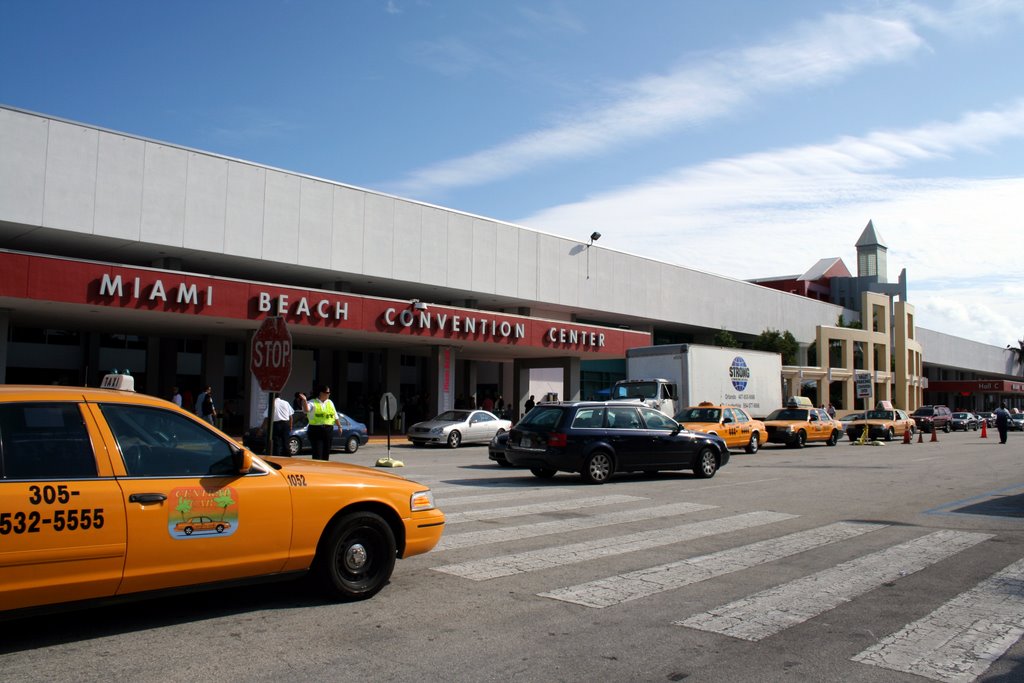
This is the fifth year of Art Basel Miami Beach—a.k.a. ABMB, The Big Fair, The Mothership—around which everything else revolves. It’s the fourth year for NADA and Scope; the second year for Aqua and Pulse; the first

The Miami Convention Center, home of Basel Miami; the fair organizers have just signed a 10-year deal, so you can make your plans for next year

for Bridge and Flow. These are the ones I was able to cover in four days. There was also Diva, the digital fair on the beach, in its second year; plus Ink, the print fair, and Photo Miami, as well as three artist-run events: Fountain, Pool and Zone, all in their first year.

The seven venues I covered featured a total of 573 galleries and somewhere close to 6000 artists in two disparate locations: the Miami Convention Center, two blocks in from the beach, and the hotels clustered

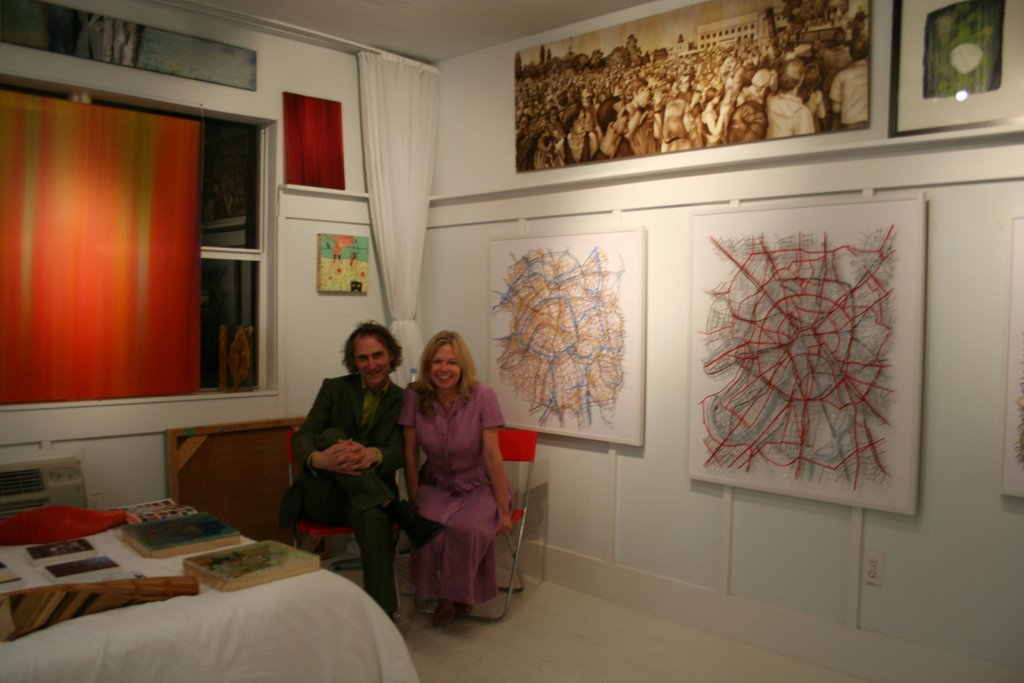
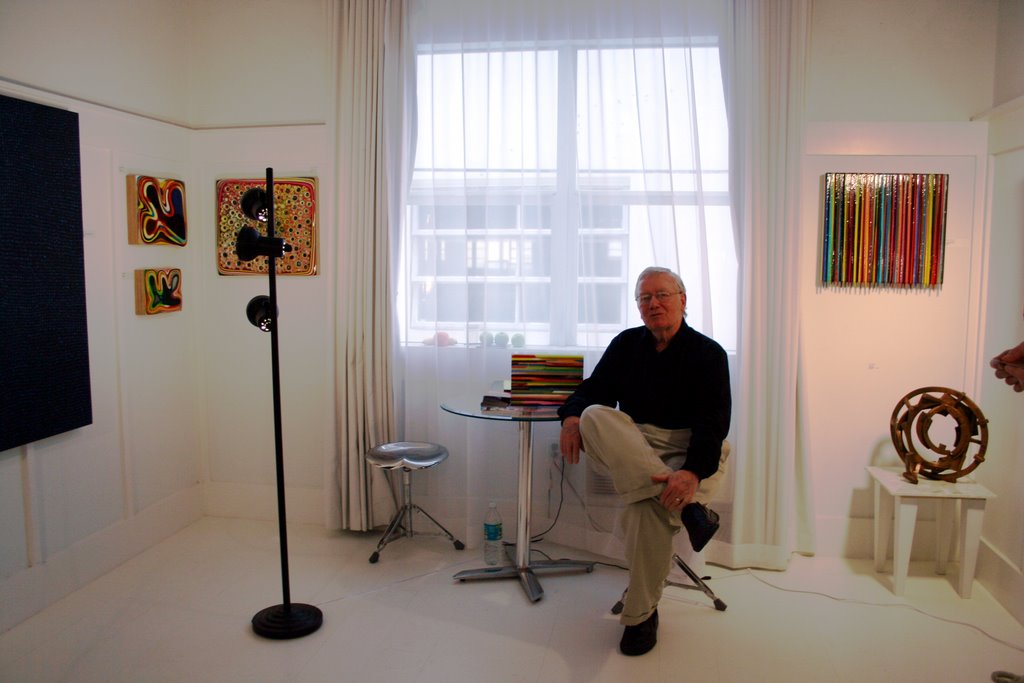
Two fairs at the Catalina Hotel on Collins Avenue: Flow and Bridge. Furniture was removed to make room for the art (though some budget-minded dealers retained the bed and slept there at night)
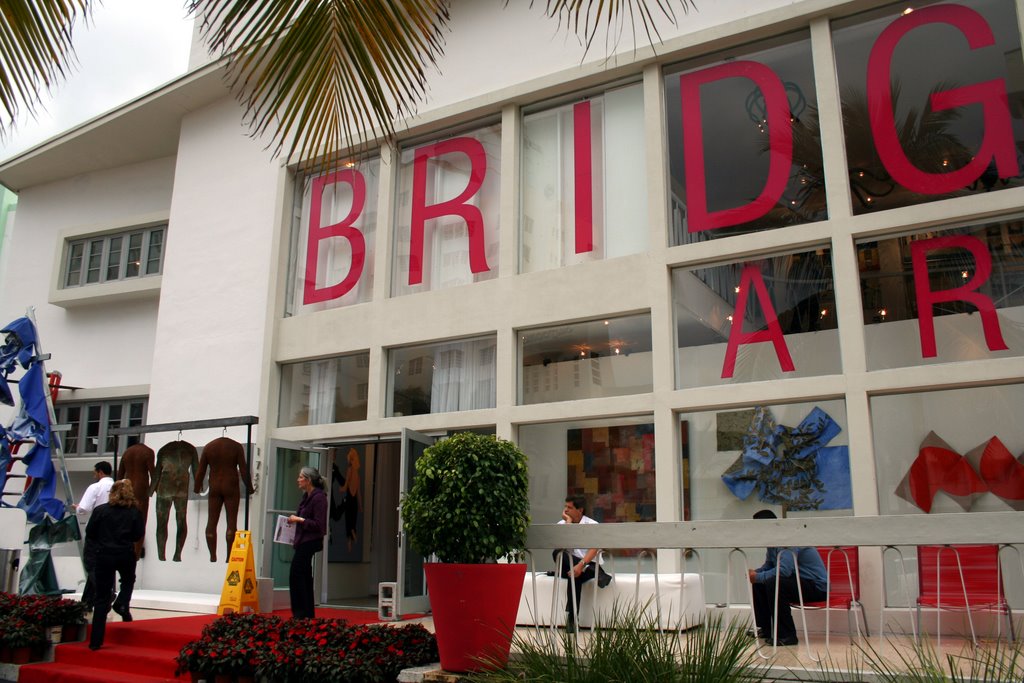
around it; and the Wynwood Design District across the causeway in Miami proper, under tents and in warehouse-style buildings. Sales ranged from a reported $5.5 million for a secondary-market Basquiat at Jeffrey Deitch, to under-$1000 works by emerging artists at the smaller venues.
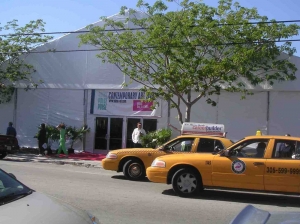
Starting with Art Basel Miami Beach, I’m writing about each venue in separate blog entries that will be posted over the next few days. Just so you know: I went to the fairs with an avid interest in painting and work on paper—the more abstract,

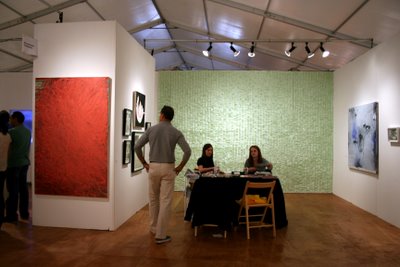
Pulse Fair, under the tent in the Wynwood Design District, above; Aqua Art, the best best venue for air and light--and the art wasn't bad, either
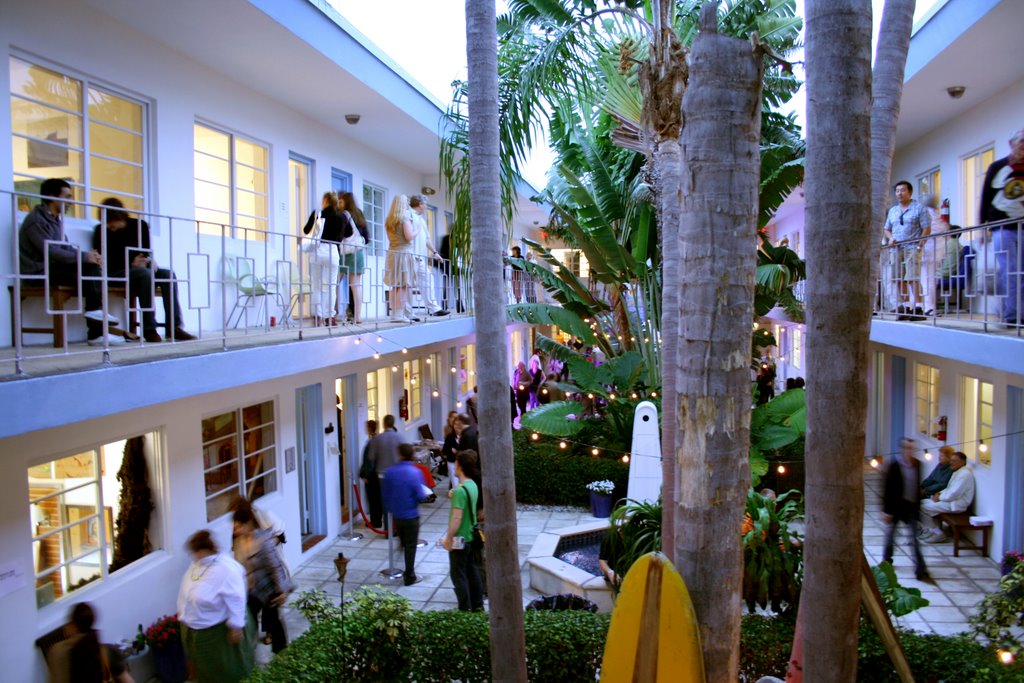
geometric and reductive the better; a healthy interest in sculpture; a moderate interest in photography and installation; and an utter lack of interest in video. This report reflects my preferences.

If you didn’t go yourself, I urge you to take a look at a few other websites—links below—to round out your vicarious view of things. I’ll be back shortly in another post with my report on The Big Fair, Art Basel Miami Beach.

In the meantime, take a look at:

. Art Info, which published excellent daily online coverage of the event
. Paul Klein’s Art Letter
(Miami report is at http://www.artletter.com:80/html/current_artletter.html)
. The Art Newspaper, which printed a special daily edition during the fair (see some writing online at
http://www.theartnewspaper.com/article01.asp?id=530 )
. The New York Times on line: (
http://www.nytimes.com/2006/12/09/arts/design/09fair.html?pagewanted=1&_r=1)
. The Miami Herald on line: (
http://origin.miami.com/mld/miamiherald/entertainment/16200114.htm)
. Roberta Fallon and Libby Rosof’s Philly-based artblog which features a short piece as the current entry, and Tyler Green's Art Blog

You are free to share, blog or print this post. However I ask you to make a link to my blog, and you must credit me as the author, per the (c). Miami art fairs; art blog about art fairs, miami

All's Fair: Basel Miami (Painting)

Imagine Costco on steroids and filled with art. Now throw in a carnival atmosphere, tradeshow commercialism, museum reverence, fashion attitude, and the frenzy of Filene’s Basement when the bridal gowns go on sale.

Add sublimely beautiful contemporary paintings, modern masters from the secondary market (like Ad Reinhart from his pre-somber period in three booths), big-ass sculpture, inventive installations, cartoon imagery and some rice and beans (I’m not kidding). And, hey, why not include the oversize figure of a man performing a physically impossible scatological function? Like the blind men describing an elephant, no one perception comes close to describing this event but together they create a pretty good picture of this behemoth of a show.

© Joanne Mattera, 2006 www.joannemattera.com

Saleswise, it was a dealer’s dream. I overheard this conversation between two exhibitors:
He: "How are you selling?"
She: "It’s good. It’s good."
He: "Everybody is selling everything! It’s crazy!"

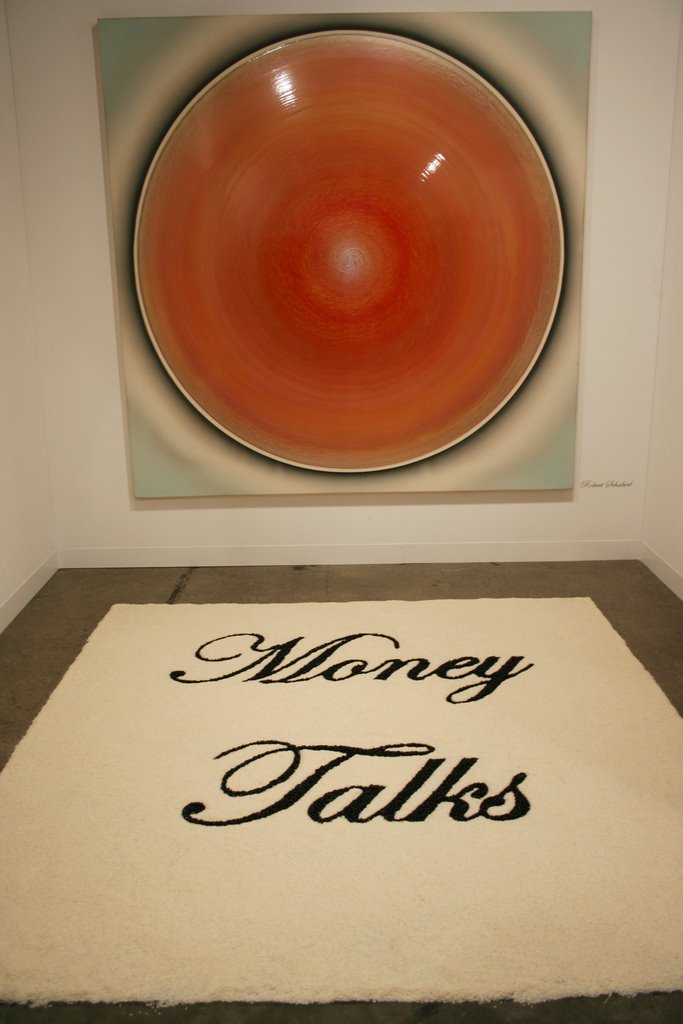
Lucia Madriz: Money Talks, rice and beans, dimensions variable; painting by Robert Schaberl, both at Galeria Jacob Karpio

Ron Warren, director of the Mary Boone Gallery, which was changing its one-artist installations daily, put a finer point on it: "We sold out the Barbara Kruger show by 2:00 p.m. yesterday." It was the first day of the show. When I was there on Thursday, the show was of David Salle’s paintings and many, according to Warren, were sold. There were no red dots, but "sold" was resonating at a low frequency throughout the booth. Indeed, throughout the fair.

By the way, the lack of red dots was no indication of sales one way or another. According to one dealer I can’t name, most of the work was already sold before the show went up. "It’s the dirty little secret of these shows," she said. "Seventy percent of the work is spoken for beforehand, but the collectors like to say they bought it at Art Basel."

A little background

Basel Miami is set up with a hierarchy. The main show is composed of galleries whose booths are in the center of the exhibition space. The bigger galleries have bigger booths. I don’t have exact figures, but I think we’re in the $50,000 range for a mid-size booth. The newer or "emerging galleries" ring the room as part of the less-expensive Art Nova section. The designation Art Kabinett on a booth’s sign indicates that a museum-quality show is on display; typically there is a historical component, and the installation is more restrained than on the Midway, er, elsewhere in the hall.

Finally, Art Positions is out on the beach in Collins Park in shipping containers repurposed as exhibition spaces. It was too windy most of the time to go that close to the shore, and besides, I ran out of time, so you’ll have to get someone else to tell you about it. For the most part I’m skipping titles and sizes. (To be honest, it’s because I can’t read my own notes.) The installation images will give you a sense of scale, and if you want to know more you can go onto the gallery website, which is live-linked if you see the name in red.

Painting
One thing the Convention Center has in abundance is space, so there’s plenty of room for large painting and sculpture. What pleased me most were the geometric abstractions, in particular the most minimal ones in which color floated in and over the surface. That said, it was the big, brash geometric abstractions of Sarah Morris that initially drew my eye. She had work at Berlin’s Hetzler Gallery
and London’s White Cube.

Sarah Morris: Hetzler Gallery (above) and White Cube (below). Both paintings described as "household gloss on canvas"

San Francisco’s Jack Hanley Gallery showed Chris Johanson, whose painting is worked in a more rectilinear manner. In Two Artists Talking, the blog I write with artist Chris Ashley , we looked at the blocky abstractions of several painters (Helen Miranda Wilson, Marco Casentini and Richard Schur), and Johanson’s work has a strong visual kinship there.

Chris Johanson’s geometric abstraction at Jack Hanley Gallery

.

.

.

.

.

.

.

.

.

.

.

.

.

.

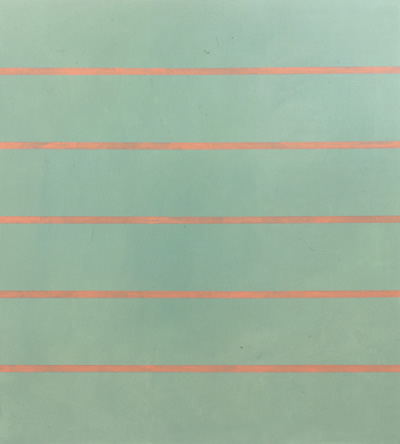
The best discovery for me was the work of Yuko Shiraishi at London’s Annely Juda Gallery. Shiraishi, a Tokyo-born woman now living and working in London, paints reductive linear abstractions with a precision of line and delicacy of color. Her palette teeters on the edge of pretty, but the pristine geometry of the composition and the muscularity of the size (about five feet squarish) negate any sweetness. If Agnes Martin had been Amish, this is what she might have painted, don’t you think?

Yuko Shiraishi: Equipoise, 2006. In foreground: Crack and Warp Column by David Nash, both at Annely Juda Fine Art. Below: Diverge and Diverge 2, both oil on canvas, app. 60 x 48"

.

.

.

.

.

.

.

.

Imi Knoebel, whose work I encountered for the first time last year, did not disappoint. His work occupies a place between painting and sculpture. Some works are flat against the wall while others, definitely planar, are installed in a way that makes you consider the space around and behind them. He showed work with at least two galleries, the international (New York, Paris, Zurich) Galerie Lelong and Hamburg’s Galerie Vera Munro. Take a look:

Imi Knoebel: Gelb (Yellow; above) with installation view at Galerie Vera Munro

Luiz Zerbini, another artist I was pleased to revisit, works in that same sculptural painting/planar sculpture zone. His work, as last year, was at Fortes Vilaca from Sao Paolo. Brazil has an abundance of galleries with a strong program of geometric abstraction. Galeria Millan Antonio, also in Sao Paolo, showed an unlikely beauty in lavender and pale ultramarine by Paulo Pasta.

Luiz Zerbini: Paisagem Inutil (Useless Landscape, above), acrylic on wood and canvas, at Fortes Vilaca; Paulo Pasta at Millan Antonio, both Sao Paulo

As for abstraction without the geometry, five large paintings drew my attention. The first was the cinematic Donde Llegar by Corinne Wasmuht at Cologne's Galerie Gisela Capitain. The second was by Hiroshi Sugito at Berlin's Arndt & Partner, as sweetly intimate as a larger-than-life painting can be.

Corinne Wasmuht: Donde Llegar at Galerie Gisela Capitain; Hiroshi Sugito at Arndt & Partner


The third and fourth large abstractions were by Tomory Dodge, a young painter from Los Angeles, at New York’s CRG Gallery .
Dodge’s paintings dance on the edge of image and materiality. Thick impasto defines a delicate suggestion of waterscape, for instance, in gestures both crude and refined. And the fifth was by Lydia Dona, a veteran painter, represented here by Jacob Karpio Galeria with a brash orange painting as unconstrained as Sarah Morris’s is perfectly plotted and contained.

Tomory Dodge at CRG Gallery (above); Lydia Dona at Karpio Galeria

The interesting thing about seeing so much large, large, large is that when you come across small you look, look, look. Thus was the case with Richard Tuttle’s five small paintings and a singular sculpture at Sperone Westwater. Tuttle’s work always beckons for a closer view anyway.

Richard Tuttle: Reservations, 1999, five painted constructions, each 15x15 inches, and Space, 1964, acrylic on linen on wood construction, at Sperone Westwater

Up shortly: All’s Fair: Basel Miami (Sculpture, Installations)

All's Fair: Basel Miami (Sculpture, Installation)

If there were a bumper sticker that said "I Brake for Martin Puryear " I’d slap it on my Jeep. I love his work. So when I came across a large Puryear sculpture at Chicago’s Donald Young booth, of course I stopped.

(c) Joanne Mattera www.joannemattera.com


Martin Puryear: Confessional, wire, mesh, tar, wood, 1996-2000

On view was a large, dark, full-bodied object. Puryear’s work often has an anthropomorphic quality to it, and this large piece was no exception. To me it was shaped like an elongated head, yet its mesh skin suggested—as his work often does—a basket or shelter. Like no other artist I know, Puryear’s work dips into the river of what it means to be human, by suggestion (the shape) and association (the forms we need for basic survival) as well as a higher calling (it’s art, after all).

..
At
Carlier Gebaur, the Berlin dealer, Michel Francois’s silver "balloons" are nicely contradictory to the open skin of Puryear’s work. Solid seeming, they hang suspended from nylon wires, unable to transcend gravity. It’s a shock to realize they’re blown glass—and thus extremely fragile—unprotected from the hoards of curious lookers. They’re also extremely beautiful, an earthbound, vitreous cloud.

Michel Francois, Souffles dan la Verre (Glass Bubbles), blown glass of different sizes suspended on nylon wire, at Carlier Gebaur. Detail below


Here’s what else I loved: Anish Kapoor’s large concave disc of polished stainless steel at Lisson Gallery, which distorted the reflection of its observers. Strangely it's not do much a funhouse-mirror thing as it is an opportunity to think about how we see. Did you see hisSky Mirror in Rockefeller Center a couple of months ago?


Anish Kapoor: Untitled, stainless steel, 2005, at Lisson Gallery

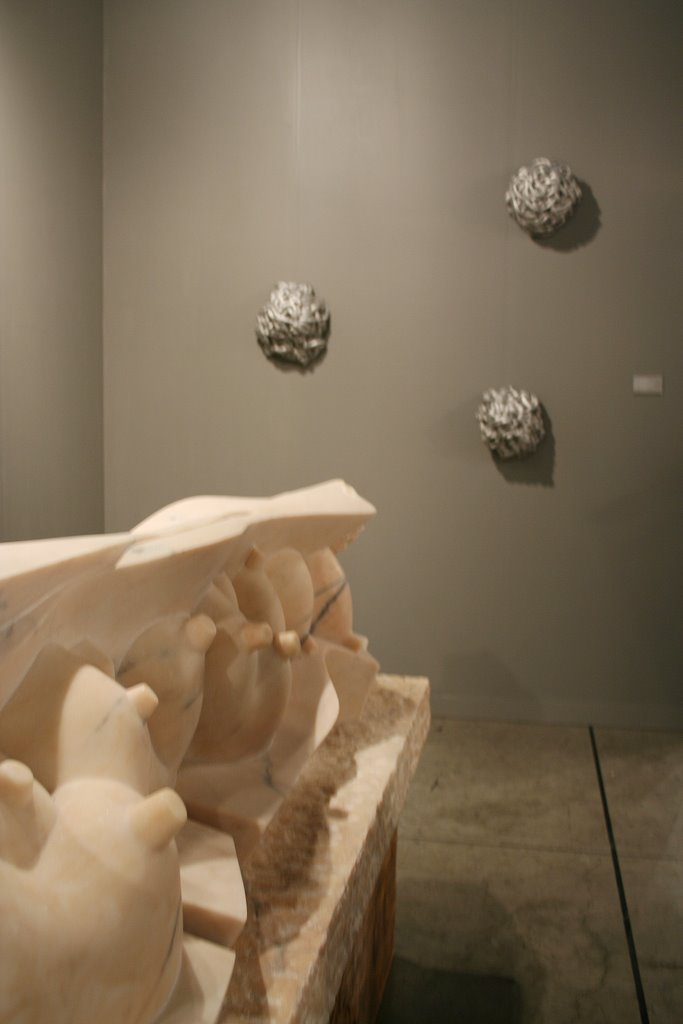
Across the corridor was a quiet and beautiful installation at New York’s Cheim & Read Gallery:a large pink-and-gray marble sculpture by Louise Bourgeois and three cast metal hemispheres by Lyndas Benglis. Both sculptors are masters of multiple materials. Indeed at Galerie Karsten Greve, Bourgeois was represented by drawings and a sculptural head of stuffed cloth.

Two views of Louise Bourgeois’s marble sculpture (foreground) and Lynda Benglis’s hemispheres on the wall, at Cheim & Read

After the weight of marble, a ring of tape kept aloft by dueling floor fans was a lark at Spencer Brownstone. I loved its mutability--a kinetic, dimensional drawing barely more substantive than a smoke ring or a circle traced by a finger on frosty glass.

Zilvinas Kempinas: Ring of tape at Spencer Brownstone, New York

At Galeria Luisa Strina, yet another Sao Paulo gallery, wooden trowels were stacked about the corner booth. The geometry of the installation--quite beautiful--was in keeping with the purpose of the trowels. Think walls, buildings, the Pyramids, even. Still, the reference to manual labor seemed ironic in a venue where the art was going for millions. Then again, perhaps it was a testament to laborers--artists included.


Marepe (I think): Installation of wooden trowels at Galeria Luisa Strina

The carnival atmosphere I mentioned earlier is personified by three galleries: the joyful installation at Mexico City's OMR Gallery, the nothing-is-as-it-seems environment of reflective and transparent surfaces at Berlin's Neugerreimschneider, and Emmanuel Perrotin's cheerful sideshow where that scatological contortionist drew smirks, gasps, quizzical looks--and probably a buyer.

Basel Miami: part festival (Galeria OMR)....

...part funhouse ( Neugerreimschneider, above), and part carnival sideshow (Galerie Perrotin)


After two days of heavy looking, I was approaching art overload, so it took me a moment to realize that this was not, in fact, a sculpture but fire safety equipment.

You know you're on art overload when you stop to look at the safety equipment. Well, it is sculptural

Basel Miami is a tumult of booths and people. You may start out trying to follow the grid of the map—I did, anyway, because on paper it’s orderly—but looking is rarely a step-by-step process. You follow your eye, not your plan. Talk about being distracted by color and shiny objects. Of course you stop to chat, and then you find yourself walking back in the direction you just traveled. But because you’re approaching the booths from a different direction, you’re seeing things you missed, so you stop to look. Then chat, then find yourself walking in another direction. In two separate visits to the venue, I think I saw everything but I’m not sure.

Which brings us to Gavin Brown's Enterprise. Holding down a prime corner spot, this New York gallery was bare except for gray industrial carpeting and two catty-corner benches at the periphery. There was a crushed and empty cigarette box in the middle of the floor. But wait, it was moving. First slowly and then faster. Stopping. Starting. Inching upward and then crashing soundlessly to the floor as people crossed the empty expanse. It’s an installation, of course. Art, manipulated high above the crowd by a complex mechanical arm that swung in a circle, then folded on itself to trace a smaller arc, pulling the invisible string up or down. That Camel box going in circles, doubling back on itself, soaring and then crashing seemed nothing so much as a metaphor for the Basel Miami experience.

As of December 7, according to that day’s issue of The Art Newspaper, two editions of this sculpture by Urs Fischer at Gavin Brown's Enterprise had sold for $160,000 each

Next up: All’s Fair: Flow

All's Fair: Flow

We go from Basel Miami at the Convention Center, the largest fair (204 galleries) to Flow in The Spy Lounge at the Catalina Hotel, the smallest (18). But don’t let that tiny number fool you. This was a terrific show: cohesive, articulate and friendly.

(c) Joanne Mattera www.joannemattera.com

The "friendly" part was built into the fair’s criteria. Producers Matt Garson of M% and Julie Baker of Julie Baker Fine Art, invited galleries from around the country not only for the quality of their programs but for the personality of the dealers. They wanted an attitude-free zone. And they got it. Of all the fairs, Flow was the most fun.

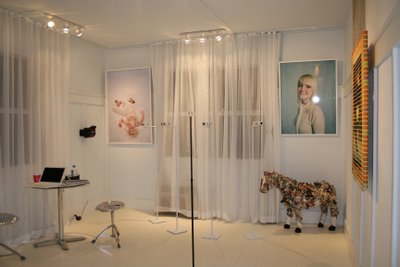
Flow Fair at the Catalina Hotel on Collins Avenue

Let me start with a disclaimer. I’m represented by two galleries that showed here: Kenise Barnes Fine Art, which included several of my paintings, and the Marcia Wood Gallery. But I’m not the only one saying nice things about this show and its galleries. Robert Ayers filed his December 8 Art Info report with this lead: "If we were to offer a "Fairest of the Fairs" award, then…Flow would be the front runner."

The virtue of a small fair such as this (and of Aqua Art, which I'll tackle in the next blog installment) is that it's just not possible to saunter and browse. Smaller exhibition spaces make for more concentrated viewing.

At PDX Contemporary Art I loved the work of Marie Watt, who reclaims materials for her geometric collages (you could also call them stitched paintings) and sculptures. I’ve seen this Portland, Oregon, gallery at other fairs and am always impressed with director Jane Beebe’s esthetic, which includes a strong object and textile sensibility

Marie Watt: Sculpture (wood) and collage (wool) from reclaimed materials at PDX Contemporary, Portland, Oregon

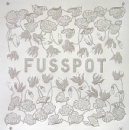
Across the hall, Miller Block Galley was featuring the work of, among others, Jane Masters, who creates embroidery-like drawings with a fine-pointed burning tool. I pulled this image from the gallery’s website because my own shots in the room were too blurry to use. (Low light and small quarters = many out-of-focus images.)

Jane Masters: Fusspot, burned paper, at Miller Block Gallery, Boston


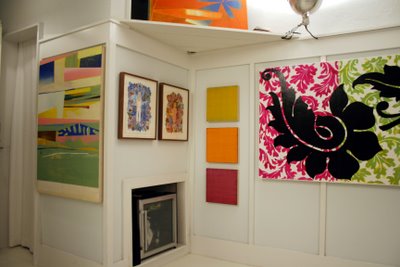
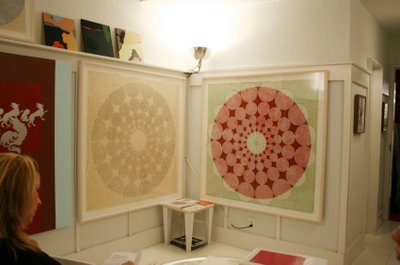
Kenise Barnes Fine Art featured an installation in which pattern and color prevailed: Margaret Lanzetta’s fern-and-floral arabesques, Tricia Wright’s geometric florals, Mary Judge’s compelling monoprint mandalas, and my own small, slub-textured color fields in encaustic.

You get an almost 360-degree view of the installation at Kenise Barnes Fine Art in this image and the ones below. From left: David Collins painting, Lucy Fradkin framed gouache figures on paper; my three Silk Road paintings; Margaret Lanzetta large-scale arabesques. Below: Kenise standing in front of a painting by Tricia Wright

Mary Judge's mandala monoprints at Kenise Barnes Fine Art, Larchmont, New York

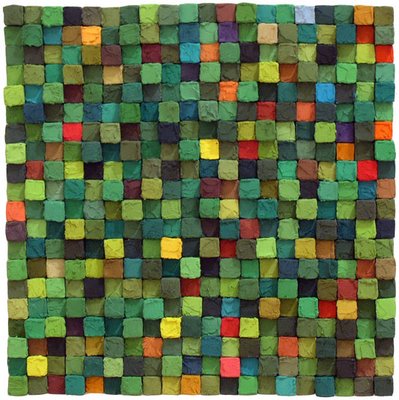
At the Roy Boyd Gallery, pattern and color also prevailed. This Chicago gallery shows a number of artists whose work never disappoints: Marcus Linnenbrink, Carlos Estrada Vega (see my mention of his work in the blog, Two Artists Talking) and Teo Gonzalez.

Here's Roy Boyd, sitting amid the Linnenbrinks

Carlos Estrada Vega: Walt, oleopasto on individual canvas-wrapped squares, 10 x 10" at Roy Boyd Gallery, Chicago

The installation at the Marcia Wood Gallery was all about the reward of seeing beyond the surface of things, from Peter Bahouth’s stereoscopic images that must be seen through a special viewer, to Devorah Sperber’s pixilated images viewed through a sphere (see my blog mention of her work in "The Centered Eye"), to Mary Engel’s made-you-look-twice animal-encrusted animals.

Installation at the Marcia Wood Gallery, Atlanta: Chris Scarborough pixel-manipulated photographs and Mary Engel animal sculpture. Harder to see are Peter Bahouth's viewing stands (in front of the window) and an oblique view of Devorah Sperber's pixilated installation with its viewing spere atop the dark stand in the middle of the picture. Below: a mono view of Peter Behouth's stereoscopic image, Lamb Henge

I also liked the installation of small semi-geometric abstractions in encaustic by Lenore Thomas at M% Gallery, and Eric Garduno’s small acrylic-sandwich geometric abstractions, inspired by Sixties LPs, at Linda Durham Contemporary Art, where they were displayed on a narrow ledge. "He likes to think of them as objects," says Durham.

Lenore Thomas's abstractions in encaustic at M% Gallery, Cleveland; below, Linda Durham with Eric Garduno's LP-inspired geometries on the ledge at Linda Durham Contemporary Art, Santa Fe

Word spread quickly that the Toomey Tourell gallery had sold everything early on. This San Francisco gallery has a varied program that includes abstraction and figuration, including the cartoony narratives of Heather Wilcoxon, the metallic color fields of Jimi Gleason and the map-like constructions of Matthew Picton. And with that good news I'll close this installment.

Below, Artist Matthew Picton and dealer Nancy Toomey of San Francisco's Toomey Tourell Gallery seated with Picton's cut-paper works over their left shoulders

Next up: All’s Fair: Aqua Art

All's Fair: Scope

The pedicabs were doing a brisk business shuttling visitors from Pulse to Scope and vice versa, but with the weather so nice and the distance between the two venues just blocks away, I decided to walk. There was no need for directions. I just followed the arrow: a big red balloon arrow marked Scope hovering over the tent.

(c) Joanne Mattera www.joannemattera.com

My favorite piece at the Scope fair was about Nothing. Not a Seinfeldian nothing but an elegant installation by Joseph Havel at Dallas's Dunn and Brown
booth composed of hundreds (thousands?) of custom-embroidered shirt labels pinned to the wall.


About Nothing: The installation (detail above) by Joseph Havel at Dunn and Brown Gallery, Dallas; Sam Reveles painting at left

The red Sam Reveles painting on the wall to the left was the perfect complement, not only chromatically but conceptually, as energetically sensuous as "Nothing" was formally cool.

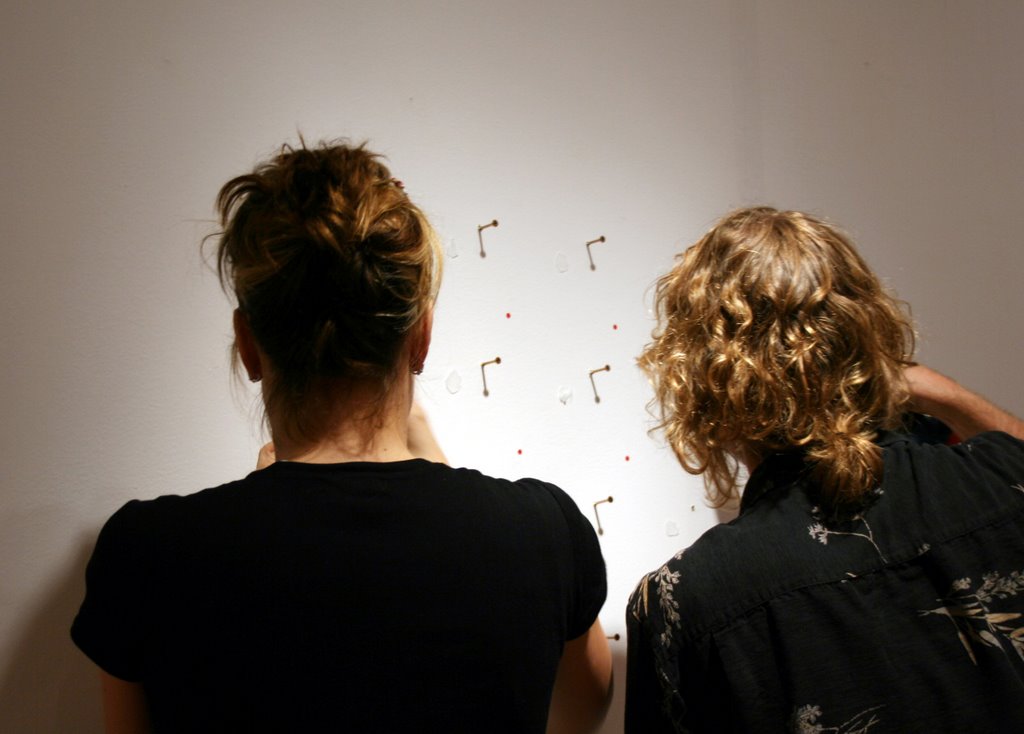
Then there was the grid installation, about three feet square, composed of black sheetrock screws and red dots. Oops. This one really IS about nothing. Whatever was there had been taken off the wall (sold, presumably). I shot the grid moments before the gallery personnel moved in to remove the screws.

Really about nothing: What's left after the work comes off the wall

At Las Vegas's Dust Gallery, I saw the pristinely reductive work of Marietta Hoferer. You can’t see this work too well in the installation shot below, so I’ve pulled an image from the artist's website. What you’re looking at is a work on paper composed of meticulously cut and placed strapping tape on paper. Such elegance from workaday material.

At Dust Gallery: An installation of six reductive works by Marietta Hoferer, all strapping tape on paper, with a related work below

Continuing with the elegantly minimal, I loved the work of Frank Gerritz at Pablo’s Birthday. Gerritz paints bands of dark color on thick sheets of steel. The brushstrokes are visible, a sensuous texture against the cool, milled metal. Gerritz just might be the lovechild of Richard Serra and Agnes Martin. Clicking this New York gallery’s link on the Scope website just kept looping back to Scope, so if you wish to see more, Google Frank Gerritz.

Frank Gerritz: Oil on metal, the painting/sculpture at Pablo's Birthday Gallery, New York


Add a shock of color to your reductive abstraction and you have the work of Paul Pagk at Moti Hasson Gallery. I get the sense that this is a painter who works slowly and purposefully. Each painting is dense with paint, but there's not one extraneous brushstroke, line or gesture.

Paul Pagk: Reductive imagery with a chromatically dense surface at Moti Hasson, New York
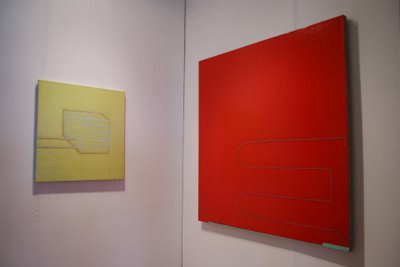

The geometric constructions of Lisa Sigal at Frederieka Taylor
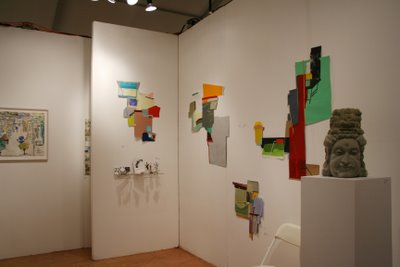
are neither painting nor sculpture but flat assemblages composed of layers of paper and tissue and other materials—freeform geometries that are ephemeral but muscular.
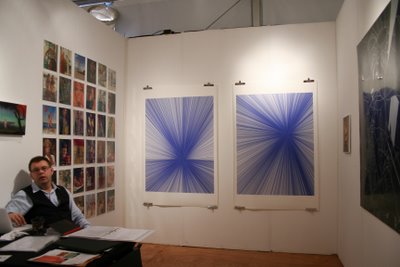
Lisa Sigal at Frederieke Taylor Gallery, New York

Other works I liked were 10,000 Lines to a Point at London's Carter Presents. Two works from a series of large-scale inkjet prints by Daniel Jackson were uniquely written to code—computer to printer--so that while all were related, none were alike. At Daneyal Mahmood, blue ink (via much handwork and many ballpoint pens) went in a different direction with Andrei Molodkin’s two soldiers embraced in a kiss in God is Great. Art Info reports that the Brooklyn Museum decided not to buy it for fear of offending its visitors but that the museum director, Arnold Lehman, purchased it for his own collection.

Working blue: Daniel Jackson's 10,000 Lines to a Point at London's Carter Presents, above (that's the dealer, seated); Andrei Molodkin's God is Great at Daneyal Mahmood Gallery, New York


At Patricia Sweetow’s booth, a collaged head by Jonathan Burstein was startling—equal parts delightful and freakish. I’m guessing this is the work of a recently minted MFAer. In any case, his collages are made from images taken from art magazines, a visual variant on you-are-what-you-eat.On the outside wall of the booth, below, you can see the sensuous geometry of Jane Harris. Harris’s show was in the San Francisco gallery when I was there last month. I’ve pulled an image from the gallery’s website so that you can see some of what I saw. Cindy Rucker was working the booth along with Sweetow—that’s Cindy seated. She’s about to open her own gallery on the Lower East Side: Numberthirtyfive (www.numberthirtyfive.com, when the website launches, which should be soon). Good luck, Cindy. Put me on your mailing list!

Outside the Patricia Sweetow Gallery booth: Jane Harris's twinned geometries, with Cindy Rucker, seated, above; an installation view from Jane Harris's recent show at Patricia Sweetow Gallery, San Francisco


And since I'm on the subject of gallerists, I’m going to close this post with The Proposition’s Ellen Donahue and Ronald Sosinski. Their booth had a large work by the hot young painter Mickalene Thomas, but for me it was the dealers themselves who stole the show with their his-and-hers patterned suits. "We’ve been in business together over 20 years, and this always happens," said Donahue. And no, she says, "We don’t plan it."

The pattern at The Proposition: Sartorially resplendent gallery partners Ronald Sosinski and Ellen Donahue, with their assistant

Next up: All's Fair: NADA