Pages

11.14.2006

Waxing Enthusiastic (and vice versa) in San Francisco and Sonoma


Over the past couple of years I’ve been traveling around the country to give workshops and consultations. Mostly I talk about career issues for artists and do individual consultations, but sometimes I hold Master Classes related to encaustic. I just got back from San Francisco and Sonoma where I offered some of each.

Back in April I was invited by Hylla Evans—painter, paintmaker (Evans Encaustics) and entrepreneur extraordinaire—to fly out to Sonoma to do a Master Class. It was an offer I couldn’t refuse. She said she would line up the participants and handle all the details. She did, and I went. Here’s a recap of the trip. . . . . . Cakes of paint at Evans Encaustics


Wednesday, November 8
I flew into Oakland and caught a commuter bus to San Francisco where I’d stay for the next couple of days. Flying West is a workaholic’s dream because you get to cram extra hours into a day—in this instance, a second afternoon. So my first order of business after checking into the Cartwright Hotel was to hit the galleries on Sutter, Post and Geary, more of which shortly.

In the evening, tired but still kicking, I met my longtime and dear friend Frank Wild for dinner. Frank is a DJ, art collector and world traveler. We were neighbors on 21st Street in Manhattan,
D.J. and friend, Frank Wild

and I love going to his Mission Street high-rise to see him. I also get to see his fabulous collection and a south-facing, almost aerial view of the city. In the living room are a luminous painting by Prudencio Irazabal, deep color achieved through layers and layers of translucent resin; gridded drawings by Sol Lewitt; and a relief sculpture in yellow beeswax by Jack Pospisil, whose surface is covered with hundreds of circle-and-cross impressions (made by casting or pressing philips-head screws), and much, much more, including a marvelous collection of black and white photographs of the male figure in action. Did I mention that Frank has my work in his collection? And not just in SF, but in his Miami apartment, where I’ll be hanging with Lewitt.

Detail of a beeswax sculpture by Jack Pospisil showing his signature texture
Thursday, November 9
Continuing with the all-art-all-the-time theme, I started the day at 9:00 am sharp at the Andrea Schwartz Gallery where I viewed Howard Hersh’s solo show. Howard met me there. Who needs the exhibition list when you’ve got the artist himself to give you the painting-by-painting tour?


At Andrea Schwartz: Howard Hersh, Double Take (2), encaustic on panel, 42 by 68 inches, 2006
Howard is a visual alchemist who combines geometric abstraction with a cursive gesture—he calls it a "tendril"—plying transparent, translucent and opaque elements into lyrical, deeply spatial compositions of poetry and order. His paintings are often comprised of multiple panels misaligned in a way that makes you think about their planar placement at the same time that you are acutely aware of the space within them. Howard works primarily in encaustic, the medium that brought me out West and will serve as the unifying element of this blog entry.

Howard Hersh in the studio

From the gallery we drove to his studio, Howard at the wheel of his little sports car. Like many artists at midcareer, Howard owns his loft. If there’s one thing artists can to make their tenuous place in the world a little more secure, it’s to own the spaces they live and/or work in. Howard's work-only loft was filled with big paintings, some in progress, others being readied to be shipped out. Howard’s working method includes a lot of pouring, and poured wax can be messy. There’s something of a topographical environment near his worktable—mounds and hillocks of wax that have accrued from successive pours. Ah, the things you see in the studio.

I met Cynde Adler for lunch. Cynde and her husband Jim are the principals of Adler and Co, the Post Street gallery that represents me in San Francisco. If you visit the gallery you’ll see my work on the walls. The Adlers’ vision is eclectic—modern (such as Hilla Rebay, painter and a founder of the Guggenheim) and contemporary (my buddy Jeff Schaller, whose pop-inflected images show his remarkable skill in encaustic).


At Adler and Co: Jeff Schaller, B, encaustic on panel, 12 by 12 inches, 2005, above; and Play, encaustic on panel, 24 by 24 inches, 2006
.
.
Later that day I met my blog buddy Chris Ashley at SF Moma where we spent the afternoon at the Anselm Kiefer exhibition, "Heaven and Earth." This is a beautiful show—intimate ideas (we are tethered to the earth and yet our spirits soar) on a monumental scale. Most of the paintings and sculptures are worked in common, even ugly, materials like mud, straw, seeds and lead, but there is a sublime sense of poetry in each work.

At SFMoma: Anselm Keifer, Buch mit Flügeln (Book with Wings), 1992-94; lead, steel and tin

At the museum Chris introduced me to several of his artist friends and later sent me links to their sites. Nancy White works in geometric abstraction. She summed up her focus in one word: "triangles," though her exploration of the shapes and the space they define (or are contained within) is subtle and richly varied. John Zurier paints monochromatically, reductively. He's represented by Paule Anglim, and in Philadelphia by Larry Becker. I'll be in Philly in a few weeks and will stop in to see more.
Nancy White: #19, gouache on pigmented paper, 10 by 12.875 inches, 2006. You can see more at www.nancywhite.net

After the museum, Chris said, "Let’s go to the Gay Outlaw opening at Paule Anglim." I went expecting to see work by a queer collective. But no. Sometimes you just have to leave your New York point of view in New York. Gay Outlaw is a sculptor, and a good one. The upper-case Gay is a woman; I have no idea about the lower case. Outlaw creates reductive sculptures with repetitive elements and a material bent—wood, plastic, felt, knitted fabric.
At Gallery Paule Anglim: Gay Outlaw, Three-Legged Intersection, 2006, plywood, milk paint, 48 by 64 by 64 inches

Chris and I have been blogging together since July. We should have marked our visit with a photograph so that I could have included it here—it’s only the second time we’ve met in person—but we didn’t. But I can show you a picture of his recent work. Next trip I'll take pictures of us, and I hope to visit his Oakland studio as well. In the meantime, you can read our blog at www.twoartiststalking.blogspot.com . You can also read's Chris's own weblog on his website, www.chrisashley.net

Chris Ashley: Three paintings titled Bojagi, oil on canvas, 2006. From left: 18 x 24", 20 x 16", 16 x 14"

.
Friday, November 10
Today was "Gallery Day." Painters Daniella Woolf, Eileen Goldenberg, Hylla Evans, Lissa Rankin (Californians all: Santa Cruz, San Francisco, Sonoma and San Diego, respectively) and I visited galleries around town.
Our first stop was at Himmelberger Gallery on Sutter, where David Himmelberger graciously ushered us into the back to show us the range and depth of his vision. It’s primarily contemporary European with forays into contemporary Californian, with a sensitivity to sculptural forms and tactile surfaces. Typically there's a reference to the figure, whether realistically or abstractly rendered.


David Himmelberger in his Sutter Street gallery

What was on display in that back room was not just the wide-ranging work (painting, sculpture, drawing and prints) of a midcareer Romanian artist named Drobitko, but the passion David brings to his job as gallerist. Any artist who’s ever complained about the gallery commission needs to see a good dealer at work representing his artists. It’s a partnership, and something of an art in itself.

We stopped into the Jenkins Johnson Gallery across the street where Sonya Sklaroff’s New York street scenes were on view. Sonya is a friend, a paint-everyday artist who supports herself from the sale of her work. Her rooftop views of Chelsea, looking west to the Hudson in late afternoon, are luminous and her street scenes are often reduced to their most graphic elements. I promise: you’ll never look at a water tower or a fire escape in the same way again.

At Jenkins Johnson: Sonya Sklaroff, Shoes Over Broadway, 30 by 20 inches, left; and Ninth Floor Panorama, 16 by 48 inches, both oil on panel, 2006

Continuing on Sutter, we stopped into Caldwell Snyder, a big gallery given to bold color and big visual statements. T.R. Coletta was on the walls. Roger Azevedo was the personable, well-dressed man behind the desk. With humor and an insider's point of view, Roger helped demystify the process by which dealers find artists, and by which artists might find dealers. ....


The entry to Caldwell Snyder Gallery on Sutter Street

We broke for lunch at Bangkok Best, a great little Thai restaurant at the corner of Bush and Kearny. (Good food, great prices.) Jackie Battenfield, New York painter, arts adviser and good friend in town on business of her own, joined us for lunch.


Then we headed off to 49 Geary Street, a SoHo-like building that’s home to a number of good galleries.
49 Geary Street, home to galleries such as Elins Eagles-Smith, Brian Gross, Haines, Gregory Lind, Don Soker and Patricia Sweetow

First stop there was Elins Eagles-Smith where we asked to see the work of Tim McDowell. Tim’s botanical images, rendered primarily in encaustic, are a glorious combination of lush and spare, abstract and representational, landscape and still life, and--to me--magic and reality. Here's how Tim describes them: "The metaphysical and the phenomenal in defining a sense of place that hopefully connects to the viewer's memory of place. "

At Elins-Eagles Smith: Timothy McDowell's Hearth, beeswax and pigment on panel, 48 by 40 inches, 2006

We also stopped in at Brian Gross, Gregory Lind, Toomey Tourell and Patricia Sweetow. At Don Soker, we looked at the work of Eleanor Wood, who creates spare and formal drawings of thread and wax. Don brought us into the back room so that we could see more work. He’s committed to artists who employ substantive materials: wax, graphite, concrete, glass, resin. The work is spare, usually, but counterpointed by a rich material presence.

At Don Soker: Eleanor Wood's spare, formal drawings in wax, paint and thread

Hylla wanted to see Howard Hersh’s show, so five of us piled into a taxi (you couldn’t do that in New York; four’s the limit) and drove down Second Street to the Andrea Schwartz Gallery. Having seen the work the morning before, I appreciated the opportunity to see it again at the end of the day. Andrea came out to chat briefly with our group.

If you’ll be in Miami during the fairs, look for Andrea's booth at the Bridge fair. You’ll also see Elins Eagles-Smith at Bridge, and Gregory Lind at Aqua Art. (I expect to be talking more about the Gregory Lind Gallery, one whose program I like a lot, in my Miami report, which will be posted in mid December.)

For our last stop, we walked back up to Mission. I’d arranged for Frank Wild to talk to the group about his collection—what he collects and why--so as we looked at his work, we learned how many of the pieces came into his collection. There were gallery visits, of course—he talked about the dealer-collector relationship—but also open studios and lots of on-line looking.

The group would reconvene the next day at my Master Class in Sonoma, so just after sunset I headed north over the Golden Gate Bridge with my host Hylla at the wheel. Hylla had arranged for me to stay at a loft in her complex. My head was on West Coast time, but my body was lagging three hours behind. After a tasty dinner at Cafe La Haye in downtown Sonoma, I crashed. The clock said 11:00 pm; my body said 2:00 am. And more to the point, it said, "Sleep."


Saturday, November 11
The main reason for my trip was to give a Master Class, a beyond-The-Art-of-Encaustic-Painting workshop. Twenty artists, most of whom work in encaustic, convened at the Sonoma Arts Guild for a day of Q&A, show and tell, and my slide talk, "2000 Years of Encaustic Painting."
Among the participants were Judith Williams, and Mary Farmer. Hylla is a well-oiled machine of organization, and the day came off without a hitch.
A small group followed the class with dinner at a Thai restaurant across the street (everyone was invited, but some folks had other plans). Dessert was at "my" loft, where a smaller group still—Hylla, Eileen Goldenberg, Cari Hernandez, Kathleen McMahon, Christine Towner and Daniella Woolf and I--satisfied our collective ice cream jones with fig and goat cheese gelato (hey, this is Sonoma) and some Ben and Jerry’s classics.

Sunday, November 12
Today was Consultation Day. Hylla scheduled five one-on-ones for me. I never get tired of consultations. Each artist’s work is different, and each artist’s career aspirations are focused differently—who wanting to show locally, who regionally, who looking to make a place in New York. It’s emotionally draining work, but at the end of the day I’m oddly energetic. Each artist has given me as much as I’ve given her or him.

Throughout the weekend I found time to hang out at Hylla’s loft. Hers is a robust live/work space dominated by double-height windows and a large work table. The tools of her trade—pigments and wax—are safely ensconced on one wall of cabinets. There’s a wall of small plein air paintings, and abstractions in encaustic everywhere else.

Monday, November 13
I arrived in the dark on Friday night and left in the dark on Monday morning (to catch the 5:45 bus to the Oakland airport), so I’m taking the locals at their word that Sonoma has a landscape of vineyards and lemon trees. Next time I hope to see it in the daylight.


What I didn't see in Sonoma

P.S. If you missed out on the weekend, Hylla is already planning two Master Classes and a day of consultations for me in November 2007, as well as several days of teaching her own workshops. She expects enrollment to be filled by early April. Contact her through the Evans Encaustics website. See you there?

11.02.2006

"Luminous Depths"

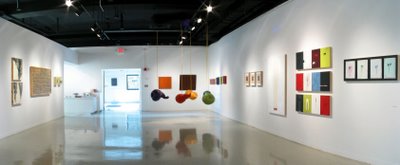
Two panoramas from the "Luminous Depths" show. Above, looking into the gallery, from left: Sylvia Netzer (suspended sculptures), Rachel Friedberg, me (Mudra on back wall), Diana Gonzalez Gandolfi; Megan Klim

I'm in a group show at the Ben Shahn Galleries of William Paterson University in Wayne, New Jersey, about 20 miles outside of Manhattan. Curated by gallery director Nancy Einreinhofer, it’s called "Luminous Depths: Six Women Explore the Ancient Art of Encaustic Painting." The six of us are Rachel Friedberg, Diana Gonzalez Gandolfi, Gail Gregg, Megan Klim, Sylvia Netzer and myself. The thematic element here is light. Encaustic—pigmented wax—is particularly suited to luminosity given that wax is almost ethereally translucent, and as light passes through the layers of paint and is reflected up through the surface, an encaustic painting is essentially illuminated from within. Each of us explores that luminosity in a different way, though abstraction is another unifying element.

Below, looking toward the entry, from left: Megan Klim, Gail Gregg, Sylvia Netzer, Rachel Friedberg

Apropos of the exhibition’s title, someone at the opening asked if women comprised a majority of artists working in the medium. I don’t think so. This show happened to be six women, but from my experience writing The Art of Encaustic Painting, I’d say that wax is less about gender than it is about sensuality and process. If those things turn you on, you're drawn to the medium, whoever you are. Sylvia Netzer is the sculptor in the group. Her fired clay forms, gourdlike in shape, are cloaked in bright wax. They are suspended from yellow rope to within a few feet from the floor, yet they seem to hover, belying the weight and substance of their materials.

Sylvia Netzer's wax-covered clay forms, foreground, from The Baby Barry Family; Gail Gregg's paintings and relief sculptures, including Reisling, second from right, and One Way, right

Gail Gregg's forms emerge slightly from the wall, satisfyingly mysterious. Closer inspection reveals that the forms, symmetrical, geometric and topographical, are in fact carton separators laid flat or fast food containers given a healthy new life as art.

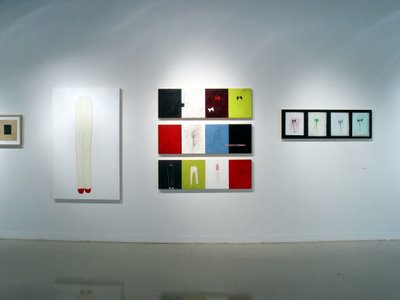
Rachel Friedberg's work is figurative in the most reductively abstract way. There are bowties, neckties, trousers and spats along with full-body forms that suggest Cycladic figures or even mummies. The imagery might be a comment on maleness, or the role of males in society, but those reductive forms suggest something about transitional states.

Rachel Friedberg's paintings and work on paper

Diana Gonzalez Gandolfi combines geometric abstraction with softer organic shapes. Four paintings, almost twice as long as wide--like windows--open a metaphorical window into her personal iconography.

Four paintings by Diana Gonzalez Gandolfi, including From March to March, second from left, and Hidden Truths, second from right

Layered and netlike, Megan Klim's work was new to me. The paintings were different from one another--one grid based, two landscape like, two biological forms with an erotic charge. Klim seems to be feeling her way through the medium. It's a welcome reminder that wax is a process-intensive medium, and that we are all in some way indebted to the process.

Megan Klim's paintings, back wall on the right

I showed a grid installation of 21 small paintings from my Mudra series, as well as a diptych of larger proportions. Nancy Einreinhofer writes in the catalog: "The build-up of drops of wax signifies the passing of time, a real passing as well as a metaphorical one. The poetry of time passing is seen in the light captured in the layers of wax, seemingly frozen in the medium like a seed in amber." You can see more from my Mudra series on my website.

Joanne Mattera: Big Mudra, left; installation grid of Mudra

After the opening, Nylvia Netzer, Christopher Knowles and I entered the newly dark evening. We'd turned the clocks back the night before, and by 5:00 all daylight was gone. But the moon, a perfect half slice, lit up the sky. "It's a waxing moon," said Christopher. A perfect complement to the show.

"Luminous Depths" is up through December 1. The Ben Shahn Galleries are open Monday through Friday, 10:00 a.m. to 5:00 p.m. Here’s the link for directions: http://ww2.wpunj.edu/aboutus/directions.cfm (click onto the campus map, and you’ll see that the Ben Shahn Center is building #9).

There is a catalog.

Post-exhibition addendum: Paintings from my Mudra series are now at Simon Gallery in Morristown, NJ.

Mudra 24, 12 x 12 inches, encaustic on panel, 2004

10.02.2006

The Centered Eye

Devorah Sperber, After Van Eyck

5,024 spools of thread, stainless steel ball chain and hanging apparatus, clear acrylic viewing sphere and metal stand; 104 x 100 x 60"

.

At the 212 Fair this past weekend, I spent time at the Marcia Wood Gallery booth which showed some of my Silk Road paintings. The hit of the booth was the wall-size installation by Devorah Sperber, who creates large-scale pixilated portraits. The "pixels" are spools of thread suspended in vertical rows with the wall as a backdrop. The image is so diffuse because of its scale and inverted orientation (and your proximity to it) that it doesn’t register visually until you peer into a small acrylic sphere centered about 5 feet in front of the installation. The sphere is perfectly aligned with the central eye of the portrait, which is perfectly aligned with the central axis of the work. There a clear and beautifully nuanced right-side-up portrait appears.

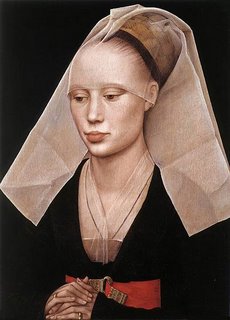
I mention the centered-eye portraits—that is, three-quarter-view portraits in which one of the eyes falls at the central axis of the portrait --because after spending part of the weekend looking at portraits, indeed it appears to be true. Another thing you never learned in art school. A recent study of the portraits of 282 artists--drawn from diverse cultures over five centuries--finds that the eye is central to the vertical axis of a painting to within an eye width in virtually every instance. You can read the study for yourself: http://www.ski.org/cwt/CWTyler/PrePublications/ARVO/1998/Portraits/ and http://www.ski.org/cwt/CWTyler/PrePublications/ARVO/1998/Portraits/

On her website, Sperber talks about both the physiology of seeing and the theory of centered-eye portraits. You can see more of her brilliantly conceived and beautifully executed work there as well. I've posted a few examples here:


Michelangelo Self Portrait; Sofonisba Anguissola Self Portrait, 1554; Tiziano's portrait of Cardinale Pietro Bembo, 1540

Rogier van der Weyden, Portrait of a Lady, 1554

There's also Leonardo's Mona Lisa, Vermeer's Girl with a Pearl Earring, and many of the Fayums. On Friday, while visiting the Met’s early Renaissance paintings with my friend, the painter Kay WalkingStick, I mentioned this centered-eye theory, and as we looked, portrait after portrait followed this form. Perhaps it is simply a visually intuitive way of creating an image that looks you in the eye, whether or not the sitter is actually looking back at you, satisfying a human need for equilibrium and harmony.

Or perhaps it was a trade secret passed along from painter to painter. Talk about a Da Vinci code: "Sfumato schfumato, Leonardo. The secret to making a haunting portrait is to make sure one of her eyes aligns directly with the central axis of the portrait. Pass it along."

Leonardo Da Vinci, Mona Lisa, 1505

Even Picasso, who broke with the conventions of painting, didn't stray far from this one:

Picasso, Weeping Woman, 1937

9.14.2006

"Luminosity and Emotional Juiciness"

Above, from left: Uttar 294, 36 x 36 inches; two paintings from Vicolo, each 12 x 12 inches; and an installation of Silk Road paintings, each 12 x 12 inches
Below, from left: Uttar 295, 36 x 36 inches; Uttar 298 and Uttar 296, each 24 x 24 inches; all paintings encaustic on panel, 2006

While the actual painting for an exhibition is finished by the time the exhibition is installed (though sometimes just barely), there is much to be done after the fact. On Saturday, a few hours before I gave a talk about my work to a nice turnout of artists and collectors, I shot the installation. Yesterday I edited and Photoshopped the pictures, and today Cate McQuaid's review, "A Clever Pairing," appeared in The Boston Globe. I've excerpted her review below:

"Wax and rubber have certain things in common--a tactile similarity, a translucence--that make the two solo shows by Joanne Mattera and Niho Kozuru at Arden Gallery a clever pairing.

"Mattera's encaustic paintings involve pouring layers of pigmented wax one over the next, building up and scraping away to create pieces of brilliant color that catch the light in surprising ways. She lays her emotive tones over grids, bringing order to the expressiveness. Her understated, lovely "Silk Road" series features several foot-square panels, each monochrome, and each bearing the texture and luminosity of silk.

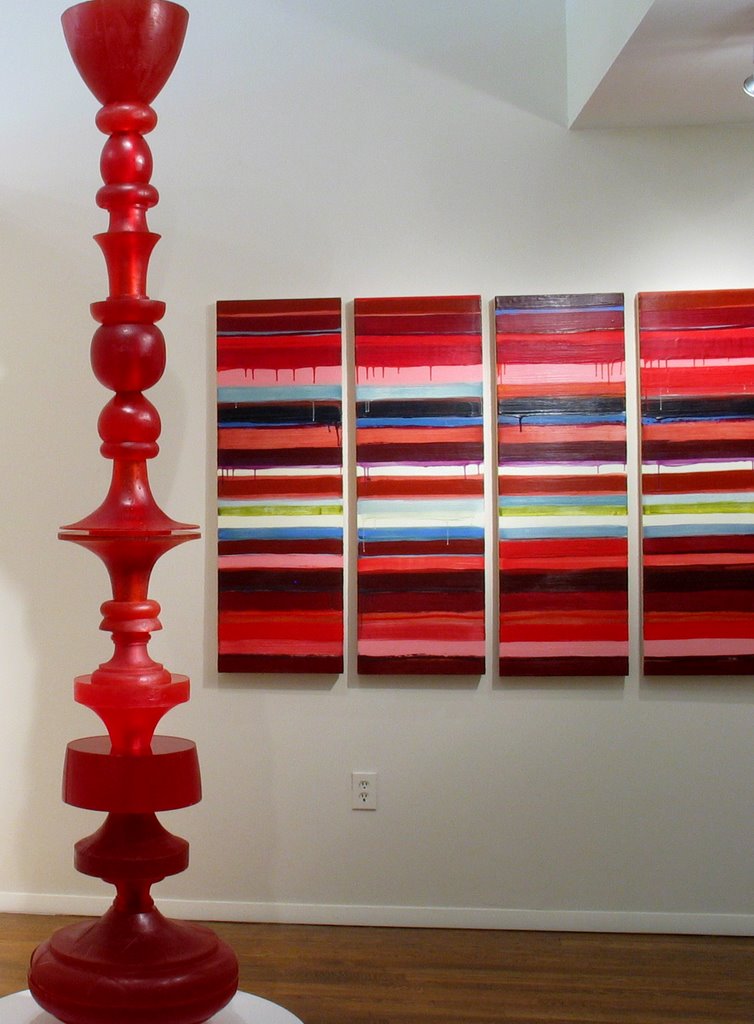
"In her "Uttar" series, she borrows tones from Indian miniature paintings. "Uttar 295" sports a checkerboard of blues with an occasional watery rose. The squares drip, leaning into one another like keening women at a funeral.

" Mattera's stacked lipstick reds appear in columns in "Uttar 295 (Ciel Rouge)." It hangs beside Kozuru's "The Rising Column," made of cast red rubber; the two make a gorgeous installation. "The Rising Column"... shares not only the soft texture of Mattera's work but the wonderful conflation of crisp, traditional form with luminosity and emotional juiciness."


.

.

.

.

.

.

.

Uttar 294 (Ciel Rouge), 48 x 67 inches; foreground: Niho Kozuru, Rising Column, cast rubber

Uttar 295, encaustic on panel, 36 x 36 inches, 2006

9.09.2006

Acrylic as a Second Language

Pressed with the need to create a painting for the big front window of Arden Gallery for my September

Installation: Quadrate 1 in the window of Arden Gallery on Newbury Street, Boston

solo, I pulled out some old acrylic paints and brushes, purchased two gallons and several large tubs of gel, set up the easel, and immersed myself in a medium I hadn’t touched in over a decade.

Normally I paint in encaustic, but I didn’t want to put a wax painting in the gallery's window because I wasn’t sure what the trajectory of the sun would be in late summer and thus how hot the window area would get. (Wax + intense heat = puddle.)

I've been involved with encaustic for so long that the wide variety of gels are a new (to me) development in acrylic painting. I had the idea that by mixing acrylic paint with polymer medium--the way I mix encaustic paint with wax medium--and by applying clear layers of the polymer medium to create physical and optical depth, I might achieve something of the substance and luminosity of encaustic.

Well, I did. And I didn't.


Quadrate 1, acrylic on canvas, 48 x 48 inches, 2006

Once I got over trying to make an "encaustic painting" in plastic and gave into the idea that I was making an acrylic painting, I got into the process. There are some similarities between what I'm doing in the two mediums. The acrylic paint dries almost as fast as the wax paint cools, and by using combinations of no gel, some gel or a lot of gel--mostly semigloss--with various paints that are by nature opaque or semi-transparent, I can create some of the same play of opaque, translucent and transparent hues that I do with wax, with something of the same built-up texture. And, of course, I'm still making the same kinds of paintings: repetitive geometric compositions whose focus is color.

But there are differences. Unlike molten wax, which literally flows off the brush, acrylic paint mixed with gel is slippery; it needs to be pushed, pulled or dragged across the canvas. Since I normally work on panel, I’d forgotten about the "boing" of the canvas; I feel as if I’m painting on a trampoline. While I can wipe or scrape the acrylic while it’s in a plastic state, working it after it has begun to polymerize is messy and gooey. The paint was not meant to be worked that way. Yes, it’s always interesting to push a medium into new places, but scraping a semi-polymerized surface is literally ripping the skin off the painting. It doesn’t yield the way wax does. In fact the yielding surface is one of the reasons I turned to encaustic.

I’m not about to give up encaustic any time soon. Wax is an extension of my hand. But working in a second medium is like speaking a second language. Your ability to get around in the world, and certainly to communicate, increases immensely. Particularly with regard to larger-scale painting, acrylic lets me "speak" upright at the easel with fluency and to transport the work with relative ease. So we’ll see where this goes.

I certainly have enough gel left.

9.07.2006

Post-partum Abstraction

I have just delivered a show, and I'm recovering from post-partum abstraction.

It happens just after the work leaves my studio. It’s the huge emotional, psychic and physical depletion that follows the long preparation of a show. After working 12-hour days for months--a steady, though not necessarily painful labor--I am in an empty studio completely drained. I’m not moving fast enough, but at the same time, I can barely catch up to myself.

Artists of all sexes know what I’m talking about. It takes a huge amount of energy to go into the studio to paint every day. A delivery date looms. And then, in the exhausting weeks just before the show when most of the work is finished, you want to do just one more painting because there’s a surge of energy and inspiration yet to emerge. I don’t have children, but I’d guess it’s like pushing out 15 babies and then, wait, there’s one more—no, I think it’s two—ready to slide.

While the eighth child is crowning, there are a dozen little (and not so little) administrative things that must be done. I’m fortunate to work with galleries that install beautifully and take care of all the details. Still, the work needs to be shot and Photoshopped before it leaves the studio. There are postcards to send out, personal notes to write, and an inventory list to make. Did you get my "Joanne’s Art News?" I sent that out late last week.

Today I clean the studio and work out the palettes for the next couple of paintings. I said that yesterday. I’ll probably say it tomorrow.

Next week I’ll be back to my regular self and the maternal metaphors will be shelved until the next delivery—which will be in March.

9.05.2006

Unexpected Commonalities

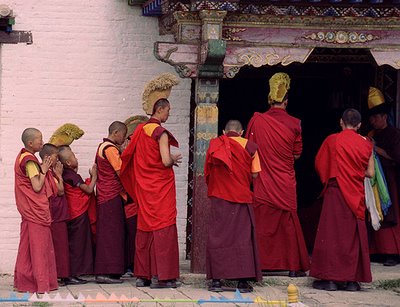
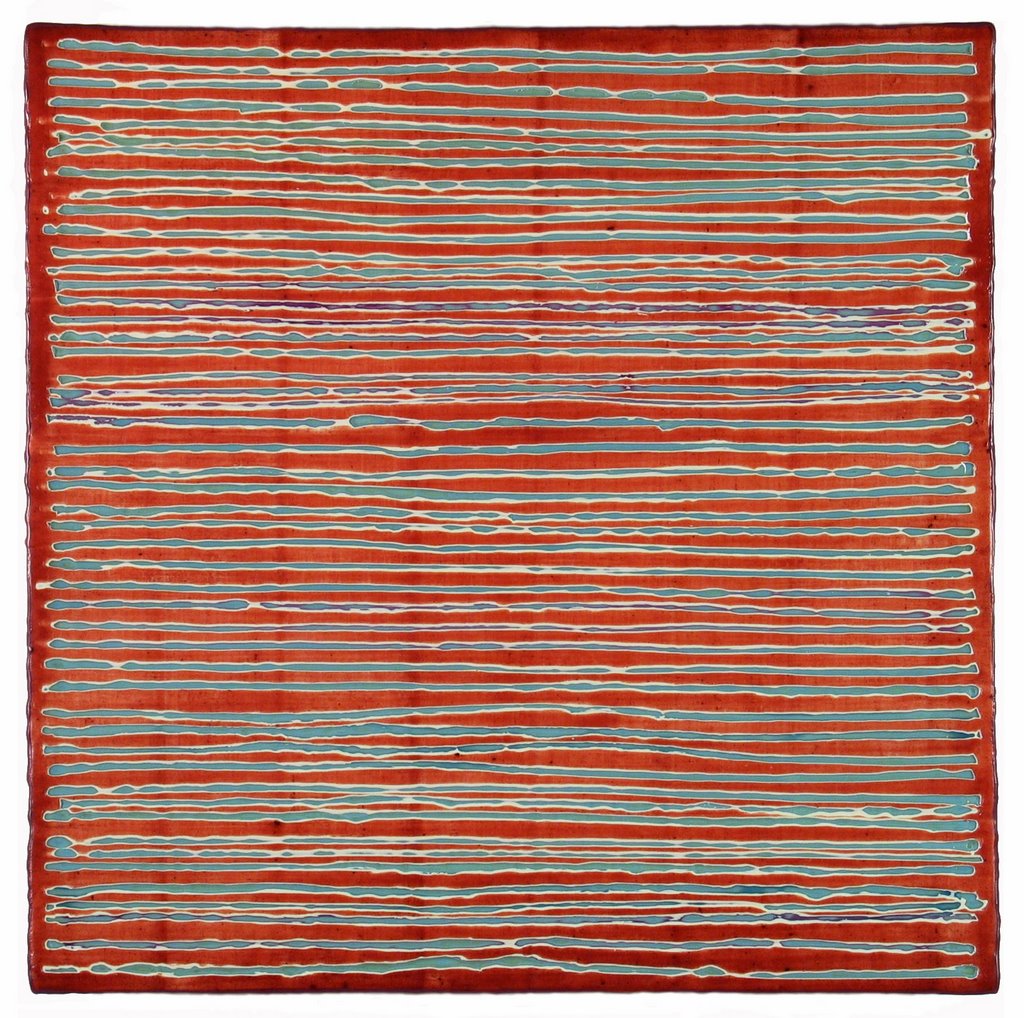
On one of my periodic image surfs of the web, I came across this picture of Buddhist monks in Bhutan (or maybe it was Tibet). It's a lovely picture, but what shocked me was the palette. On the easel in my studio was the painting you see below. Not only does it have an almost exact palette, the color relationships are in almost the same proportion, too. If you scroll the window so that you see the bottom of the photograph and the top of my painting, you'll see just how proportionate those relationships are. Perhaps I was a Buddhist monk in a previous life?


Quadrate 2, acrylic on canvas, 48" x 48", 2006


I made this painting in acrylic. That's a change for me. In a subsequent post, I'll talk about working in a different medium.

9.02.2006

Heat of the Moment


Uttar 298, encaustic on panel, 24x24 inches, 2006


For years I’ve described my painting as lush minimalism. Occasionally I think about coming up with another description, just to keep the signifier as current as the work, but nothing resonates as well as those two little words. The thesaurus is no help. "Succulent reduction" sounds like a sauce de cuisine; "drunk negligibility," like grounds for arrest. And "voluptuous insignificance" just reeks of a bad Internet translation. Geometric abstraction is a good umbrella term for what I do, but it lacks the specificity to describe my particular version of it, which is a sensuous surface married to the austerity of the grid. Fortunately, my visual explorations have yielded more satisfying results than the thesaurus. Tilling a formalist field, I’ve produced three series over the past six years. Uttar, inspired by the brilliant palette of Indian miniatures and the small paintings of Renaissance Siena, continues apace motivated by some force within me that keeps finding new reasons to combine blocks and stacks of color. There are almost 300 paintings in this series—the most recent of them in this exhibition. You might think, "How much can you do with those simple geometric elements?" It’s no longer a matter of the broad gesture—if it ever was at all—but of the variations, painting to painting, within the series. Working serially lets me explore the subtleties of an idea. Inevitably there are changes along the way. I’m not totally in control; things happen in the heat of the moment.


I like how Uttar, while retaining its own identity, has shown me the way to two other series: Vicolo and Silk Road. Italian for "narrow passage," Vicolo exists for

Vicolo 25, encaustic on panel, 18 x 18 inches, 2006

its skived and riven layers. Much of each painting is hidden in layers, and only the act of dragging a metal tool across its surface exposes some of what is beneath. Sometimes I float new color into the channels I have created, and I may then scrape those back. I’ve often referred to my work as a controlled version of the unexpected, and nowhere is that more true than here, for despite my concentration and planning, the painting reveals itself as I work.

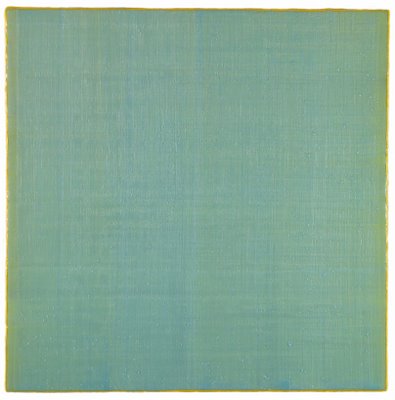
Silk Road, my newest body of work, is the most reductive series I’ve ever done. Each painting is a luminous monochrome achieved by applying layers of translucent paint at right angles. Actually it’s not quite the monochrome it appears. Each painting has about 20 layers and five or six different hues. Working in encaustic, pigmented wax, I apply the paint when it is molten. I could mix colors on a hot palette—the Teflon griddle that holds my paints—and sometimes I do; but mostly the color mixing takes place in your eye as the layers of color, sometimes as disparate as yellow and purple, coalesce into one hue. While you’re up close, you’ll see that the subtlest of grids is formed by the trail of brushmarks and intentionally grainy elements within the paint. The suggestion of iridescence and fabric came after the first few paintings were done. The series just named itself. What else to call it but Silk Road? I’ve limned each painting to charge the intensity of its color field and intensify the square shape of each painting. The paintings are typically installed in a grid.

Silk Road 82, encaustic on panel, 18 x 18 inches, 2006

It would be disingenuous to say that a show titled "Heat of the Moment" is just about the fleeting moments of creative ecstasy in the studio. It’s about the way I work. I paint primarily in encaustic, and encaustic requires elevated temperatures—hotplates to melt the wax, a heatgun to fuse the layers of paint once they are laid down. Painting in encaustic permits but a tiny window of opportunity to get a paint-laden brush from the heat source to the surface of the painting before the wax cools and the brush gets stuck. I didn’t choose encaustic because I wanted to make an already difficult calling even more difficult by adopting a process-intensive medium with unyielding parameters. I was drawn by the materiality of the paint, the lushness of it. And by the luminosity. Like a moth to a flame.


8.19.2006

In the Bay of Naples: Ischia and Procida

In this post we head out to two islands in the Bay of Naples. From the port you can see Capri, a soft gray lopsided rock straight ahead in the distance. Everyone goes there, so we’re not.

We’re going to Ischia and Procida (www.ischiaonline.it and www.procida.net if you know Italian; http://en.wikipedia.org/wiki/Ischia and http://en.wikipedia.org/wiki/Procida if you don’t). The islands aren’t far from shore, but to get to them you need to take a ferry (90 minutes) or hydrofoil (35 minutes) and head about 12 miles north-ish. You arrive at tiny Procida first, make a brief stop to drop off or pick up passengers and then make the 10-minute hop to Ischia.

A digital panorama of Ischia Porto, the port, with Monte Epomeo in the distance

Ischia

Ischia is first. It’s lopsided like Capri, but bigger--and thankfully free of boldface names--with Monte Epomeo dominating both the profile of the island and the island itself. There’s a thriving tourist and spa life ringing the island—every town, commune, along the water has its own port and its hotels with thermal waters.

But up the mountain there’s life as it’s always been lived, with modest homes, each with a backyard vegetable garden, lemon trees, and a rabbit pen—rabbits, coniglie, being the chickens of the island. I know this because some 15 years ago I went up the mountain to Serrara Fontana to visit Zio Mario and Zia Maria, my father’s uncle and aunt, in their modest house with a wood cookstove and a semi-outhouse (you walked through the courtyard to get to it, but it had running water). Zia Maria kept a big vegetable garden and raised rabbits. I’m a vegetarian, but I ate her pasta with rabbit sauce because you can’t refuse food at an Italian meal (no actual rabbit though; I've been vegetarian for too long). Despite their 19th- (or 18th- or 17th- or 16th-) century way of life, they were very much connected to life in the late 20-th century. They received CNN on the tube, which they accessed via telecomando, the remote. Their adult kids had jobs in Pisa and in Belgium, and their grandson, also named Mario, who drove his motociclo all over the island, had a late-20th-century American vocabulary: Winston, playboy, Levi’s 501 jeans. (When I set up my scanner, I’ll post some images from this trip.)

The homes are modest, but the color schemes are not. This house is in Serrara, up the mountain. The road to Monte Epomeo is at right.

At sea level, the Island is ringed by lovely towns: Ischia Porto (the port), Casamicciola Terme and Lacco Ameno (site of many thermal spas) , Forio, Sant’Angelo, and Ischia Ponte, whose pedestrian causeway links it to a 12th century fortress, the Castello Aragonese, on a rock of an island. You won't find too many Americans without family ties to the island, because few residents speak English, but those intrepid spa-going German tourists are out in force, and just about everyone on the island has learned German to be able to cater to them. Tourism appears to have made the whole island wealthier—there’s a better dock, new buses that connect the island efficiently and on time, and renovations on even the smallest homes and shops. But it pisses me off when I'm given a menu in German. Italiano, per favore.


The authentic and the touristic: A cobbler's shop, closed for the afternoon break, above; Sapori d'Ischia, Flavors of Ischia, open for the tourists all day (the food is authentic, though)


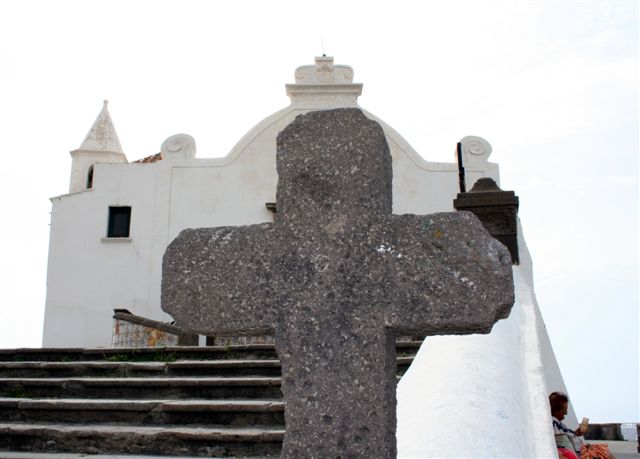
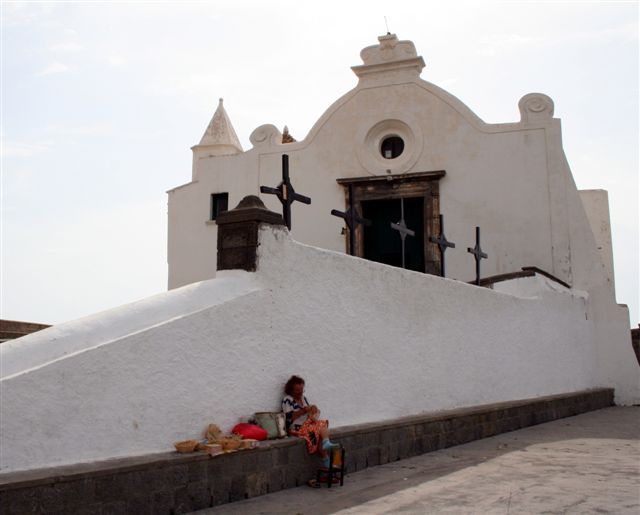
Forio is my favorite commune. The town is modestly scaled, and while it has all the conveniences of modern life (I bought a chemical ice pack for a sprained knee at a clean, modern farmacia ) it also has the beautiful fourteenth-century Chiesa del Soccorso, where seagoers and their families prayed to Santa Maria of the Ships for a voyage’s safe return. The church is nothing like those big baroque marble-and gilded structures you find in Napoli. It's a modest whitewashed building decorated on the outside with a wall of tiles and on the inside by models of ships, ex votos, offered in thanks for those safe voyages. The church is constructed on an immense and solid rampart of a foundation, all the better to withstand the force of the sea, which it overlooks. It appears Greek in style because its builders--the founders of Ischia--were Greek. And just as Napoli has an original Greek name, Neopolis, so does Ischia: Pithecusa.

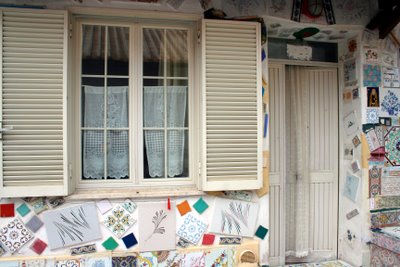
The facade of the Chiesa Del Soccorso is plain except for the formally patterned tiles accenting its stairway. The tiles on the facade of the house, below, are the polar opposite--an asymmetric, wildly vernacular expression of pattern and color. The last time I was here, the woman of the house was standing in the doorway wearing a geometrically patterned dress. It couldn't have been more perfect


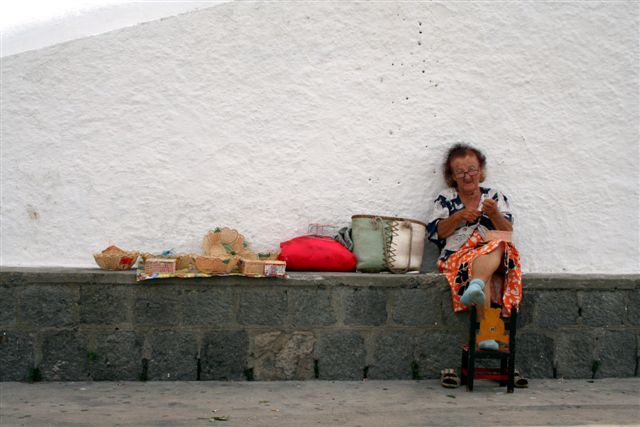
Working in her al fresco studio at the wall abutting the church--see her at left, below--this woman makes baskets


.
.


.
.
...Someone took the time to sample a multitude of colors for the door of a garage that is set into a hillside. I love that the swatches almost assume the shape of Italy on the map. I shot this on the road to Sant'Angelo

.

Do you remember the film, "The Talented Mr. Ripley"—the Anthony Minghella-directed 1999 film from the Patricia Highsmith novel? The story was set outside Naples, but some of the scenes were shot on the island. Some Internet souces say it’s Ischia Porto, but it looked like Forio to me.

Procida
I know for sure that "Il Postino"--from 1994, the story of the town postman who befriended the poet Pablo Neruda in exile--was shot on Procida, Ischia’s tiny neighbor. Like Ischia, Procida was founded by Greeks around the 8th century BC. It can be toured in an hour, though of course, that’s a typically touristic thing to say. People live their whole lives savoring every square centimeter of the place. But as a return visitor who was bringing friends there for the first time, I wanted them to get a sense of the place before we took the ferry back to Napoli.
We hired a driver. I needed someone who spoke Italian, rather than the more regional Prodcidano, a dialect unintelligible to me, as I was translating. I found Antonio, whose initial brusqueness mellowed into warmth as we drove around the island together. Here are some pictures of the island.

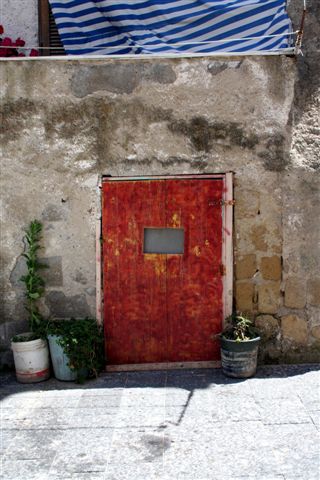
On Procida: A doorway near the Abbey of San Michele


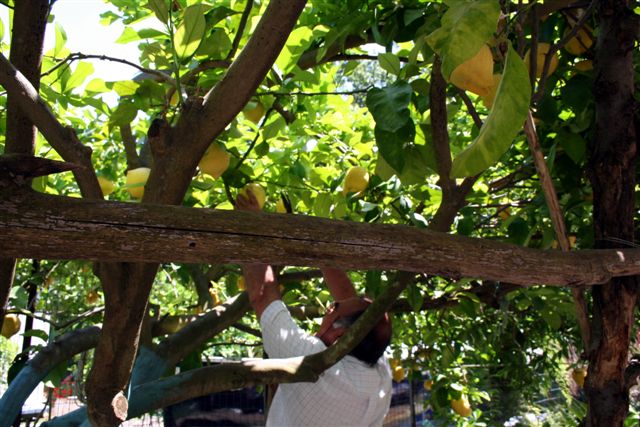
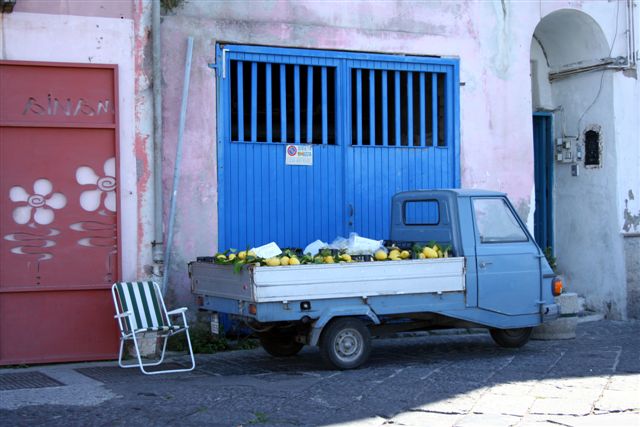
Our driver picking grapefruit-size lemons; at the port, a three-wheel truck loaded with the fruit

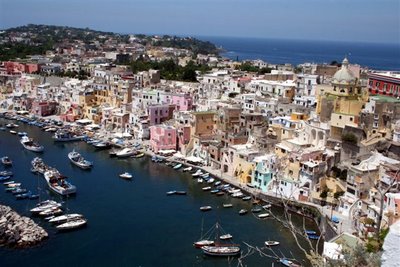
Santorini? This is a tourist shot looking down on the port of Chaiolella. The architecture appears Greek because it is--built by Greeks who inhabited the island long before it became part of the Citta di Napoli


8.04.2006

Soggiorno a Napoli

The bella and the brutta of Napoli: sublimely beautiful buildings; the traffic so heavy it takes to the sidewalk. These buildings are on Via Toledo, the main street that connects the Capodimonte Palace, high above the city, to the porto and the glorious Bay of Naples below

I ’ve been all over Italy in the past 25 years, but Naples—Napoli— is where my heart is. It’s where my DNA is, too. Everyone there looks like a cousin. Grandma Josephine (Giuseppina) was from a hill town above the city; Grandpa Antonio was from the island of Ischia (you can’t see the island from the port as you can Capri; Ischia is off to the north, a 40 minute ride by hydrofoil, but still part of the city of Napoli).Napoli itself is the personification of Yin and Yang, Italian Style. It’s big, noisy, hot, congested, dirty—and sublimely beautiful. Povery exists check by jowl with extraordinary wealth, like the renovations going on next to crumbling buildings, or the generosity of a shopkeeper (‘ssage, ‘assage, dialect for "have a taste,") in direct proportion to the taxi driver who tells you the meter’s broken and then charges you double what would have been on it.

Open city: I love how the door to the pizza display swings out onto the street

I go there in early spring when the mornings are cool and the churches remain refreshingly so all day. A classic cultural mosaic, Napoli started life as a Greek outpost, Neopolis—"new city"—several millenia ago, and over time was built up by the Romans, and in recent centuries by the Spanish who ruled it for two hundred years. The architecture reflects all of this. You can, for instance, leave the Spanish Baroque (and the motorini, the motor scooters, and the Smart Cars) of street level and descend to the remnants of a Roman street and shops, and below, that, to the stones of a Greek road.

The ubiquitous lines of laundry hanging overhead are a metaphor for Neapolitan life. Everything is out in the open: the immodestly clothespinned underwear, the shop displays dramatic as stage sets, the gelato machines pushed aggressively out into the middle of the sidewalk. It’s not unusual to see families sitting down to dinner, napkins tucked under chins, in a kitchen that’s open to the cobblestoned streets. On the streets, the motor scooter is an al fresco stationwagon holding the driver, a passenger, a couple of kids and the groceries.

More life on the street. A theater set? No. A family is assembled on the steps of a church for a photo op (how convenient for me) for a boy's First Communion. The horse and carriage is a dramatic touch, no?

Even the inside is outside. This is the Cloister of Santa Chiara, cool and quiet, despite the noisy street life of Spaccanapoli on the other side of the walls. The majolica tiles are unusual in that they depict Neopolitan life, not scenes from religious life. It's a museum now. You can see orange trees and grape vines on the grounds

Animated conversations take place on street corners, and from balcony to street level, and from motor scooter to sidewalk, and via wireless, as the talkers gesticulate wildly to one another—or to the air in front of them when a cellphone is involved. I know this sounds like a cliché, but it’s not. (When I was a kid, my parents would say, "Don’t talk with your hands." They might as well have been saying, "Don’t walk with your feet." It just can’t be done in Southern Italy or its diaspora.)

Down by the water, seagoing life is surprisingly well scheduled as ferries and hydrofoils pull in and out of the port. (Except for the sciopperi, the one-day strikes that take place just when you want to go somewhere.) In Santa Lucia, the picturesque orignal port increasingly crowded by restaurants, muscular old guys painting their boats stop to flex for a tourist—is this real life or theater? Oh, right, it’s Napoli, so real life is theater.

I've never been here when the shrine to Santa Lucia wasn't freshly painted. The fisherfolk take care of her--and she of the them, at least the faithful. "Without me you can't do a thing," says her plaque

Maybe this is where my stripes come from?

Italy is a Latin country, and south of Rome, you really feel the passion, the color, the heat. Hispanic Latins have son and salsa; Iberian Latins, flamenco and fado. Italian Latins, the Neapolitans in particular, have their songs of heartbreak and longing, and the opera of the stage and the street. The languages and expressions are different by degree, but these are cultures cut from the same passionate cloth.

Next post: The Islands in the Bay