Pages

Showing posts with label Gail Gregg. Show all posts

1.08.2008

On the Geometric Trail in Chelsea

There was a wealth of geometric expression in Manhattan last month. I photographed some of it. Then I went to Miami for the fairs and spent the subsequent two weeks blogging about them. I was prepared to let this New York report go--one has only so much time, after all--but in reviewing the images, I realized the work was too interesting to ignore. I made time. If you don’t go to New York regularly, I suppose it doesn’t make all that much difference when you see these shows en blog; and if you did see the shows, well think of this post as a bit of 2007 déjà vu all over again.

.

.
Bridget Riley: Recent Paintings and Gouaches
at Pace Wildenstein
.
Of course you know Riley’s work. She shot to fame in the 60s with eye-blazingly, undulatingly graphic paintings that practically created the genre of Op Art. She’s mellowed. The colors are Monet-esque and the geometry is larger, more sinuous than searing. As you would expect at this gallery, the work was big--but it was an invitation to see, not a challenge. A catalog is available. Click gallery website for more info.
.
Above: The central gallery at Pace Wildenstein. The work on the right is painted directly onto the wall. The painting visible through the doorway to the far gallery orients you to the installation below
.

.
.
.
Gail Gregg: Recent Paintings
at Luise Ross
.

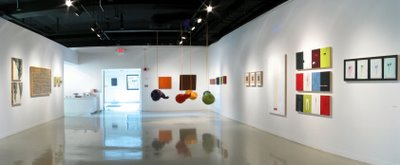
Gregg has taken the lowly packing carton and turned it into geometric abstraction. Her symmetric shapes, reminiscent of totemic images, are from flayed carboard boxes, carton dividers, cup holders—the stuff of our throwaway culture—all coated with wax. Some works hang as relief sculptures; others are laid onto a wax ground. Technically these latter are more assemblage than painting, but painting embraces everything these days, and Gregg is a painter with a great sense of compostion and color.

You can see more at the gallery's website and at www.gailgregg.com

Installation view of Gail Gregg's show at Luise Ross

Below, a work from the show

.
.
Polished and Pressed: Bill Thompson and Peter Weber
at Thatcher Projects
.
First I liked the title, with its suggestion of neatness and order. Then I liked the work: relief sculptures that played shiny against matte, rounded edges against sharp, crease against smooth. Thompson has the polished work: geometric wall sculptures carved from urethane, many of which glisten with layers of, I’m guessing, automotive-type paint. Weber has the pressed work: felt objects that have been folded and formed into geometric order, like weave patterns under a microscope. See more at the gallery's website.
.
.
.
.
Polished and Pressed at Thatcher Projects: Bill Thompson, above, and Peter Weber, below
.

.

.

The Geometry of Seeing: Elaine Lustig Cohen
at Pavel Zoubok Gallery

Although I knew of Cohen’s work, I hadn’t realized the breadth of it. Thanks to the show at Pavel Zoubok and the impressive catalog with it, I saw a range of Cohen's work in this 40-year retrospective. Painter, collagist, sculptor and graphic designer, she has worked within a hard-edge idiom that has traversed fluidly within her various modes of expression. See more on the gallery's website.

A second part of this exhibition was held at the Julie Saul Gallery. I didn't get there, but you can visit the website to see more work.

The Geometry of Seeing: Elaine Lustic Cohen at Pavel Zoubok Gallery. This view looks into the gallery from the entry

Below, a view behind the desk

.

Alberto Burri at Mitchell-Innes and Nash through January 19

When you hear arte povera, you think Merz or Kounellis. Burri? Who knew? The exhibition is a 40-year-plus survey of the artist, who died in 1996. The work is varied but the constants are the materials--commonplace stuff like plastic, Celotex wallboard, burlap, clay--and a geometric sensibility that threads its way through the material and the years. Not surprisingly, Rauschenberg cited Burri as an influence. Read more and see additional images at the gallery website.


Above: Alberto Burri installation view

Below: Oil and gold leaf on Celotex--a little ricca with the povera


Next post: The geometric trail continues below Houston

11.02.2006

"Luminous Depths"

Two panoramas from the "Luminous Depths" show. Above, looking into the gallery, from left: Sylvia Netzer (suspended sculptures), Rachel Friedberg, me (Mudra on back wall), Diana Gonzalez Gandolfi; Megan Klim

I'm in a group show at the Ben Shahn Galleries of William Paterson University in Wayne, New Jersey, about 20 miles outside of Manhattan. Curated by gallery director Nancy Einreinhofer, it’s called "Luminous Depths: Six Women Explore the Ancient Art of Encaustic Painting." The six of us are Rachel Friedberg, Diana Gonzalez Gandolfi, Gail Gregg, Megan Klim, Sylvia Netzer and myself. The thematic element here is light. Encaustic—pigmented wax—is particularly suited to luminosity given that wax is almost ethereally translucent, and as light passes through the layers of paint and is reflected up through the surface, an encaustic painting is essentially illuminated from within. Each of us explores that luminosity in a different way, though abstraction is another unifying element.

Below, looking toward the entry, from left: Megan Klim, Gail Gregg, Sylvia Netzer, Rachel Friedberg

Apropos of the exhibition’s title, someone at the opening asked if women comprised a majority of artists working in the medium. I don’t think so. This show happened to be six women, but from my experience writing The Art of Encaustic Painting, I’d say that wax is less about gender than it is about sensuality and process. If those things turn you on, you're drawn to the medium, whoever you are. Sylvia Netzer is the sculptor in the group. Her fired clay forms, gourdlike in shape, are cloaked in bright wax. They are suspended from yellow rope to within a few feet from the floor, yet they seem to hover, belying the weight and substance of their materials.

Sylvia Netzer's wax-covered clay forms, foreground, from The Baby Barry Family; Gail Gregg's paintings and relief sculptures, including Reisling, second from right, and One Way, right

Gail Gregg's forms emerge slightly from the wall, satisfyingly mysterious. Closer inspection reveals that the forms, symmetrical, geometric and topographical, are in fact carton separators laid flat or fast food containers given a healthy new life as art.

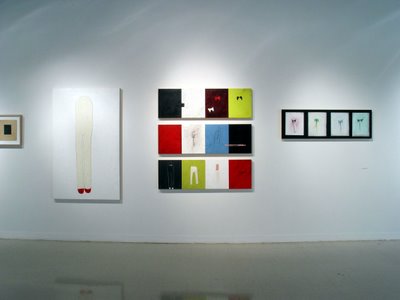
Rachel Friedberg's work is figurative in the most reductively abstract way. There are bowties, neckties, trousers and spats along with full-body forms that suggest Cycladic figures or even mummies. The imagery might be a comment on maleness, or the role of males in society, but those reductive forms suggest something about transitional states.

Rachel Friedberg's paintings and work on paper

Diana Gonzalez Gandolfi combines geometric abstraction with softer organic shapes. Four paintings, almost twice as long as wide--like windows--open a metaphorical window into her personal iconography.

Four paintings by Diana Gonzalez Gandolfi, including From March to March, second from left, and Hidden Truths, second from right

Layered and netlike, Megan Klim's work was new to me. The paintings were different from one another--one grid based, two landscape like, two biological forms with an erotic charge. Klim seems to be feeling her way through the medium. It's a welcome reminder that wax is a process-intensive medium, and that we are all in some way indebted to the process.

Megan Klim's paintings, back wall on the right

I showed a grid installation of 21 small paintings from my Mudra series, as well as a diptych of larger proportions. Nancy Einreinhofer writes in the catalog: "The build-up of drops of wax signifies the passing of time, a real passing as well as a metaphorical one. The poetry of time passing is seen in the light captured in the layers of wax, seemingly frozen in the medium like a seed in amber." You can see more from my Mudra series on my website.

Joanne Mattera: Big Mudra, left; installation grid of Mudra

After the opening, Nylvia Netzer, Christopher Knowles and I entered the newly dark evening. We'd turned the clocks back the night before, and by 5:00 all daylight was gone. But the moon, a perfect half slice, lit up the sky. "It's a waxing moon," said Christopher. A perfect complement to the show.

"Luminous Depths" is up through December 1. The Ben Shahn Galleries are open Monday through Friday, 10:00 a.m. to 5:00 p.m. Here’s the link for directions: http://ww2.wpunj.edu/aboutus/directions.cfm (click onto the campus map, and you’ll see that the Ben Shahn Center is building #9).

There is a catalog.

Post-exhibition addendum: Paintings from my Mudra series are now at Simon Gallery in Morristown, NJ.

Mudra 24, 12 x 12 inches, encaustic on panel, 2004