Pages

12.14.2006

All's Fair: NADA

I wouldn’t want to belong to a group whose acronym is the Spanish word for nothing. (Especially because the buzz for this show was less than kind.) But I’m not a member of the New Art Dealers Association, so what do they care about my opinion. And I certainly wasn’t going to let a little nattering negativity keep me from going. Though it would be the last of three big shows I saw on Saturday, I soldiered on. And I’m glad I did. There was a lot I liked.

© Joanne Mattera www.joannemattera.com
If only I could read my notes to tell you about it. In the fog of art overload I omitted artists’ names, wrote illegibly, and shot bad digital images. In fairness to my photographic skills, the Ice Palace is a venue with uneven lighting. What’s worse, whole sections of booths are blurred in my memory. (I’ll do better with Bridge, coming up.) But I did do some after-the-fact gallery surfing on the web and found material to help fill out this post.

The path into the Ice Palace, a big barn of a building where NADA is held, is lined with hammocks. Thirty minutes in one of those slings would have gone a long way to clearing up my cranial fuzz. Photo is by the emerging photographer David Schoerner

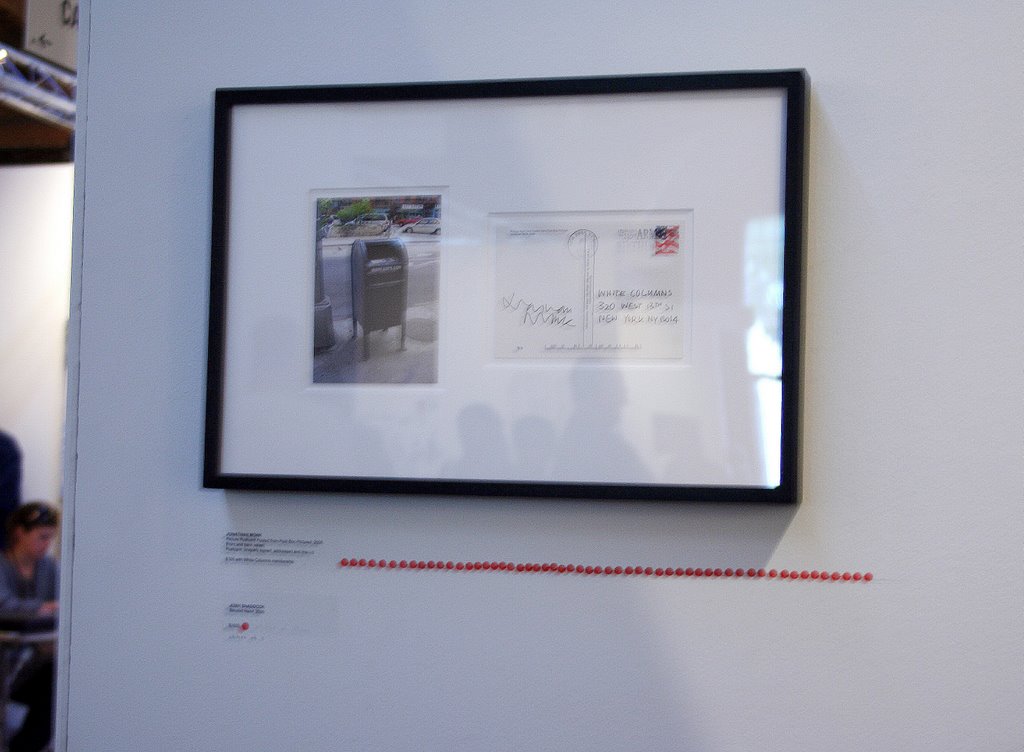
First stop was at the White Columns booth, where the prints always sell well. See what I mean: .

I liked the luminous "bone" curtain in cast resin at Elizabeth Dee Gallery, New York. Looking now at the gallery’s website, I think it’s by Virgil Marti.

The bone scrim in cast resin (by Virgil Marti?) at Elizabeth Dee Gallery, New York

And I liked the quilt-like abstractions by Mette Winckelman at Copenhagen’s Galleri Christina Wilson—some paintings, others paper-and-cloth collages under glass.

Mette Winckelman: geometric abstractions at Gallerie Christina Wilson, Copenhagen

On a Scandinavian roll, I liked three small framed paintings by Haavard Homsvedt at Brooklyn’s Southfirst Gallery. These paintings were built up from the swipes and wipes of the artist’s brush, a la Scott Richter. But these are as quiet as Richter's are brash. (Heidi Cho Gallery has two wonderful Richter paintings at Scope.)

Havaard Homsvedt at Southfirst Gallery, Brooklyn

..

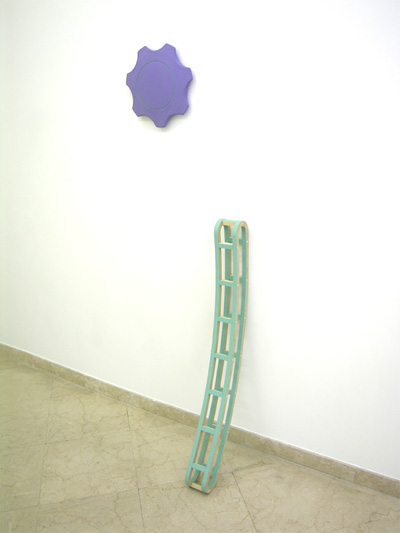
Following the thread of material sensibility, I really liked the work of Olivier Soulerin at Atelier Cardenas Bellanger, Paris. A corner of the booth contained wrapped armatures, painted sponges, and household fabrics used as the canvas for the artist’s unstretched paintings. The lovechild of Mario Merz and Martha Stewart, maybe? Though my pictures were not good, the gallery has some good images, two of which I reproduced left and right.

Olivier Soulerin: Untitled wall piece, resin and acrylic on mixed media, 12 x 12 x 2", and sculpture against wall, Echelle, 42 x 4 x 5", left; Eponge, synthetic sponge and acrylic paint, 5 x 6.5 x 2.5"; all 2005, at Atelier Cardenas Bellanger. Below, a corner of the gallery's booth at NADA

At the booth for Los Angeles’s Mary Goldman Gallery, Rob Fischer deconstructs not only the materials of his sculpture but the space it occupies. The piece here suggests a spatially reconfigured hallway that holds the wall and floor.

Rob Fischer sculpture at Mary Goldman Gallery, Los Angeles

At Boston’s Samson Projects, I watched a transaction taking place. Frame one: Young man in shorts and t-shirt studies the small figurative paintings at left and asks if he can take the work with him. Frame two: Gallery owner Camilo Alvarez comes over and chats with the potential collector. Yes, the work can be taken. Sold.

Looking and buying at Samson Projects, Boston

Artists who labor under the studio responsibilities of making the art, promoting it, and handling administrative, janitorial and delivery duties will appreciate the Samson Gallery staff as described in the NADA catalog: "Camilo Alvarez: Owner/Director/Preparator/Curator."

Last up: All’s Fair: Bridge

All's Fair: Bridge

For this last installment of "All’s Fair," we go back across the causeway to Miami Beach and the Bridge Fair. With its 65 galleries, Bridge took place in the Catalina Hotel, occupying the larger of the hotel’s two buildings (Flow resided in the smaller one). I didn’t hear much buzz either way about this new event, but running in the middle of the pack is not a bad position for a fair’s first year.

© Joanne Mattera www.joannemattera.com


Of course the top spot in the Miami hierarchy goes to Art Basel Miami Beach. The number-two position seemed to be split between newcomer Flow and second-year Aqua. Surely it’s not coincidental that the two smallest fairs got some of the biggest attention. After the mega-dose of art at the Convention Center, there was a visual and visceral need to scale down and experience art on a smaller scale.
Bridge boasted excellent galleries from around the country: Andrea Schwartz, Brian Gross and Elins Eagles-Smith from San Francisco; Pentimenti from Philadelphia; Kidder Smith and Howard Yezerski from Boston, and Rice/Polack from Provincetown, a tiny lick of land (with several very good galleries) at the end of the long curling arm of Massachusetts. The New York galleries included Chelsea’s Sundaram Tagore, which occupied the lobby, as well as SoHo’s Nancy Hoffman and Brooklyn’s Metaphor Contemporary.

If you're going to show art in small hotel rooms, the white walls and floors here were perfect. But the lighting was not well thought out (some dealers brought their own illumination, but others scrambled to install aluminum bowl reflectors, and still others used, with unsatisfactory results, the pole lamps that came with the room). Between the lighting and the small spaces, I found it difficult to photograph in the little rooms. In a few instances I went to a gallery’s website for images.
.
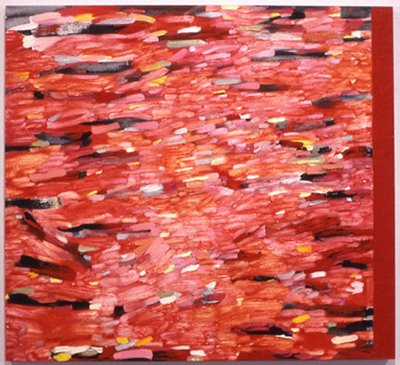
Following the map on the venue's two floors, these were the highlights for me: In the lobby, color dominated. This was the exhibition space of Sundaram Tagore, New York, which showed Natvar Bhavsar’s saturated color fields and Judith Murray’s large-scale, brushstroke-y abstractions.
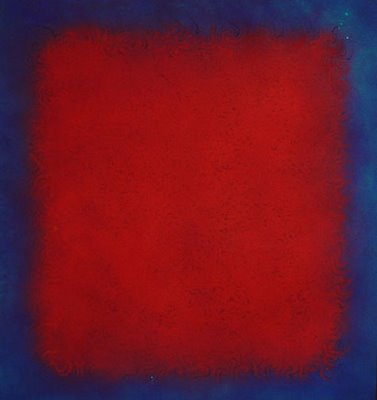
Natvar Bhavsar: Bhandraa, pure pigment on canvas, 67 x 68", 2005 (above); Judith Murray: Fusion, oil on linen, 41 x 45", 2004; images from the Sundaram Tagore website

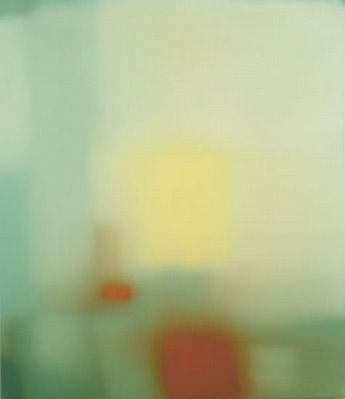
At Metaphor Contemporary Art, Brooklyn, I liked Mary Judge’s monochromatic monoprint mandalas, Manfred Mayerle’s tiny gouache grids, and gallery partner Julian Jackson’s light-infused abstractions.

Mary Judge: monoprint from the Rose Window Series, 48 x 48" (above); Julian Jackson: After Vermeer, oil on canvas, 76 x 63", 2006, both from the Metaphor website
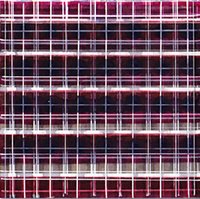
Manfred Mayerle: from the series For All We Know, ink, watercolor, and gouache on paper mounted on aluminum, 6.75 x 6.75", from the Metaphor website
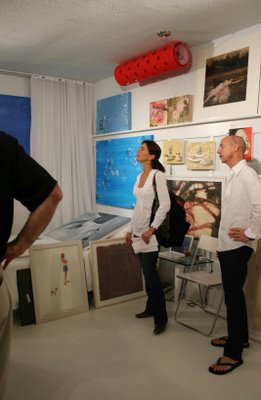
Looking at work in the Metaphor Contemporary room

At Kidder Smith, Boston, I liked Cheryl Goldsleger’s smallish black and white geometric paintings in encaustic with elements of relief sculpture, David Moore’s linear color fields and Jimi Gleason's atmospheric light-refractive paintings.
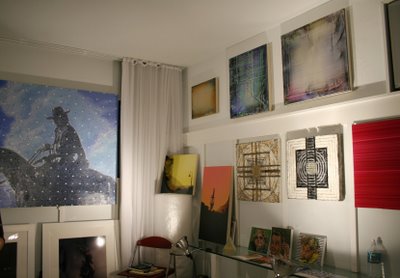
A view of the room for Kidder Smith Gallery, Boston


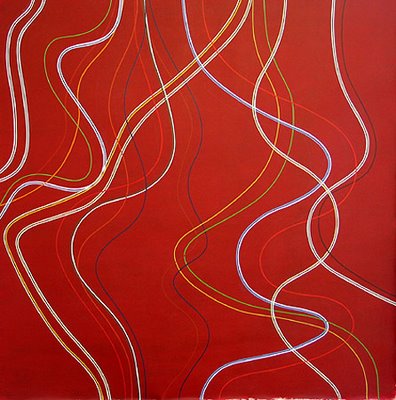
At Hogar Collection, Brooklyn, the fluid geometries of gallery partner Cecilia Biagini dominated.
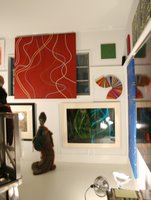
Installation view of the Hogar Collection room, above; and gallery website image of Meandering, by Cecilia Biagini

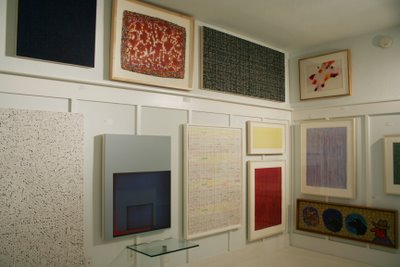
Upstairs, working my way in the same counterclockwise direction, I stopped in at the room of Brian Gross Fine Art, San Francisco. Its organized installation and formal work--paintings by Teo Gonzalez and Marco Casentini; works on paper by Jill Baroff, Stephen Sollins and Andrea Way--resonated on my frequency.

Andrea Way: detail of For Renee, ink on paper, 30 x 22", 2005
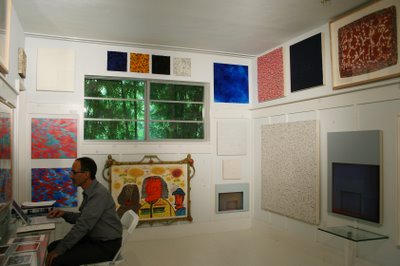
Two views of the installation of Brian Gross Fine Art, San Francisco; that's Brian Gross seated at the desk, above
Pentimenti Gallery, Philadelphia, has a strong program with restrained pattern and geometry in equal measure. At the fair I liked, among other work, Kevin Finklea’s reductive geometry, shown below.
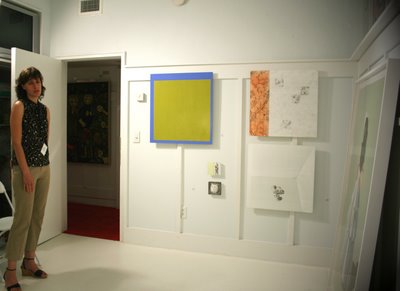
Christine Pfister, Pentimenti's owner and director, in her room at Bridge


At Howard Yezerski Gallery, Boston, I particularly liked Malham’s Cove, a small deeply spatial and atmospheric diptych, by the reductive abstractionist Paul Shakespear
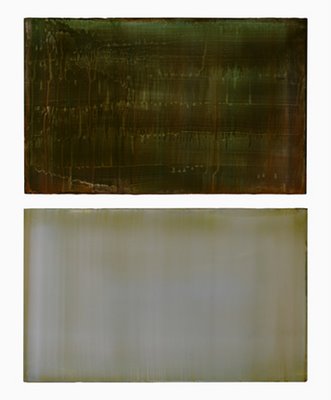
Paul Shakespear: Malham Cove, 2006, acrylic on wood, 20.75 x 16.75 at Howard Yezerski Gallery, Boston


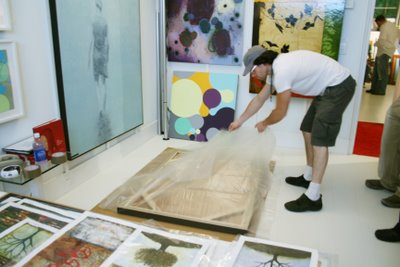
At Melanee Cooper Gallery, Chicago, there were paintings in encaustic by two artists whose work I like, Tremain Smith and Kathleen Waterloo, and sensuous circles in oil and gouache by Julie Gross.
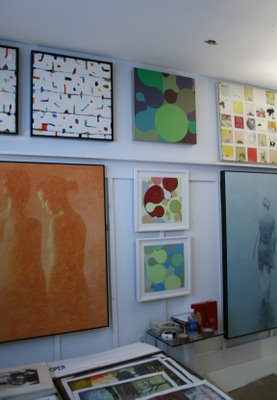
Two views at the Melanee Cooper Gallery: circles in oil (top) and gouache (framed) by Julie Gross, above; a painting being packed for delivery
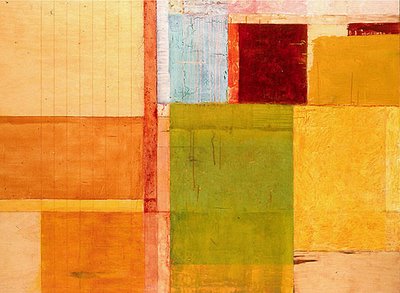
Tremain Smith's work was installed in the hallway outside the Melanee Cooper room, impossible to shoot, so I pulled this painting from the artist’s own website: My Great Prakriti, encaustic on panel, about 48 x 60

My shots of Andrea Schwartz’s room were too blurry to publish, so I pulled this image of John Berlingheri’s coolly ebullient painting, Diphthong Cobalt, to show you. Do you remember it? It was the far left wall, as you walked in.
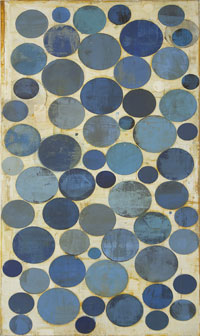
John Berlingheri, Diphthong Cobalt, oil on canvas, 60x36, at Andrea Schwartz Gallery, San Francisco


At Provincetown’s Rice/Polak Gallery I liked the black and white paintings of Berndt Haussmann. Suggestive of chalkboards, his surfaces are in fact a thin layer of rubber mounted to panel on which he has worked his signature lyrical gestures in a retstrained palette.
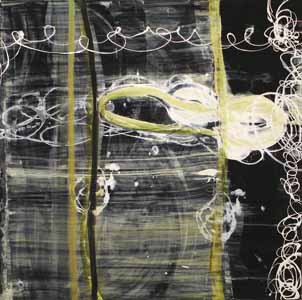
Berndt Haussmann: from The Blackboard Series, 21 x 21", oil on rubber-mounted panel, from the Rice/Polak Gallery website


Here's Marla Rice, director of the Rice/Polak Gallery, in her exhibition room


I have no pictures of the Elins Eagles-Smith Gallery exhibition room. It was a corner space, with big paintings (by Johnnie Winona Ross and Ricardo Mazal) always full of people. So I just pulled an image of a work by Mazal from the gallery's website to show you.
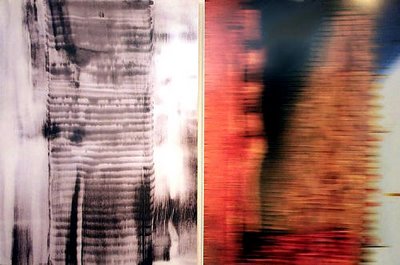

Ricardo Mazal: Untitled Diptych, mixed digital process, 41 x 61.5 inches, collaboration with photographer Gary Mankus, from the Elins Eagles-Smith website

By Saturday evening the exodus began. I stuck around until Sunday, visiting The Big Fair one more time with my friends Gloria De Sole and Meredith Butler. We made time for lunch at the Botanic Gardens across from the Convention Center, and I departed for the airport in late afternoon. I’ll leave you with one final image from Miami, shot by Joseph Poras on Tuesday, December 12, in Collins Park, with the Containers barely visible in the background:
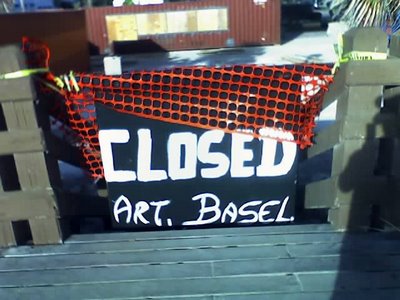
December 12, 2006: The party's over. Photograph courtesy of Joseph Poras

See you next year.

www.joannemattera.com
www.joannemattera.blogspot.com
www.jmschedule.blogspot.com

12.05.2006

Six Hours in Philadelphia on Sunday

After the dozenth, "Sorry we have no rooms," and an uncomfortable number of, "Sorry we have no rooms in your price range," I decided to fly to Philadelphia for the day instead of driving down and staying over. The Winged Goddess must have been a kind mood because I found a round trip on US Air for $124—cheaper than the cost of gas.

My impetus for making the trip was the Sunday, December 3, opening of the "Gigantic Small Works Show" at t
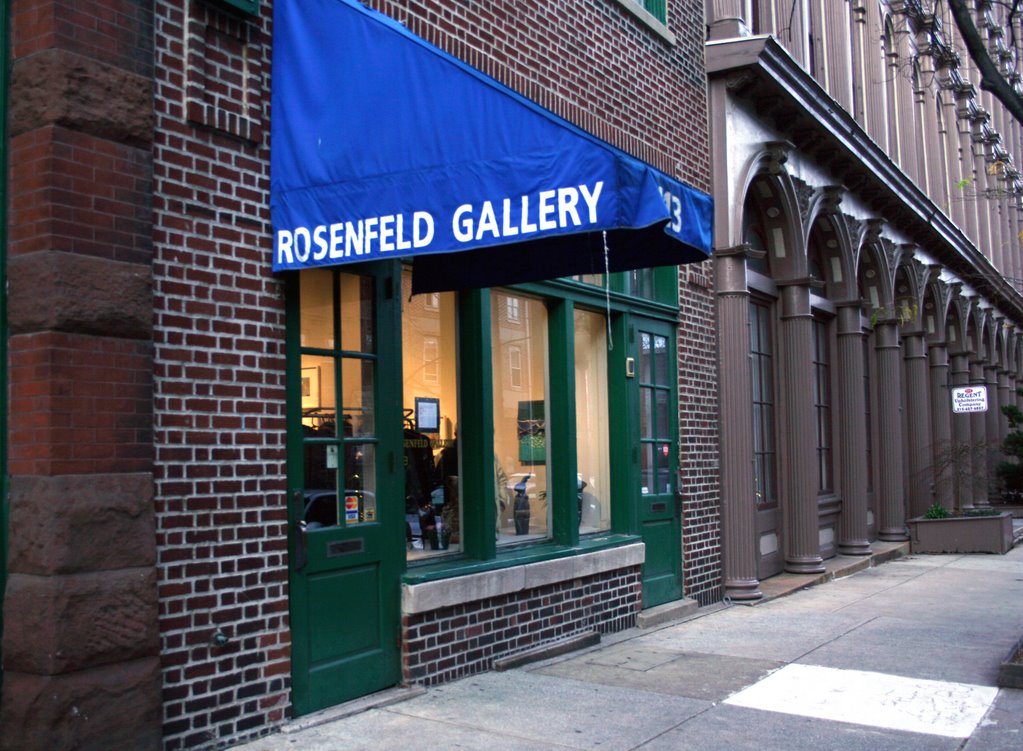
he. . . . . . .. . Rosenfeld Gallery, where I’m participating. The Rosenfeld Gallery is on Arch Street, a few doors down from the Betsey Ross House. It’s as large and rambling as the Ross house is teeny tiny. There’s about 2000 square feet of narrow-but-deep exhibition space in the ground-floor venue. It reminds me (in the best way) of SoHo in the early days: dark wood floors, white display panels over brick walls, and an emphasis of art over architecture. For this exhibition—an annual event at the gallery—about 30 artists showed over 120. .
. .
That's my painting, Uttar 247, in the center of the picture above
works in various media. The opening was from noon to 5:00 p.m. The space comfortably accomodated art, artists and the guests who kept arriving all afternoon.

Two views from the opening at Rosenfeld Gallery on December 3


One of the things I like about Philadelphia is the collegiality among artists and dealers. Last May, when I was in town for the "Order(ed)" show at Gallery Siano, I’d visited the Rosenfeld Gallery to see Tremain Smith’s work. Unbeknownst to me, Tremain had mentioned me to Richard Rosenfeld, the owner, so when I introduced myself to the softspoken bearded man behind the desk, it was Richard, and he was familiar with my work. Long story short, he invited me to participate in this show. I love when that happens.

I stayed at the opening until 5:00 pm and then took a taxi back to the airport and flew home. But I’ve got to backtrack to my arrival because I’m leaving out a chunk of the story.

When I landed at 11:00 am, I took a taxi to Minimal Works on Chestnut Street in Center City. There I met the gallery’s owner, Dennis Towers, a man with a passion for reductive work, and he opened the space for me to take a look (it’s normally closed on Sunday). I have five paintings and some


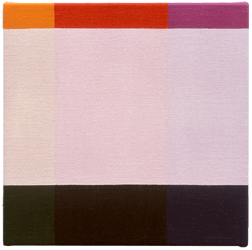
Above, Sharon Brant: Untitled, 24 x 24", acrylic on panel, 2002. Below, Siri Berg: Small Bars One, 12 x 12", oil on linen, 2006

work on paper in the gallery. Moreover, I have Richard Rosenfeld’s good wishes about participating in the project, just as I have Dennis’s good wishes about my involvement with the Rosenfeld Gallery. This is what I mean about collegiality.

Minimal Works is unique as a gallery in that rather than mounting shows of an individual artist each month, it focuses on a curated group exhibition that evolves as work sells—kind of like what happens at an art fair. Dennis recently started spotlighting the work of his artists for the "Second Friday" openings that take place in Center City. ("First Friday" openings take place in Old City, where Rosenfeld Gallery, Pentimenti, Larry Becker, Wexler and other galleries are located.) My work is spotlighted for December. Here's the announcement:


Dennis has promised to send a few shots of the gallery, and I'll post them as soon as they arrive. In the meantime, I've pulled a few images from the gallery's website, some just above and some below:

Above, Douglas Witmer: Bungalow, 20 x 16", acrylic on canvas. Below, Edward Shalala: E.S. Six, 12 x 16", painted canvas and handmade paper made from the painting.

If you’re in Philadelphia this month, please check out both Galleries: Rosenfeld Gallery, 113 Arch Street and Minimal Works, 2007 Chestnut Street.

12.03.2006

Going With the Flow in Miami

If you're in Miami at the fairs, December 7-10, please stop in to Flow Fair at the Catalina Hotel, Room 173, where Kenise Barnes Fine Art will be showing a few of my Silk Road paintings. The Catalina Hotel is on Collins Avenue, right in the thick of things, and just around the corner from the Convention Center where Art Basel/Miami is taking place. I expect to be at Flow around 9:00 on Thursday and Friday evenings.

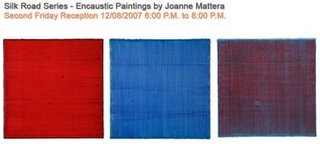
Silk Road 45, encaustic on panel, 12 x 12 inches, 2006

I'll report on many of the venues--Art Basel/Miami, Aqua Art, Bridge, Flow, NADA, Pool, Pulse and Scope-- for this blog. This year I'll share some of what I write with Resolve 40, a web-based art magazine that's published out of New York City. I should be posting by mid month. I'll let you know when everything's up.

If you run into me, that look of consternation will mean I'm trying to read something without my glasses, I'm lost, or I've receded into the fog of art overload. In any case, please wave your arms until I emerge and focus.

See you there?

Joanne
www.joannemattera.com
www.jmschedule.blogspot.com
www.twoartiststalking.blogspot.com

11.19.2006

Eva Hesse at the Jewish Museum

.
New York is enjoying an extended minimal moment this fall. Although it’s been over half a century since reductive work made its first appearance, Minimalism’s "Greatest Hits" (and some current favorites) are playing all over town. Is there something in the ether that has provoked a spate of related shows at the same time? Or, as in fashion, is it simply a cycle whose time has come round again? Whatever the reason, there was and is a lot to see—and this is not an oxymoron.

Eve Hesse: Sculpture

Eva Hesse’s long-overdue retrospective, Eva Hesse: Sculpture, curated by Elizabeth Sussman and installed at the Jewish Museum this summer (May 12-September 17), seems to have been the catalyst.
.
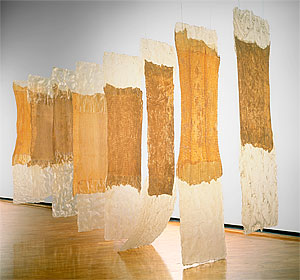
Installation of Eva Hesse: Sculpture at the Jewish Museum, New York City, May 12-September 17, 2006

.
The Jewish Museum, located on Fifth Avenue’s Museum Mile, is a lovely turn-of-the-century structure that was once a private home, but it's no Whitney. The exhibition is installed in one large U-shaped gallery on the ground floor, with a low ceiling. Still, this was the institution that made a commitment to showing Hesse’s oeuvre after the Whitney backed out a few years ago. I was grateful to see this work in one place. As an art student I remember seeing Hesse’s work around town and periodically after that at MoMA until the work’s fragility required it to be archivally sequestered. Here, it’s everything I remember and more.

 
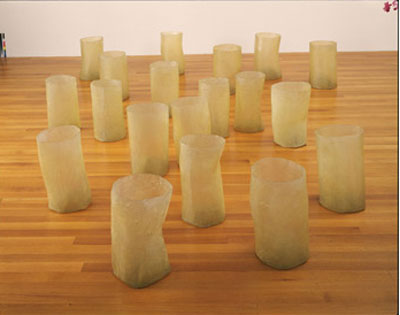
Eva Hesse: Repetition Nineteen III, cast resin, 1968


.
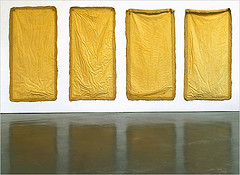
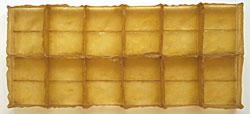
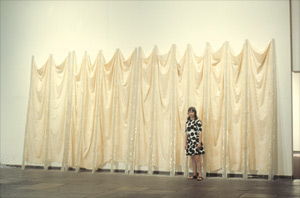
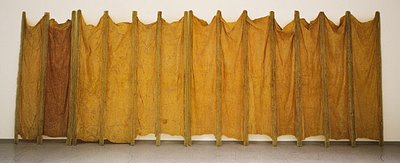
Hesse, as you well know, used non-beautiful materials—modest conventional stuff like twine and rope; industrial stuff like fiberglass; and at-the-time archivally untried stuff, like latex and resins—to effect her reductive and repetitive, and largely translucent, forms. Hesse’s great works are here: the 19 cast fiberglass vessels of Repetition Nineteen III (1968) in curatorially organized disarray; the protuberant grid of Schema (1967-1968); the multiple box-like segments of Sans II (1968); the stuffed latex and canvas panels of Aught (1968); the wall-like curtain of Expanded Expansion (1968); the latex-dipped sheets of Contingent (1969) and more. Since there was no photography in the gallery, I have pulled images from the Internet.


Eva Hesse: Aught, stuffed latex and canvas, 1968


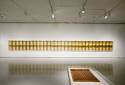
Eva Hesse: Sans II, cast resin, shown in a segment, top, and in full installation, 1968; (segments have gone to various institutions and private collectors)


Eva Hesse: Schema, cast latex with movable elements,1967-1968. The hemispherical elements look as if they were cast from a handball. Their placement is ordered but not perfect, and each element rests unattached on the flat latex surface. This is a floor sculpture; you can see it in the tiny installation picture above


Eva Hesse: Contingent, 1969


Perhaps because she intentionally left the trace of her process, including imperfect shapes and the impression of her own fingertips, her sculpture is as maximal as Minimalism can be—formally reductive but still resonating with Hesse-ian energy. Am I anthropomorphizing her work? Maybe. But her process—the dipping, casting, rolling, stitching, knotting, repeating; low-tech construction and the evidence of her hand—is so much a part of her work that it’s impossible not to “see” her still in the work.

An audio component allowed you to hear her as well, as it included fragments from interviews.

Many of her two dimensional works and some of her sculptures have a decided textile reference. Her four-part Aught--latex on the front, canvas on the back and stuffed with some kind of textural material--reads not only as sculpture but as blankets or quilts. The latex and fiberglass sheets in Contingent hang like, well, sheets, though Hesse herself said something like, "It’s really a painting hung in another material than a painting." Hesse worked early in her career as a textile designer, and that might account for the way she connected her particular dots—her use of thread, twine and rope; the sheets of latex--or it may be my own background (I am the granddaughter of tailors) that sees those connections.

One thing I can tell you for sure is that time has not been kind to the sculptures. Conceptually they are as strong as they always were, but structurally they are old before their time, the latex having become yellow and brittle with age. See the difference between Expanded Expansion when it was first made in 1968 and more recently. (The paintings and works on paper appear to have aged better.)
.

Hesse standing in front of Expanded Expansion in 1968 or sometime in the late 60s, above; a more recent shot of the work, which has yellowed (and become brittle) over time


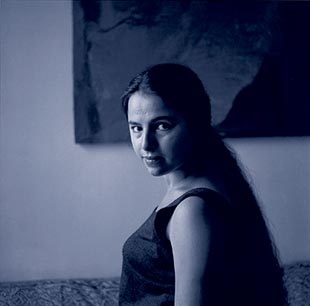
While the work has aged, Hesse has not. She will always be pictured as a round-faced woman in her early 30s. The exhibition includes black-and-white--and voiceless--Super-8 footage from that time showing her working in her studio. Hesse never lived long enough to grow old. Born in 1936 in Hamburg, she died of a brain tumor in New York in 1970 at the age of 34. (It comes as of a shock to realize she would have been 70 this year.)

The show is over, but the museum has produced a catalog, Eva Hesse: Sculpture, and there are a number of additional good books on the artist.


This post was adapted and edited slightly from New York's (Extended) Minimal Moment, posted November 24, 2006, on the collaboratiove blog I wrote with artist Chris Ashley, Two Artists Talking, now archived. In addition to reporting on "Eva Hesse: Sculpture," I talk about two gallery exhibitions--"Elemental Forms" at L&M Arts, and "Minimalism: On and Off Paper"-- and finished with "Brice Marden: A Retrospective of Paintings and Drawings" at the Museum of Modern Art.