Pages

3.12.2008

On the Geometric Trail: Part Seven


On the Geometric Trail, Part Two: SoHo

On the Geometric Trail, Part Three: Isensee

On the Geometric Trail, Part Four: Two of a Kind

On the Geometric Trail, Part Five: McKenzie

On the Geometric Trail, Part Six: Zox and Martin


Harriet Korman at Lennon, Weinberg
and
Juan Usle at Cheim & Read


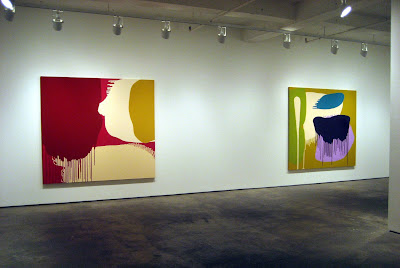
Harriet Korman at Lennon, Weinberg: Installation view looking toward the back of the gallery
.

Harriet Korman’s solo show is no longer up at Lennon, Weinberg, but that doesn’t mean I can’t show you a few pictures. Her painting, with its hard edges, shifting planes and saturated hues, is geometric abstraction in a modernist vein. There’s a bit of the cubist composition in her work, with its loopy intersections and Matissean shapes, but her seemingly straight-from-the-tube color and strong graphic quality give the work a signature that is unmistakably her own: joyous but rigorous.


As an artist who works serially, I like to see how other artists explore or attenuate an idea. Here, two paintings with a similar composition-- and even some similar color passages--allow
you to eavesdrop on their conversation
.

Is it me, or is there a suggestion of landscape in these paintings?

New for me is the painting, above, in which patches of color are painted with roughly equidistant parallel lines. I like this rectilinear order. I want to say that I’ve seen this composition, or something like it, while flying over the country’s midsection at 30,000 feet, but that’s not quite right, for while I perceive something of a landscape in this work—in both paintings shown above, in fact—I’m not at all sure it was intended. I don't think Korman is making paintings that are about anything but painting.

Despite their almost playful color and composition, these paintings establish boundaries between themselves and the viewer. Maybe it's their mid-range size or relatively uninflected color. Or maybe it's that intellectual rigor. You step back to see these painting, and each painting seems to say, "You stand there." That's fine. I can dig them from a few feet away.

.
.
.
Juan Usle at Cheim & Read


Juan Usle at Cheim & Read: Installation view taken from the gallery's website

Juan Usle’s paintings, on the other hand seem to whisper, "Come closer, mi amor." Maybe it’s their small size—his show, "Brezales," at Cheim & Read consists of fewer than a dozen small canvases (and two large ones)—but they exude something that just pulls you in. While there’s a new fluid line in some of the paintings, I’m fonder of the rectilinear compositions, patchworks of color and visual texture that are marvels of painterliness. The gallery’s press release describes the work as "organic geometry." That’s a good term, because the grid has been constructed block by block within the composition rather than imposed onto it; moreover, the color is fluid and the mark of the brush very much in evidence. (Usle uses pigment in a vinyl dispersion medium to get the streaked, almost textile-like surfaces of his color, and from the looks of the linearity of the application, I'd say he uses something like a squeegee as well as a brush. )


Juan Usle: La Camara Oculta, 2007, vinyl, dispersion and dry pigment on canvas, 18 x 12 inches.


Above: installation view of the small front gallery, from the gallery's website

Below: Miron, 2006-07, vinyl, dispersion and dry pigment on canvas, 12 x 18 inches.The gallery press release calls his work "organic geometry," and you can really see that here--the way the artist has dragged and pushed his pigment, creating lines that waver and vibrate


Juan Usle: Installation view of Cada Vez Mas Cerca, 2006-07, 24 x 18 inches, left; and Sone Que Revelabas (Tigris), 2007, 108 x 80 inches; both vinyl, dispersion and dry pigment on canvas. Installation shot from the gallery's website


"Brezales" is up through this weekend. If you’re reading this blog before March 15 and you’re in New York, log off and go see it.

3.09.2008

On the Geometric Trail: Part Six


Larry Zox at the Stephen Haller Gallery
.

I promised a post on the geometry behind the wall against which these containers were stacked. Here it is: Larry Zox at the Stephen Haller Gallery. See the painting in the lower left corner of the picture below? We're entering the doorway there.


Geometry on both sides of the wall. We're entering the gallery at the lower left corner of the picture
.

Below, as you enter: Esso Lexington, 1968, acrylic, epoxy on canvas, 79 x 64 inches. This is a composition that Zox mined over and over in different combinations of hues


.

To be honest, I hadn’t known about Larry Zox until a conversation with Stephen, about a year before he mounted his first show of Zox’s work in 2005 . This was at the end of a relatively long career for Zox, one that had seen his work in numerous museums, even a retrospective at the Whitney. By the time that first show at Haller went up, Zox’s heyday was over. The show was stellar—a combination of his hard-edge geometry from the Sixties and Seventies, along with newer, softer compositions that introduced a looping, nicely lyrical line.

A second show followed in 2006, and then—I’m not sure of the exact chronology—Zox died. Wherever the lyrical color fields might have gone, we won’t know. Both bodies of work are in the current show. I’m partial to the Seventies geometries with tinted color, a nice hard/soft combination in which the edge is mollified by the gentler palette.


Looking into the main gallery: No information on the gallery website for this large horizontal painting, but it ranks among my favorites. The paint is rendered with an almost suede-looking surface that's at odds with the hard-edge shapes. I love that!


In the main gallery: No info on the gallery site for this painting, either, but I can tell you that it's part of the Diagonal series from the Sixties


Looking into the center gallery, far wall: Change of shape--and century. Hayward, 2003, acrylic on canvas, 42 x 57 inches


In the center gallery: No info on this large horizontal, but it resembles other work on the gallery's website from the Seventies

.

.

Chris Martin at Mitchell-Innes and Nash

A few doors down at Mitchell-Innes and Nash, Chris Martin delivers his geometry with eye-searing color and collaged surfaces—glitter, newsprint, sponges (?)— that inform his shapes with a slight depth and dimensionality. While Zox’s painting seems to have come from his brain, Martin’s comes from straight from the gut. It’s raucus. It rocks.


Chris Martin: Untitled, 2007, oil, gel medium, collage on canvas, 64 x 59 inches


Chris Martin installation view at Mitchell-Innes and Nash: Seven Pointed Star, left, and Untitled, both shown below

In conversation with Craig Olson in a recent issue of The Brooklyn Rail, Martin said this about his process:

"These forms come from a long process of unconscious drawing. Then there is this desire to see it in paint—a kind of compulsive curiosity that drives me to choose colors, mix up buckets of paint, and prepare a surface. The actual performing of a painting involves giving oneself over to a series of actions and trusting in the body and what the body knows. And when I step back to look at this thing, I’m still trying to figure it out just like everybody else."


Chris Martin: Seven Pointed Star, 2007, oil and collage on canvas with gel medium, 54 x 45 inches

Below: Untitled, 2007, oil and collage on canvas, 54 x 49 inches


Next posts: Harriet Korman and Juan Usle

3.04.2008

Color with a Y Chromosome at MoMA


In the lobby, above, Jim Lambie's wildly striped and angled color.

In the sixth floor atrium, below, a Donald Judd sculpture dominates. My photography ends here, as the no-photos policy kicks into place.

.

I was going to make another stop on the Geometric Trail, but we're taking a quick detour up to 53rd Street for Color Chart: Reinventing Color, 1950 to Today at the Museum of Modern Art, organized by Ann Temkin. The exhibition is all about hue, whether right out of the tube, off the chart, or based on color systems devised by the artists or left to chance. There's oil paint and mototcycle enamel, car lacquer and Color Aid, Pantone and the Macintosh palette. In other words, it's a big show with broad parameters.

So, first the good news: This wide-ranging survey covers more than half a century of chromatic work with the usual suspects well represented: Dan Flavin, Damien Hirst, Ellsworth Kelly, Yves Klein, Frank Stella and others. You've probably seen most of this work in museums over the past few decades, but it's thrilling to see it all together.

The exhibition starts dramatically in the lobby with Jim Lambie's striped floor, all sharp lines and acute angles, continues into the sixth-floor lobby where a Donald Judd painted aluminum sculpture dominates, and opens into the special exhibitions gallery, where you are greeted by a horizontal painting, installed up high, by Marcel Duchamp. In the first gallery alone there's work by Frank Stella, Ellsworth Kelly, Jasper Johns, Robert Rauschenberg and Andy Warhol.

Now, the bad news: If you've followed the names I've dropped so far, it should be obvious that this show's color comes with a Y chromosome. Of the 44 artists in the show, 38 are men and six are women. This is the curator's privilege, of course, but I wonder how such broad parameters could be so exclusionary.

You should see Color Chart. It's a visually powerful show, but to my mind it's half a show. Spend some time with the two large Jennifer Bartlett pieces--each an installation of enameled squares in her signature dots and grids (alas, no pictures available from the MoMa website)--and Angela Bulloch's lightbox that flashes the colors of the Macintosh 0S9 operating system (ditto). While those colors are flashing, imagine the reductive color fields of Marcia Hafif, the macro-pointillist compositions of Alma Thomas, the undulating geometries of Bridget Riley, the dyed floor sculptures of Polly Apfelbaum--and make your own list while you're at it.

The show is up through May 12.

Feel free to add names to the Comments, below.

3.01.2008

Impromptu Geometry

Rounding the corner from 11th Avenue to 26th Street I came upon this
.
splendid composition of containers in colors that paired perfectly with
.
the wall of the building next door. Next post we're back on the
.
Geometric Trail with visits to a show of vintage Larry Zox at the
.
Stephen Haller Gallery (on the other side of that oxide red wall) and
.
up-to-the-moment Chris Martin just down the Street at Mitchell Innes
.
and Nash.

.
Voyage to mars (red and orange) on 26th Street

2.24.2008

The Women's Room

Unexpected illumination: Partly it's the color, that deep coral against .
.
the lavender .wall, but I've never before seen soap light up a room.
.
The women's bathroom on the 6th floor of 511 W. 25th Street

2.17.2008

Paintings and Process--Thirty Years Apart


Larry Poons at Jacobson Howard: Festinniog, 1975, acrylic on canvas, 78 x 69.5 inches


If you read this blog regularly, you know that while geometry is a recurring theme, I'm just as interested in material and process. It is those two latter issues we'll consider in this post via a couple of New York shows--one still up, the other now closed--both with references to nature.

Larry Poons at Jacobson Howard Gallery through March 1

"Throw, Pour, Drip, Spill and Splash" offers a fine selection of Poons’s paintings from the Seventies and Eighties. True to the title of the show, these are paintings at their most process intensive. Layers of paint in frozen rivulets and and richly encrusted surfaces still resonate with the energy of their making, an effect heightened by their large size in relation to the two small rooms of the Upper East Side gallery in which they’re shown.

There was nothing in the gallery information that made reference to landscape, yet the paintings themselves recall all manner of nature and of the payssage: mossy earth, flowered fields, waterfalls. Perhaps I'm reading them too literally, but I see what I see. lllglg


Tantrum 2, 1979, acrylic on canvas, 65 x 165 inches

Detail below


Carolanna Parlato at Elizabeth Harris Gallery, through Feb. 2

Downtown, in "Nature Games," a show that closed on February 2, Carolanna Parlato showed work in the same vein. While her m.o. would seem to cover the same territory as Poons, her process is much more controlled; the enamel-like paint flowed and dripped but only, it seems, until she said, "Stop." The paintings are worked in saturated, uninflected colors, yet the topographical quality of the pentimenti and the substantiveness of the drips show you just how much dimension "flat" can have. (Both painters work in acrylic, by the way.)

Parlato makes a direct reference to landscape in her statement, but I see her elements more as land mass. It's the process here that engages me, and the pleasure of materiality that is just under--and essential to--that glossy surface.


Installation view: Carolanna Parlato at the Elizabeth Harris Gallery, "Nature Games"

Below: The Kiss, 2007, acrylic on canvas, 72 x 80 inches; image from the gallery website


What Goes Up, 2007, acrylic on canvas, 36 x 36 inches; image from the gallery website
.
Detail below:
The edge gives you some sense of the push/pull Parlato has managed so well
.
.
.
I’m not one to ascribe gender to painting, but I feel comfortable saying that the Poons paintings are genuinely beautiful—in part because of the lovely pink and lavender-tinted palette—while Parlato’s are muscular and handsome. Either show would have been satisfying to me on its own, but seeing them in the same period was more than doubly rewarding as the experience challenged ideas of time (they were painted almost 30 years apart), landscape , gender and materiality.

2.14.2008

El Anatsui at Jack Shainman


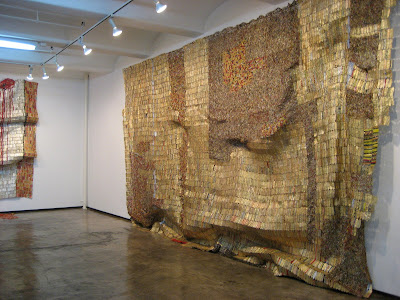
Fading Scroll, 2007, aluminum and copper wire, 88 x 472 inches

I have given up trying to cover gallery shows while they’re still up. That’s the job of a paid journalist. My reportage is typically presented after the fact, and until my twin clones are perfected, that’s probably the way it will remain.

So here we are at the Jack Shainman Gallery on 20th Street at the end of January. The show is El Anatsui’s "Zebra Crossing." God, I love this work: large, fluid expanses that hang slightly away from the wall, occasionally bulging or sagging as they yield their great weight to gravity.


Detail below


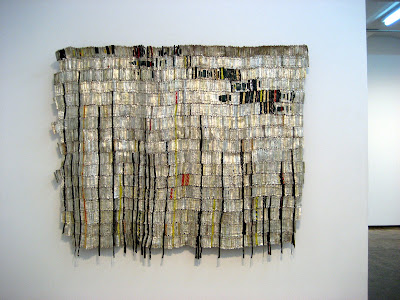
Zebra Crossing III, 2007, aluminum and copper wire, 61 x 107 inches

Detail below


The work embodies some lovely dualities. There’s an underlying geometry to the structure. Strips of metal—the aluminum wrapping from the neck of liquor bottles—are pierced and held together with twisted wire, row-on-row, but the overall effect is one of fluidity and organic growth. The patterns are textile-like in their structure, like Ghanian kente cloth, but sculptural in their presence. The work is made of junk, but the light shimmers sublimely across the surface. And of course there’s the metaphor of transcendence. It took the labels from a damn lot of devil water to make this celestially beautiful work.


Area B, 2007, aluminum and copper wire, 155 x 236 inches


You can call this work sculpture, tapestry or painting, and any description would be correct.

El Anatsui is a professor of sculpture at the University of Nigeria, so perhaps sculpture is the word he would use. But the relative flatness of the surface suggests painting. Think, for instance, of the gilding and drape of Klimt. And the structure does suggest tapestry. Are you familiar with the work of Colombian-born artist Olga de Amaral, whose large scale tapestries are painted and gilded? See both below.


.

.

,

.

Above, Klimt: Portrait of Adele Bloch-Bauer I, 1907, oil on canvas with gold and silver gilding, now at the Neue Gallery, New York City; The Kiss

Below: Olga de Amaral, Cesta Lunar, fiber, gold leaf, acrylic


More El Anatsui: Takari in Black, 2007, aluminum and copper wire, 60 x 76 inches. This one is my favorite. I particularly like the coolness of the silvery hue, and the organic geometry of the composition.

Detail below


In case you’re interested, the prices ranged from $250,000 for the smaller works, such as the one above, to $500,000 for the big one that opened the post And every single one on the gallery list had a red dot. A sante!

2.09.2008

On the Geometric Trail: Part Five

On the Geometric Trail, in Chelsea

On the Geometric Trail, Part Two: SoHo

On the Geometric Trail, Part Three: Isensee


"Geometric Abstraction" at McKenzie Fine Art
Through February 9


Don Voisine: Poised, 2007, oil on wood, 20 x 20 inches

Valerie McKenzie always puts on a good show. This group exhibition brings together gallery and invited artists to examine the multiplicity of sources and expressions of geometric art. Artists in the show are Chris Gallagher, whose gently curving stripes suggest the celestial, like rings around Saturn; Kim MacConnell, with saturated abstractions reminiscent of Matisse and Picasso; and Shari Mendelson, whose chandelier-like sculptures play with light and shadow. You can see their work on the gallery website.

Here I'm homing in on the three whose geometry resonated most strongly for me: Don Voisine, whose work opens this post; Jennifer Riley, whose paintings have been turning up everywhere lately (including at McKenzie Fine Art's booth at Art Miami and OH&T's booth at Aqua Wynwood); and Ann Pibal, whose small-scale paintings are surprisingly poetic for their stark linearity.


Jennifer Riley: This installation shot looks into the office from the gallery. Foreground, Remedy for Blunt Footing, 2007, oil on canvas, 54 x 40 inches; office: Into the Maelstrom, 2007, oil on canvas, 44 x 60 inches

Riley's work suggests landscapes and topographies--mountains, rolling hills--but in a geometric style that references computerized maps. The deep space offered to the viewer is all the more compelling for the flatness of the surface. The push/pull of these elements, with the addition of gorgeous color, makes the work irresistible.

Don Voisine's geometry is much more austere: reductive and smack up against the picture plane. But up close his austerity is softened by surprisingly gentle surfaces--one soft, velvety black; another not quite shiny but not quite matte; yet another with the light shimmer of unexpected brushstrokes. Indeed, the picture plane opens more deeply than a first look would suggest. You need to spend time with this work. I'd call it "tender constructivism."

Don Voisine: Above, an installation in the office looking into the gallery at the painting shown below. Below, Delayed Green, 2007, oil on wood, 32 x 63 inches


Ann Pibal: Above, TRPSH, 2007, acrylic on aluminum, 12 3/4 x 18 1/2 inches; below, B-Line (v.2), 2007, acrylic on aluminum, 13 x 19 1/4 inches

Pibal's paintings, unique in their small scale and lovely color, nevertheless allow me to make some visual connections within geometric abstraction: to Miriam Schapiro's famous Ox painting, currently part of the "Wack" show (opening February 17 at PS 1) to Frank Stella's early geometries, and to Warren Isensee's Body and Soul, which I posted recently. You'd think there's only so much you can do with the same shapes and angles, but the connections, the variations, the subtleties, all filtered through the eye and hand of the artist, are endlessly new. Pibal's work reminds me of all that.

2.08.2008

The Geometry of Finance

A fellow named George has a money blog called Future Modern Finance. I found it because he posts on Ed Winkleman's blog, and Ed attracts a variety of interesting people with blogs, and opinions, that encompass not only art but politics and finance--you know, the other things that go on while we're in our studios.

This chart represent some of the splendid visuals I found at George's blog. I realize there's a financial narrative here (this one is a week of trading on Sotheby's stock), but I am just digging the beauty of the geometry.

2.06.2008

On the Geometric Trail: Part Four

.
.
.
..
Two of a Kind
.
Sol LeWitt in "Deconstructed Geometry" at Vivian Horan Fine Art
.
Ted Larsen, "Constructed Objects," at OK Harris


Sol LeWitt: Wall Drawing #604A-Cubic Rectangle with Color Ink Washes Superimposed, 1989

This work was the centerpiece of "Deconstructed Geometry," which ran officially until January 17 but was still up when I stopped in at the end of the month.


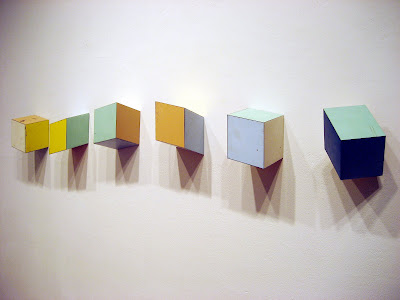
Ted Larsen: Chicklets, 2007, 6 x 6 x 6 inches

This solo show is at OK Harris through February 9th

OK, so I'm stating the obvious, but here's what I love about this pairing of Sol LeWitt and Ted Larsen: big versus little, flat versus dimensional, concept versus object, saturated versus pale, light versus shadow, uptown versus downtown. These kinds of connections sometimes occur as I'm viewing work, other times as I'm viewing the images after the fact. In this instance, geometry was the thread connecting a number of shows I've seen and posted about this winter, but it was not until I sat down to edit these particular images did this pairing fall into place. I'd call it the conceptual version of the kids' toy that requires you to fit a shaped block into the correspondingly shaped hole--even though none of the shapes is quite exactly the same.

2.02.2008

On the Geometric Trail: Part Three

On the Geometric Trail, in Chelsea
On the Geometric Trail, Part Two: SoHo


We’re back on the Geometric Trail. (Previous posts can be linked, above.) This time we’re visiting Danese Gallery, where Warren Isensee has a show up until the 9th of this month.


On the far wall, Body and Soul, 2007, oil on canvas, 78 x 120 inches. Foreshortened at left, Bipolar Express. We'll swing around to a full view of that painting.


I’m not sure there’s a more perfect space for this work than Danese's skylighted aerie. The high ceilings and broad loft expanse create a welcoming environment for paintings that resonate so visually they seem to radiate off the walls and into the the room.

Isensee employs rectilinear shapes that he limns and relimns to create forms within forms. There’s both a textile sensibility (like a Navajo chief blanket) and an architectural structure to the work (columned temples, perhaps) that come together to create intimacy and grandeur at the same time. They’d be hallucinogenic except that the palette is grounded in saturated earthen hues—like Fiestaware without the kitsch. On second thought, forget trippy. Those celadons and ochres, sienas and corals are rubbing up against one another to the point of retinal orgasm. Ahem, chromatic fervor.

.
Let's continue our spin around the large main gallery:


Body and Soul, again, leading to . . .


. . . Scenic Overlook, 2007, oil on canvas, 65 x 94 inches. In the small gallery, a peek at High Beam.
You can see all of these works on the Danese Gallery website
.

Scenic Overlook in the foreground with New Construction, 2007 oil on canvas, 60 x 60 inches, on the far wall. Just to the right of New Construction is . . .

. . . a wall of framed colored pencil drawings. They're startling, because the are the line-by-line, color-by-color starting point for many of these big paintings. You can see the drawings for Body and Soul and New Construction second and third from left


This is not the best picture of a very fine painting (you can see the color much better on the gallery website), but I wanted to take you back to the starting point of our tour, where this painting was shown in greatly foreshortened perspective. It's Bipolar Express, 2007, oil on canvas, 48 x 72 inches

Part of the visual excitement of Isensee's painting comes as much from the quality of the line as from the juxtaposition of the colors. It looks as if he paints the stripes with a flat brush, sans tape, so the ever-so-slight line variations within each stripe combine to generate many more visual watts than hue or color placement alone could do.

Next time: Ted Larsen's small dimensional geometries at OK Harris in SoHo, and Sol Lewitt's wall drawing uptown at Vivian Horan Fine Art; then back to Chelsea for "Geometric Abstraction," a group show at McKenzie Fine Art.