Pages

12.08.2010

Fair Enough: Prologue to the Report

The posts so far:
Fair Enough: And I'm Off
Fair Enough: Traveling Incognita?
Fair Enough: All Over But the Posting
Fair Enough: Art or Trash?  We have a winner!
.

2-D: Yes, it's an installation. Is it art? You be the judge
All Miami pics by Joanne Mattera unless otherwise credited


On Collins Avenue in South Beach, just around the corner from the very downscale Days Inn where I was staying, several dozen storm troopers occupied the balconies of an under-construction condo. The initial look up was jarring, but it was quickly apparent that these were two-dimensional figures. Turns out they were installed by the Los Angeles-based used-clothes-vendor-turned-artist, Mr. Brainwash. You know all about Brainwash if you saw Banksy’s street documentary, Exit Through The Gift Shop; if not two-dimensional figures are a useful metaphor for the artist and his work.

A few blocks south, in one of the many shops that cater to tourist needs, dimension ruled. In a fashion world where window mannequins are mere hangers for the clothes, the dummies in these windows presided over Collins Avenue with wildly inflated double G’s—or maybe another letter farther along the alphabet. These mannequins are the metaphor for a beach culture in which over-the-top sexuality—with staggeringly high heels, body-hugging spandex, short shorts, gem-encrusted tight jeans and, of course, pneumatic cleavage—are the norm. It's an interesting place to visit when the weather is nice, as it was (70-degree temps and low humidity, unlike the 90-degree soup of last year), but I wouldn’t want to live here.
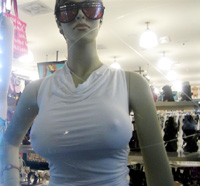

3-D, or more precisely 32 G. Not an installation, but I hope this mannequin is sufficiently anchored to the floor

As I have done in the past, I’m going to start with the big fair, Art Basel Miami Beach, ABMB for short, followed with a visit in the subsequent post to Aqua Art. In part this is because they’re geographic neighbors and it’s the way I visited them, but also because they are a study in contrasts: big versus small, self contained versus open to the outside; and, of course, hyper expensive to very reasonably priced. I’m guessing the entire contents of Aqua Art could have been acquired for the $4.5 million reportedly paid for an Yves Klein at the big fair.

 Above, the oceanside entrance to the Miami Beach Convention Center, home of Art Basel Miami Beach

Below, the more intimate Aqua Hotel, home of Aqua Art


Next we’ll go across one of the causeways to visit  Art Miami, Pulse, Scope, Seven and Red Dot. I’ll also take you to the Rubell Collection, one of the four private collections open to the public. Then we'll head back across the causeway to the beach side, where we’ll visit NADA and Ink. Once you've had a look at each venue in its own post--mostly for the flavor and personality of each fair--I'll focus on some trends according to my credo, Two of anything is a coindidence; three's a trend. Some certifiable trends: books, threads, money, and hair.

I'll also report on two events: Joanie San Chirico's Age and Gender roundtable at Jen Dalton and William Powhida's #Rank at Seven; and the blogger meet-and-greet I organized at Aqua Art--both informal and informative.

Art Miami, in its own tent

Seven, the non-fair, with seven participating New York galleries in a renovated warehouse


The lobby of the Deauville, a Fifties-era extravaganza of glass, marble, chandeliers and floral carpets, host of the NADA Art Fair. Do you think the decor clashed with the fair's Lower East Side sensibility?

Above, a large gallery at the Rubell Family Collection, a renovated Drug Enforcement Agency warehouse turned private museum. We'll also visit Jennifer Rubell's installation in the family compound

Below, the courtyard of the Dorchester Hotel, home to the small print fair, Ink


12.07.2010

Fair Enough: Art or Trash?

The posts so far:

And we have a winner. One person got them all right. But before I tell you who it is, take a look at the captions and compare them against your entry, which you'll see in the Comments section. While there was just one clearcut winner, some of you werethisclose.

1. Rubern Verdu at Raul Zamudio, Art Miami

Art professionals, start your engines. In this second annual installment of Art or Trash? I challenge you to guess which of the 25 images above and below depict work on exhibition at the Miami fairs and which just happen to look like it. One hint: Not everything indoors is art, and not everything outdoors isn’t.

I'll post the captions on Friday morning, December 10, at 9:00. Until then if you're game enough, post a comment identifying each number with "art" or "trash."  I’m upping the ante for anyone who's brave enough to post under your own name. If you guess all 25 correctly I’ll put your name in a hat and pull out a winning name.  Winner gets a 30-minute interview with me and a subsequent blog post that I'll write about you and your work--plus bragging rights that you can distinguish the art-world equivalent of shit from Shinola.

2. Artist unidentified at 3PQ Gallery, ABMB


3. Trash, shot at NADA


4. Artist unidentified at Noero Gallery, ABMB


5. Trash, shot outside the portable restrooms at Red Dot. Everyone got this right


6. Jason Dodger at Casey Kaplan Gallery, ABMB
I found this piece merely interesting until I read the label. It was knitted—by Barbera Stochmolske in Szczecin, Poland—from twelve kilometers of yarn, the height of the earth to above the weather. Clearly conceptual, it nevertheless has a lovely presence and heft, with a red stripe that was engineered, or perhaps folded in just the right way


7. Trash. Maybe not actual trash, but these stacked pallets are not meant to be art


8. Trash. I shot this and #16 on Lincoln Road
The folks who had been selling produce all day were stacking up their goods, and the withering look I received from one of the workers heaped the scorn of class and culture upon me one evening after dinner


9. Helen Mirra sculpture at Meyer Riegger Gallery, ABMB
.

10. Trash. Caution tape on a corridor rug at ABMB


11. Trash. Tape-covering wires at ABMB


12. Monika Sosnowska at The Modern Institute/Toby Webster, ABMB. How happy was I when I found this piece?


13. Ditto this piece from Elizabeth Neel at Sikkema Jenkins Gallery, ABMB


14.  Richard Rigg at Workplace Gallery, NADA


15. Artist unidentified at Parisa Kind Gallery, NADA


16.  Trash, shot on Lincoln Road.

17. Chris Astley at Bravin Lee Programs, Seven
I really like this low wall of objects and the almost anthropomorphic way the forms flop and and press against one another. My apologies for lumping this work in with the trash for the conceit of this post


18. Trash, shot behind a building in Wynwood


19. Orly Genger’s knitted units, placed around the grounds at Pulse, are both sculpture and seating. Designed to be used by the viewer, they provided a comfortable place to plop down after a day of art viewing. Orly, if you’re reading this, my apologies for suggesting that this work is anything less than wonderful. I mean that.


20. Carlos Bunga at Galerie Elba Benitez, ABMB


21. Trash, shot on the carpet in the ABMB lobby (if you've been to the venue, you'd remember that rug)


22. Not quite trash, but not art: boxes ready for repacking at Aqua Art


23. Joel Grossman at Galerie Christophe Paschall, Art Miami


24. I am not a fan of Cady Noland’s work, and her beer-can-and-trash room at the Rubell Collection did nothing to change my mind. I guess she had to go as far away as possible from the chromatic elegance of her father. But, hey, she’s in the Rubell Family Collection—and  we’re not


25. Whichever answer you gave, give yourself credit

The dumpster was in the compound of the Rubell Collection, set squarely in the back yard of the casita in which Jennifer Rubell had her installation of cups, spoons, oatmeal and raisins—the makings for a hearty Northeast breakfast on a lovely warm Miami day. Clearly the stuff had come from the interior, which was empty of pretty much everything but the tables holding the food and the refrigerators holding the milk (I hope to post some pics eventually). I called the Rubell Collection to ask about it.

RC: “It’s not part of the installation but Jennifer wanted you to see what came out of the house.”
Me: “Then it is part of the installation?”
RCl: “Well is it and it isn’t.”

An Anonymous commenter offered this criticism of the whole post: “I think I am ‘normal,’ but I see NO art in any of these. It wouldn't surprise me if some people claimed to see art in a pile of dung. This is just crazy.”

Well, Anon, I don't agree entirely with your assessment, but you have you have come to the right place to test your thesis.

Below:  Not Vital's cast bronze of Mongolian Cow Dung, which was shown in the  Gallerie Urs Miele, Beijing and Lucerne, at ABMB


And the winner? Gwyneth Leech, come on down! You know your shit. For your prize, you and your work you will be the subject of a blog post here on the Joanne Mattera Art Blog in January. Congratulations.

12.05.2010

Fair Enough: All Over But the Posting

The posts so far:
Fair Enough: And I'm Off 
Fair Enough: Traveling Incognita?


A preemptive strike with toe donuts: This is how I girded for battle each morning. Five days of walk, walk, walking and not one blister

MIAMI--I left the NADA fair at 6:00 this evening just as it was closing, the last fair of the weekend to do so. I clocked about 48 hours of fair time. Now I begin the job of editing some 5000 images. I'll begin serious posting on Tuesday. I'm still thinking about how to proceed.

If you wanted painting, sculpture and installation, you would not have been disappointed as there was plenty of it to see. If you wanted Asian Art, Middle Eastern Art, prints and design, there were fairs devoted specifically to those specialties. With Photo Miami cancelled this year, photography was folded into the other fairs and it held its own. I'll have plenty of everything to show you in the coming days.

While each venue has a distinct personality and a place within the fair hierarchy, several trends cut across the  lines.
. Books made a huge--I mean HUGE--appearance. Paintings, prints and drawings of book; photographs and videos of books; altered books, book objects, and sculptures with and of books. Trees were the big trend last year; I suppose there's a certain logic in books this year
. Threads, stitching, fabric. If you have followed my fair reports from previous years, you know that I've written about this category before, but there seemed to be even more this year
. Money. I saw "sex" once, but references to currency were everywhere. There were plenty of red dots. Hmm. Collectors using money to buy art about money
. Shine, glitter and reflective surfaces. This has always been so, for in a sea of art, the biggest, brightest and shiniest always stands out. There just seemed to be a bit more this time around
. And, of course, there was trash. This year's "Art or Trash" post promises to be a good one. Art professionals that you are, prepare to be challenged.
. There's more. I'm just too fried to pull it out of my brain at the moment.

OK, gotta go pack. More soon.

12.03.2010

Fair Enough: Traveling Incognita?

The posts so far:
Fair Enough: And I'm Off


MIAMI--I'm still in the thick of looking and photographing, downloading and editing. But I couldn't pass up this opportunity to share the art world version of Where's Waldo, created unexpectedly at the Thatcher Projects booth at Pulse, as this stylish woman passed in front of an Omar Chacon painting.

11.30.2010

Fair Enough: Miami 2010

Click for Marketing Mondays: 6 Degrees of Representation
.
Mel Bochner at Rhona Hoffman Gallery, Chicago, last year at ABMB

And I'm off.
.
A big thank you, gracias, merci, obrigada, arrigato, grazie and much obliged to everyone who sent in donations via Pal Pal or check to send me to Miami.  I am deeply appreciative of your generosity. (Anyone else who's so inclined, the Pay Pal button is just to your right.) I'm taking my assignment seriously, which is to see as much as I can and report on it intelligently and in as timely a manner as possible. I will be avoiding the parties, the fashion and the "in" crowd in favor of the art, basic black, editing images and sleep. While I don't expect to produce any big posts while I'm there, I have set aside two weeks upon my return to deliver a post a day. .
.
This is will be my sixth year of covering the Miami art fairs. I try to live up to my blog’s disclaimer, Guaranteed Biased, Myopic, Incomplete and Journalistically Suspect, though I do stretch beyond my personal tastes for the reports I'll be posting throughout the month. And truth be told, I try to be journalistically responsible. While I don’t love all the work in all the fairs, I’m aware that artists and dealers have worked long hours to get their stuff up on a wall or in a booth, and they have spent a lot of money in the process, so if I don’t dig the art or the venue I’m judicious in my negative comments.  Exception: If you’re a movie star using your celebrity to sell derivitave and poorly executed paintings, you are not getting over. (That means you, Sylvester Stallone, and your pimperiffic gallery, too.)

I have five days, starting with the previews and openings on Wednesday evening and working my way down my itinerary through the last of the events on Sunday afternoon. Thanks to Boyd Level for providing its fab guide to the fairs again this year. I've identified the venues I know to offer free entry, just in case you're in the area and plan to attend. Here’s what’s on my itinerary (Art-Collecting.com provides a good annotated listing):
.
Miami Beach
Art Basel Miami Beach (artists: it’s $20 after 4:00 pm)
. Will I attend the morning Conversations? We'll see
Aqua Art (free w/ pass)
The Oceanfront (part of ABMB located on the beach; free)
Ink (free)
NADA (free)
Verge

Wynwood
Three causeways connect Miami Beach to the design area known as Wynwood in Miami proper. The free shuttles are not not dependable and when they do arrive, theyre often full, so I will be cabbing it to and fro. The fairs I plan to visit:
Art Miami
Pulse
Seven (free)
. I'll also be attending Jen Dalton & William Powhida's #Rank sessions, including one on age and gender with Joanie San Chirico
Scope
Red Dot
Fountain
.
Private Collections
Work does not go over the sofa in these warehouses turned into museum-like settings. 
.
What I'm Probably Going to Skip
Because there's only so much time, only so much energy, and only so many cerebral bytes to process the visual information (my limit: three fairs a day), I'm not putting these on my itinerary. But you never know . . .
Zones
.
Getting Social
Mostly I travel alone, because I can’t process all the images and information if I’m engaged in conversation. But here’s where I plan to get social:
.
Preview Party at Aqua Art 
. Wednesday evening, 8:00—11:00 pm
. Collins at 15th Street
. I’ll be there about 9:00 p.m.,  hanging out in Room 106, the Conrad Wilde Gallery, where I will have paintings on view like the one at left
. Click here for a free pass
 .
Silk Road 155, 2010, encaustic on panel, 12x12 inches
.
.

Art Bloggers @
. Thursday evening, 5:00—7:00 pm, in the courtyard of Aqua Art
. Look for the signs, like the logo below, to find us
. This year we’re skipping the panel discussion in favor of a more relaxed get-together. Come on over to say Hi and have a drink. Aqua is providing the beverages
. Use the free pass to get in


.

The Boston Reception hosted by the DeCordova Museum
This is the second annual installment of an event hosted by the museum for artists, collectors, curators, gallerists and museum staff in the Boston area. I missed it last year, but as an artist who shows and teaches in Boston, I'm going to go meet my peeps. If you are from the Boston area (and I'm guessing that would include much of New England), it's on Saturday evening, 6:00-8:00 p.m., at the Loews Miami Beach Hotel, Colllins at 16th Street, Third Floor Terrace.
.
Reports from Previous Years
Just in case you start jonesing for some news from Miami, check out The Art Newspaper, which will publish daily dailiy editions  from Miami, as well as my blog reports from previous years:
Fair and Fair Alike: Miami 2009
Fair Weather, Miami: 2008
Fair Factor, Miami: 2007
All's Fair, Miami: 2006
Joanne Goes to Miami, 2005

11.29.2010

Marketing Mondays: 6 Degrees of Representation

.  
[This is the last Marketing Mondays post of the year. Reports from Miami will begin later this week and continue throughout December. MM will resume on January 3, 2011. ].
.

 We're talking gallery representation, not rocket science, but this picture does make a point, which is that while the sun is that big hot thing in the middle of the solar system, there's plenty going on in the outer orbits
.

So you’ve got a painting in a gallery show for the first time. Or a new gallery has taken a work of yours to an art fair. What’s your relationship to the gallery? Are you represented? What do you owe the gallery and what does it owe you? Nancy Baker suggested this excellent topic. Let me see if I can do it justice.

1. Represented Artists
You’re a represented artist if you’re on the gallery website and included in the regular rotation for a solo show. In a gallery that represents 20 or 30 artists, your rotation may not come up more than once every three years, but a gallery that is working hard to represent you will find ways to keep your work visible: online, in the viewing room, with a special project, with inclusion in the occasional group show. You probably have some kind of contract with the gallery—a written document or verbal agreement—that defines your mutual relationship. (Contracts: the subject for an MM post in the new year.) Typically there’s some degree of exclusivity, regional perhaps, and an understanding that the gallery gets first dibs on your new work.

2. The Inner Circle
If “represented artist” is the center of concentric rings of representation, the "inner circle" of representation is the center of the center. Artists who sell well, or with whom the dealer has a good relationship, may find they get more: a better time slot, an ad (or a larger ad) to promote a show; a review because the dealer goes to bat extra hard for the artist; their work featured at an art fair; inclusion in a special project. Chances are that if you’re one of the gallery’s “difficult” artists—always late with deadlines, never happy with anything the gallery does, you know the personality type—you won’t be part of the inner circle.

3. Affiliated Artists
Now let's move to the first outer ring. Not every artist exhibited by a gallery is represented. Sometimes the artists are listed as Affiliated, Invited or Guest Artists or another such designation, and sometimes they're not listed at all. The status is intentional on the part of the dealer, and it may be equally intentional on the part of the artist.

“Including an artist in a couple of group shows over time is an opportunity for me to try out new work, to see if collectors respond. It’s also a chance for me to see what it’s like to work with a particular artist,” says a New York dealer who asked not to be named. “Since many artists, especially new or younger artists, don’t always understand the nature of the relationship, we make it clear when we invite them to participate in a show that ours is a ‘limited partnership.’”  
.
Has an artist ever made the jump from exhibited artist to represented artist? “Occasionally,” says the dealer. “But it’s different with every gallery.”
.
Speaking from my own experience, I have good collegial associations with several galleries that have shown my work more than once. For a gallery it’s a good way to show a lot of artists without the commitment. For an artist so involved, it’s a good way to show widely and increase the network for sales without being tied down. In short, it’s like dating before you get serious. Typically there’s no contract involved and little in the way of post-exhibition responsibility to the gallery, though if you are approached after the fact by someone wanting to acquire a work that was shown, let the gallery make the sale. And definitely keep the gallery apprised of solo shows elsewhere, of reviews, of other recent achievements. Everybody likes a winner.

Also from an artist’s point of view, it’s a chance to see how the gallery performs for you. Does the gallery pay to have the work shipped there? Do they handle it carefully? Do they return your phone calls or emails in a timely manner? Do they find ways to include your work in their projects? Do they sell the work you send them? Good!  Do they let your work go out with careless consultants who return it damaged? Do you have to send a stream of emails before you get a response? Not good. You don’t want to continue an association with dealers who reveal themselves to be less than totally professional.
.
4. Tangential Representation
Not every relationship is destined for gallery representation or affiliation. There are many perfectly legitimate tangential associations. Here are two examples:
. You had an affiliation with a gallery that is now closed. The dealer may now be working as a consultant, or directing a curatorial program. You may find yourself included in projects as a result of the relationship.  I had a relationship with a short-lived gallery in the Midwest that resulted in a several good gallery sales and a big post-exhibition commission. I’ve remained friends with the owner, who is no longer in the business of selling art—but his friends buy art and he has brokered a few sales.  
. Your work was sold by a dealer as part of a package to a client.  A hard-working art dealer might put together a selection of works to show a client, often a corporate consultant who is looking to acquire a number of works of a specific type for a large project. To complete the package, the dealer may borrow work from another gallery, usually one whose owner she is friends with. You might be an artist whose work was included this way. (When the sale is made, Dealer #1 and Dealer #2 split the 50% commission.) It’s also possible the dealer found you as the result of an internet search or through the recommendation of a gallery artist or perhaps even the client himself. 

Sometimes tangential relationships develop into something more; sometimes they remain tangential. If you are developing a “portfolio” of representation (another topic for an upcoming MM), the tangential relationship, cultivated as such, can be beneficial to both you and the dealer. I would not expect to be working with a contract in this situation, just a consignment agreement.

5. One-shots
When a gallery curates a thematic show, it often invites artists working outside of its orbit, so to speak, to participate. (Postcards are a great way to bring your work to a dealer's attention.)  Congratulations if you've been invited. It’s always nice to have your work shown in good company by a good gallery. One-shot inclusion can be a way to fatten your resume, broaden your network, break into a new city. You never know who’s going to see your work in the venue.  Attend the opening, make new friends, and enjoy being part of the exhibition. A contract should be for the duration of the show; that’s all.

Given the economic climate, it’s wise of dealers to expand their parameters with new work and new artists. It’s also wise of an artist in this situation to understand the nature of the relationship, which is that it is unlikely to lead to something more permanent.  (Again, like dating.) But you never know . . . .
.
6. Inventory
You have work at a gallery—prints, let’s say—that sell well to consultants and corporate collectors. You’re not listed on the gallery’s roster, perhaps not even included in group shows, but your work fits a niche for the gallery’s sales program, and you get a check regularly.  This may not be the relationship you want with every gallery, but it's not a bad relationship to have.

(If you are more well known, you may find yourself "represented" by a gallery that shows your prints. The gallery probably acquired the prints through the publisher. In this scenario even Picasso is an inventory artist.)

If you show widely, you probably have different relationships with different galleries, represented by one, perhaps, and showing occasionally in another. In an upcoming MM I’ll talk about the “portfolio” of representation you might develop. What? You think only galleries can have a roster?  

Over to you: Artists, tell us your experiences in the solar system of representation. Dealers, please tell us about those outer rings from the gallery's point of view. Anonymous comments welcome.

11.26.2010

X Marks the Spot: Vivid, Pavers, Mendieta

.

In Vivid:  Sigrid Sandstrom, Bruce, 2010, acrylic on board, 18x14 inches


Before I head off to Miami, I want to focus on the X chromosome. There has always been good painting and sculpture by women, of course, but the past few months in New York there have been a number of really good shows as well.  Previous posts on this blog (here, here, here, here and here) have noted some of those shows.

In this post I bring you installation images from three shows, up now.

Vivid: Female Currents in Painting
The show, curated by independent curator Janet Phelps, is at the fabulous new Schroeder Romero and Shredder Gallery on 26th Street.  Springing from what the gallery describes as a “post-everything” sensibility, the exhibition includes formalist abstraction to the more expressionist and representational. I'm probably too rooted in formalist abstraction to love it all, but that's beside the point. This is an excellent survey. Phelps drew from a list of about 150 artists, noting in conversation that she could easily have created an entirely different and equally strong show, so I'm guessing there's at least the possibility of a Part 2 in our future. Lisa Schroeder and Sara Jo Romero, what say you? 

In Vivid, from left: Angela Dufresne, two by Mala Iqbal, Vera Iliatova, two by Rosanna Bruno; on the other side of the door, Nicola Tyson, Andrea Champlin


Jennifer Coates, Iona Rozeal Brown, Carrie Moyer, Jackie Gendel.

Brown and Moyer; foreground,  Rebecca Chamberlain; Elizabeth Bonaventura, Judith Linhares.

Foreground, Dona Nelson.

Barbara Takenaga, Wendy White; distance, Karen Heagle

On the foreground wall: Harriet Korman, three by Laylah Ali
.

Pavers
In the Shredder half of the gallery is the the related exhibition of painters and sculptors who bushwacked their way into visibility in two previous generations. This list includes the late Lee Krasner, Joan Mitchell, and Guggenheim founder, Hilla Rebay, as well as contemporary powerhouses Valerie Jaudon, Louise Fishman and Melissa Meyer.

In Pavers, from left: Dorothy Morang, two small paintings by Susanna Coffey, Evelyn Twitchell, Melissa Meyer.

Go see this dual show, up through January 22. If you can’t, click on the boldface titles for images of work in the respective shows.

Ana Mendieta: Documentation and Artwork 1972-2010
Across the street at Galerie Lelong, stop in to see the videos, drawings, photographs and a recreated installation of this seminal--or should I say, ovular--artist. The show marks the 25th anniversary of the artist’s death (at 36, from a high-rise fall, under questionable circumstances, though her husband, the sculptor Carl Andre, was acquitted of murder). Given the nature of her death, Mendieta’s body-based art, strong and poetic in equal measure, becomes more archetypal over time.

  Anima, 1982,  14 black rock crystals laid in soil and  grass,  55 x 25 1/2 inches


Left: Untitled (Silueta Series, Mexico), 1976, estate print 1991, 
20 x 16 inches
Right: El Ixchell Negro, 1977, lifetime color photograph mounted on board, 20 x 13 1/4 inches

The show is up only through December 11. Get there if you can, or click here for more info and the gallery’s installation images.

11.24.2010

Billionaire Boys Club (The Early Days)

.

At the MoMA Abstraction show (which  I hope to write about after Miami), several vitrines held papers and publications documenting the early days of the movement. The price list shown above was one of them. (Click pic to see an enlarged image.)

11.22.2010

Marketing Mondays: "Russian Nesting Dolls of Disappointment"

.
Find the satisfaction
(Image from the Internet)
.

A couple of weeks ago I moderated a career panel in Boston at Massachusetts College of Art, for the Fine Arts 2D department where I teach a course for graduating seniors. My colleagues, Laurel Sparks, Randy Garber, Ted Mineo and department chair Jim Cambronne, were on the panel. Our topic was "Behind the Scenes of an Art Career," a chance for the students to get a sense of what it has been like for five working artists--that would be us--to build and sustain our careers as painters. We talked about the jobs we've had, lucky breaks that helped us along, the rejections we've dealt with, and the fact that no matter where you are in your career, you still want more.

It's OK to want more. That's part of setting goals and working hard. You know how it is: All you want is to get into a juried show. Then all you want is to get into a gallery. Then have a solo at the gallery representing you. But we also need to develop the capacity to appreciate what we have achieved. Without that appreciation, you get trapped in what Ted called "the Russian nesting dolls of disapoinment."

That's when it's not enough to get the solo, but to have it when the new season opens in September. Not enough to have the September slot but get a full-page ad in Art in America. Not enough to have the September show and the ad but a review followed by a cover story in the magazine. And so it goes all the way up the line. Not enough to make the sale, but the sale to a particular collector or museum. These are all great things, of course, but where's the line between wanting more and being at least reasonably satisfied (possibly even grateful) with what you have achieved? Seems crazy, but there are artists unhappy with their solo at MoMA because it's not in the particular gallery they wanted, which another well-known artist had, or their catalog is not as big as that of another artist who'd shown there.

Jackie Battenfield, an artist and author of The Artist's Guide: How To Make A Living Doing What You Love, calls this kind of thinking "Compare and Despair." And it happens at every level.

Over to you: Can you be happy with what you have achieved and still retain a hunger that has you working for more? Or does every achievement lead to a disappointment?